
Manjit Thakur
Law Student | Passionate about Advocacy, Legal Research & Social Justice | Future Litigator
Articles by Manjit Thakur
Page 23 of 28
 Supreme Court Judgement
Where To File Cheque Bounce Cases? Supreme Court Explains
In a landmark ruling to curb forum shopping, the Supreme Court has clarified that for Account Payee Cheques, jurisdiction under Section 138 NI Act lies exclusively with the court where the payee’s home branch is located. Depositing a Cheque at any other branch for convenience does not confer jurisdiction. The Court also declared its 2023 ruling in Yogesh Upadhyay v. Atlanta Ltd. as per incuriam.
 Supreme Court Judgement
SC: In-Laws Can Be Summoned in Murder Case Based on Statements of Deceased Woman and Minor Daughter; 'Mini-Trials' Prohibited at Sec 319 Stage
The Supreme Court has held that while exercising power under Section 319 CrPC, courts must only examine whether the evidence prima facie indicates involvement of additional accused and must not conduct a “mini-trial.” Setting aside the Allahabad High Court’s order, the Court ruled that credibility of witnesses and detailed appreciation of evidence are matters for trial, not for summoning. The Court also clarified that dying declarations remain relevant under Section 32(1) of the Evidence Act regardless of time gap or mode of recording.
 High Court Judgements
Unnao Case: Delhi High Court Grants Bail To Kuldeep Sengar, Suspends Life Sentence In Rape Case
The Delhi High Court has suspended the life imprisonment sentence of former BJP MLA Kuldeep Singh Sengar in the Unnao rape case, holding that the offence of “aggravated penetrative sexual assault” under Section 5(c) POCSO was prima facie not made out. The Court ruled that an MLA is not a “public servant” under the IPC definition applicable to POCSO.
 High Court Judgements
Delhi High Court Holds HIV Infection Covered Under “Person with Disability” Definition
The Delhi High Court ruled that HIV-positive status alone cannot be a ground for termination or declaring an employee unfit. Setting aside the discharge of a BSF Constable, the Court held that the HIV Act, 2017 and the RPWD Act, 2016 prohibit such discrimination and mandate reasonable accommodation, ordering reinstatement with continuity of service.
 Supreme Court Judgement
Ravi v. State of Maharashtra (2019): Supreme Court on Death Penalty and the Rarest of Rare Doctrine
This article examines the Supreme Court’s landmark judgment in Ravi S/o Ashok Ghumare v. State of Maharashtra (2019), exploring the delicate balance between aggravating brutality and mitigating human factors in death penalty cases. It also reflects on the recent rejection of the mercy petition under Article 72, highlighting how the Indian legal system ultimately draws the line between reformative justice and irreversible crimes against children.
 Supreme Court Judgement
Why Accused Questioning Matters In Criminal Trials: SC
In a significant ruling on fair trial rights, the Supreme Court held that a mechanical or vague examination of the accused under Section 313 CrPC (now Section 351 BNSS) causes grave prejudice and can be fatal to the prosecution. Acquitting the accused in a 35-year-old case, the Court ruled that failure to confront the accused with specific incriminating circumstances, coupled with unreliable evidence and ignored defence testimony, vitiates the conviction.
 Supreme Court Judgement
Dowry Is A Constitutional Wrong, Supreme Court Says
In a landmark judgment, the Supreme Court has declared dowry not merely a criminal offense but a “Constitutional Wrong,” holding that it violates women’s rights to equality, dignity, and liberty. Restoring a conviction in a 24-year-old dowry death case, the Court issued mandatory directions to governments to strengthen enforcement, education, and awareness to eradicate the practice.
 Supreme Court Judgement
Marriage Is Not A Life Sentence, Supreme Court Says
The Supreme Court has dissolved a 25-year-old "dead" marriage, ruling that a long-pending legal battle serves no social purpose when the relationship exists only on paper. Invoking Article 142, the Court held that a prolonged refusal to accommodate each other constitutes cruelty, allowing both parties to move on from a marriage that had irretrievably broken down.
 Supreme Court Judgement
Is Husband’s Financial Dominance Cruelty? Supreme Court Says No
In a significant ruling, the Supreme Court held that a husband’s dominance over household finances and demands for "penny-wise" accounts do not constitute criminal cruelty under Section 498A IPC. Describing such behavior as a "mirror reflection of Indian society," the bench quashed an FIR against the husband, stating that vague allegations of harassment and "daily wear and tear" of marriage should not be used as tools for personal vendetta or to trigger the state's criminal machinery without evidence of tangible harm.
 High Court Judgements
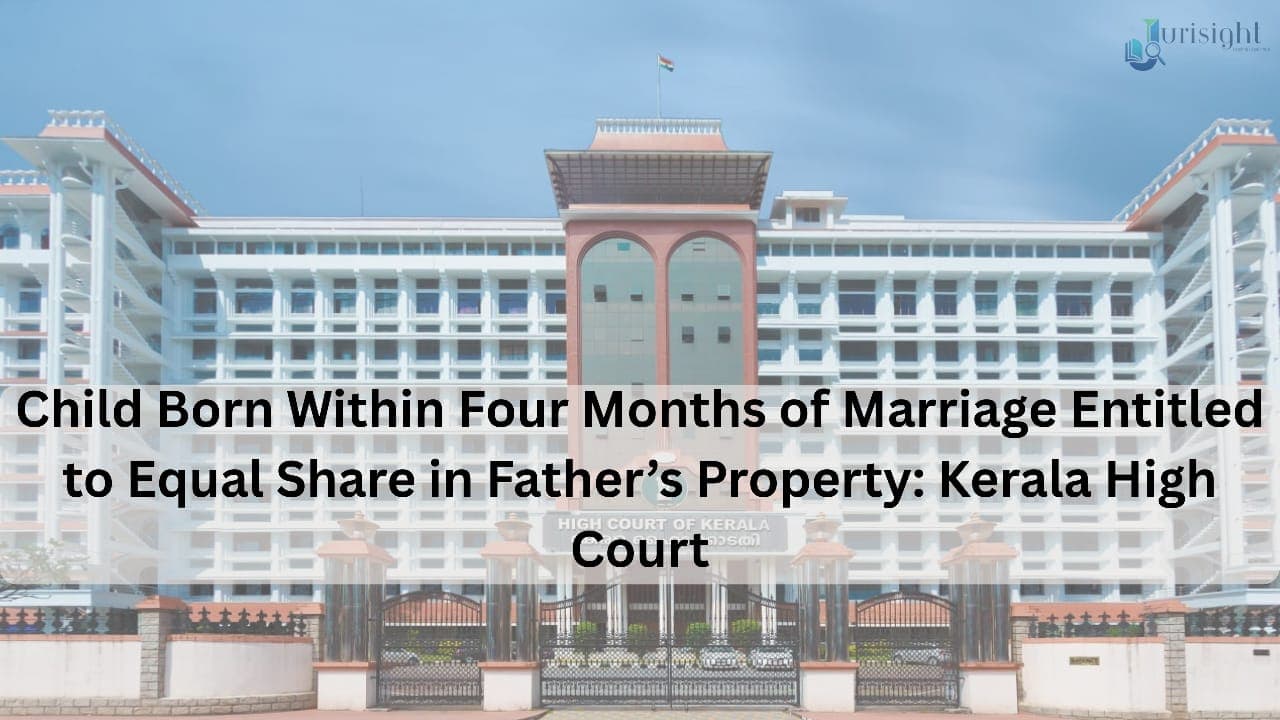
Child Born Within Four Months of Marriage Entitled to Equal Share in Father’s Property: Kerala High Court
The Kerala High Court has ruled that a child born shortly after marriage is a legitimate heir entitled to an equal share of their father's property. Relying on Section 112 of the Evidence Act, the Court clarified that legitimacy is determined by the date of birth within a valid marriage, not the date of conception, protecting children's rights against claims of pre-marital conception.
 High Court Judgements
Customary Divorce Beyond HMA Requires 'Solid Evidence' to be Recognised, Reiterates Delhi High Court
This article details the Delhi High Court's significant ruling on Hindu customary divorce, emphasizing that any custom asserted to override the provisions of the Hindu Marriage Act, 1955, must be supported by "solid evidence." It highlights the "heavy burden of proof" placed on the asserting party to establish the custom's antiquity, certainty, and conformity with public policy.
 Supreme Court Judgement
Delayed Chargesheet Can Quash Criminal Case, Supreme Court Says
Quashing proceedings against an IAS officer facing an 11-year unexplained delay in further investigation, the Supreme Court lays down crucial guidelines to ensure judicial control, transparency, and timely completion of criminal probes.