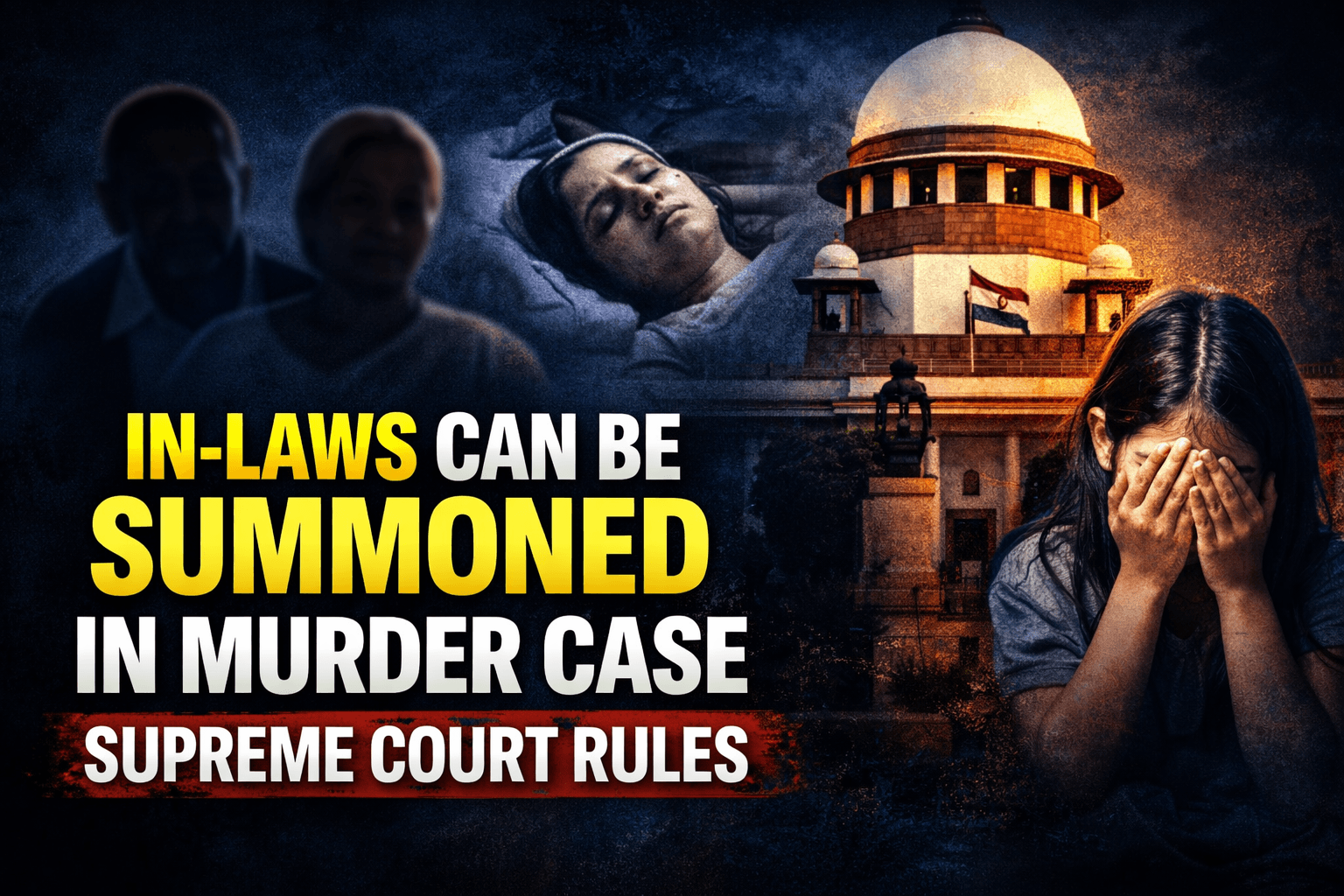
The Supreme Court of India has delivered a significant ruling clarifying the scope of Section 319 of the Code of Criminal Procedure (CrPC). In its judgment dated December 4, 2025, a Bench comprising Justice Sanjay Karol and Justice N. Kotiswar Singh held that courts should not conduct a "mini-trial" or test the deep credibility of witnesses while deciding whether to summon additional accused persons.
The Court emphasized that at the stage of Section 319, the only concern for a judge is to see if the evidence on record prima facie (at first sight) indicates the involvement of the persons sought to be summoned.
The case traces back to the unfortunate death of Smt. Nishi, who was allegedly shot by her husband, Rahul, at her matrimonial home. Following the incident on March 25, 2021, her brother, Neeraj Kumar, filed an FIR based on information provided by Nishi’s nine-year-old daughter, who told him, "Papa has shot Mummy."
Nishi fought for her life for nearly two months before succumbing to her injuries on May 15, 2021. Before her death, Nishi gave two vital statements that were video-recorded during the investigation:
- In the first statement, she named her husband as the assailant.
- In the second statement, she alleged that her husband acted at the instigation of her mother-in-law (Rajo), her brother-in-law (Satan alias Vineet), and another relative (Gabbar).
Despite these statements, the police filed a charge sheet only against the husband, leaving out the in-laws.
During the trial, Nishi's minor daughter deposed as a witness. She stated that her father shot her mother because the in-laws had instigated him to do so. On the strength of this testimony and the deceased woman’s previous statements, the prosecution moved an application under Section 319 CrPC to summon the in-laws as additional accused.
However, the Trial Court rejected this application, and the Allahabad High Court later upheld the refusal. The High Court reasoned that:
- The minor daughter was not a direct eyewitness to the firing (as she arrived in the room after hearing the shots).
- There were inconsistencies in the statements.
- There was a significant time gap between the deceased’s statements and her eventual death.
Setting aside the High Court's order, the Supreme Court ruled that the lower courts had adopted a flawed approach. The Bench observed that while the power under Section 319 CrPC is "extraordinary" and must be used sparingly, it should not be blocked by over-analyzing evidence as if the court were delivering a final verdict.
1. Credibility vs. Prima Facie Involvement The Bench noted that the High Court erred by assessing the "credibility" of the child witness and drawing conclusions that amounted to a "mini-trial." The Court clarified that at the Section 319 stage, a judge does not need to be satisfied "beyond reasonable doubt." Instead, the level of satisfaction required is higher than the stage of framing charges but lower than what is needed for a conviction.
2. The Status of the Child Witness The Court rejected the High Court’s finding that the child was not an eyewitness simply because she didn't see the trigger pulled. The Bench noted that she was present in the house, heard the shots, and immediately saw the aftermath. Questioning her testimony's reliability at the summoning stage was "premature."
3. Dying Declarations and the 'Time Gap' One of the most important legal takeaways from this judgment relates to Section 32(1) of the Evidence Act. The respondents argued that Nishi’s statements were not "dying declarations" because she died two months after making them and they weren't recorded by a Magistrate or certified by a doctor.
The Supreme Court debunked these arguments:
- No Temporal Proximity Required: The law does not require the person to be "under the shadow of death" or expecting immediate death when making the statement. If the statement relates to the cause of death or circumstances leading to it, it is relevant as a dying declaration once the person dies.
- Format of Recording: A dying declaration does not lose its value just because it was recorded by the police or lacks a medical certificate, provided it appears genuine.
The Bench reiterated the legal maxim judex damnatur cum nocens absolvitur—"the judge is condemned when the guilty is acquitted." The Court held that Section 319 exists to ensure that the real offenders do not escape trial due to lapses in the initial police investigation.
The Court noted that the allegations involved serious issues such as harassment over giving birth to female children and pressure for sex-determination tests. Such claims, coming from both the deceased and her daughter, provided "strong and cogent" material to summon the in-laws.
The Supreme Court allowed the appeal and directed the mother-in-law, brother-in-law, and the other relative to appear before the Trial Court on January 8, 2026, to face trial alongside the husband.
The Court concluded by clarifying that these observations are limited only to the summoning stage and should not be seen as a final opinion on the guilt of the in-laws, which will be determined during the full trial.
Key Legal Principles Highlighted:
- Section 319 CrPC: Power to summon additional accused based on evidence during trial.
- Mini-Trial: Courts cannot evaluate the deep merits or credibility of witnesses at the summoning stage.
- Dying Declaration: Becomes relevant under Section 32(1) of the Evidence Act regardless of the time gap between the statement and death.
- FIR Purpose: An FIR is not an encyclopedia; it is merely intended to set the criminal law in motion.
Case Title: Neeraj Kumar @ Neeraj Yadav vs State of Uttar Pradesh & Ors
Citation: 2025 INSC 1386
Bench: Justice Sanjay Karol and Justice N. Kotiswar Singh
Date of Judgment: December 4, 2025
Judgment Link : https://api.sci.gov.in/supremecourt/2025/21716/21716_2025_11_1501_66701_Judgement_04-Dec-2025.pdf