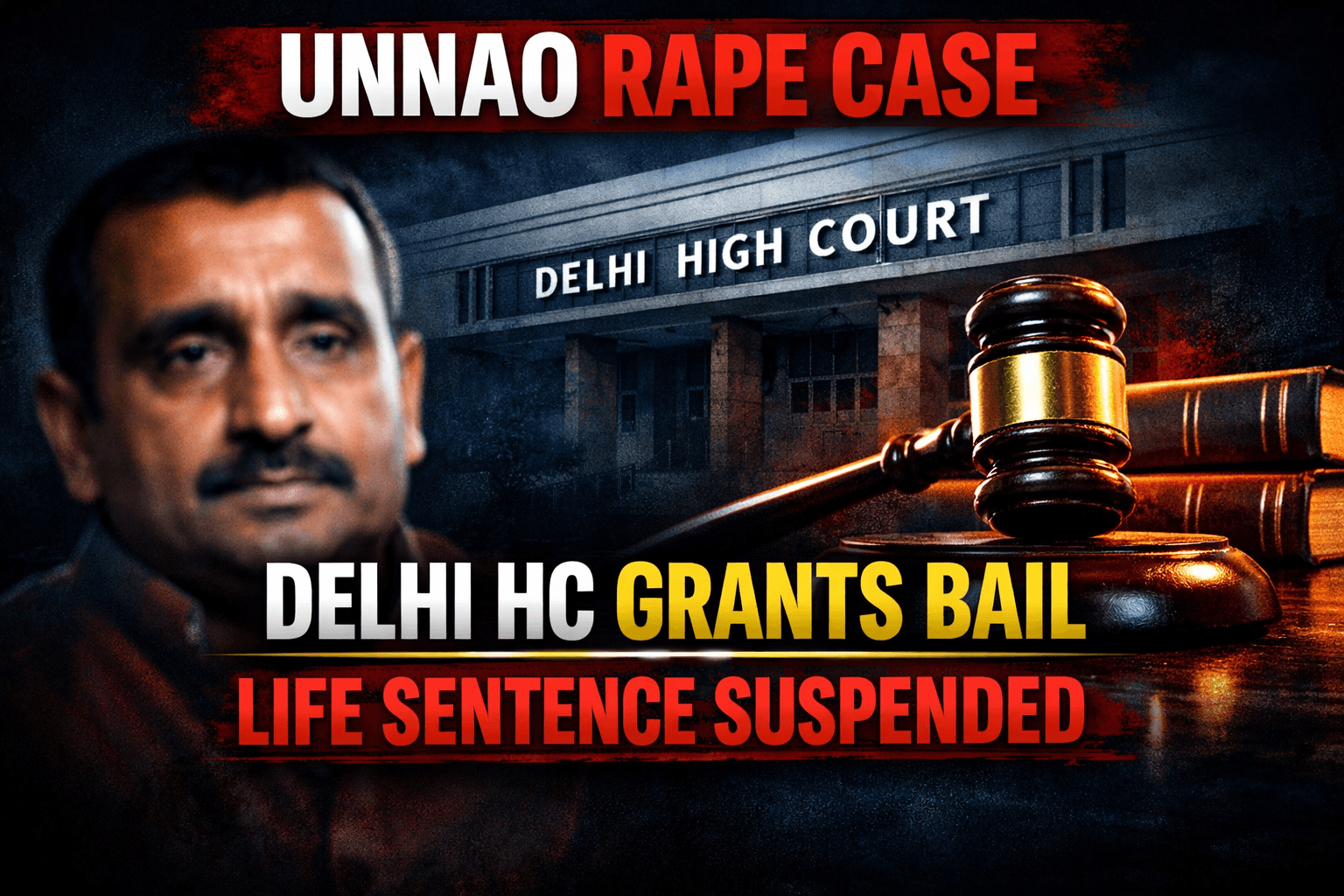
The Delhi High Court has suspended the life imprisonment sentence awarded to expelled BJP leader Kuldeep Singh Sengar in the 2017 Unnao rape case. A Division Bench comprising Justice Subramonium Prasad and Justice Harish Vaidyanathan Shankar granted the relief primarily on the ground that the offence of "aggravated penetrative sexual assault" under Section 5(c) of the POCSO Act was, prima facie, not made out against him.
The court observed that Sengar could not be classified as a "public servant" for the purpose of the POCSO Act, a classification that had originally led the trial court to award him a life term for the remainder of his natural life.
In December 2019, the trial court had convicted Sengar for aggravated penetrative sexual assault. Under Section 5 of the POCSO Act, an offence becomes "aggravated" if it is committed by certain categories of people, including public servants, police officers, or persons in a position of trust. The punishment for such an offence is significantly higher, starting at 20 years and extending to life imprisonment for the remainder of the convict's life.
The trial court had held that since Sengar was a Member of the Legislative Assembly (MLA) at the time of the crime, he fell within the definition of a public servant. However, the High Court disagreed with this interpretation.
The High Court pointed out that the POCSO Act does not define "public servant" on its own. Instead, Section 2 of the Act states that words not defined in POCSO should take their meaning from the Indian Penal Code (IPC), the Code of Criminal Procedure (CrPC), the Juvenile Justice Act, or the Information Technology Act.
Crucially, the Bench noted that while the Prevention of Corruption Act (PC Act) defines an MLA as a public servant, the POCSO Act does not list the PC Act as a reference for definitions. Under Section 21 of the IPC, which is the relevant reference for POCSO, an MLA is not explicitly categorized as a public servant. Therefore, the court held that the stricter "aggravated" charge under Section 5(c) could not be applied to Sengar at this stage.
By removing the "aggravated" tag, the court noted that the offence would fall under Section 3 (Penetrative Sexual Assault), which is punishable under Section 4 of the POCSO Act.
The Bench observed: "At this stage, being satisfied that (i) offence under Section 5(c) of the POCSO Act is not made out against the Appellant on account of him not falling within the definition of a 'public servant', (ii) only an offence under Section 3 of the POCSO Act would be made out... the Court is inclined to suspend the sentence."
At the time the crime was committed in 2017, the minimum punishment under Section 4 was seven years. The court recorded that Sengar has already spent 7 years and 5 months in custody, which is more than the minimum sentence prescribed before the law was amended in 2019.
The counsel for the victim/survivor had strongly opposed the suspension, arguing that her life was in danger and that the investigation had been compromised. However, the High Court held that once it is prima facie convinced that the life-term provision (Section 5) is not applicable, the prisoner cannot be denied bail solely based on security apprehensions.
"Courts cannot keep a person in custody being apprehensive that the police or paramilitary may not do its job properly," the Bench remarked. The court added that such a view would undermine the work of the police forces.
Instead, the court directed the Deputy Commissioner of Police (DCP) of the area where the victim resides to personally supervise and ensure her protection. It also ordered the Delhi Commission for Women (DCW) to continue providing her with sufficient accommodation.
While granting bail, the Court imposed strict conditions to ensure the safety of the survivor and the integrity of the ongoing appeal:
Sengar must furnish a personal bond of Rs 15 lakh with three sureties of the same amount.
He is strictly prohibited from entering a 5 km radius of the victim’s residence.
He must remain in Delhi and report to the local police station every Monday.
He is barred from contacting or threatening the victim or her mother.
He must surrender his passport to the trial court.
The court warned that any violation of these conditions would lead to the immediate cancellation of his bail.
It is important to note that despite this relief, Kuldeep Singh Sengar will not be released from prison immediately. He is also serving a separate 10-year sentence for the custodial death of the victim’s father. His application for suspension of sentence in that matter is still pending before the High Court.
Sengar was also convicted of murdering the victim's father in connivance with police officers from Makhi village in Unnao. The trial in these matters was famously transferred from Lucknow to Delhi’s Tis Hazari Courts by the Supreme Court in 2019 to ensure a fair and speedy trial.
Case Title: Kuldeep Singh Sengar v. CBI