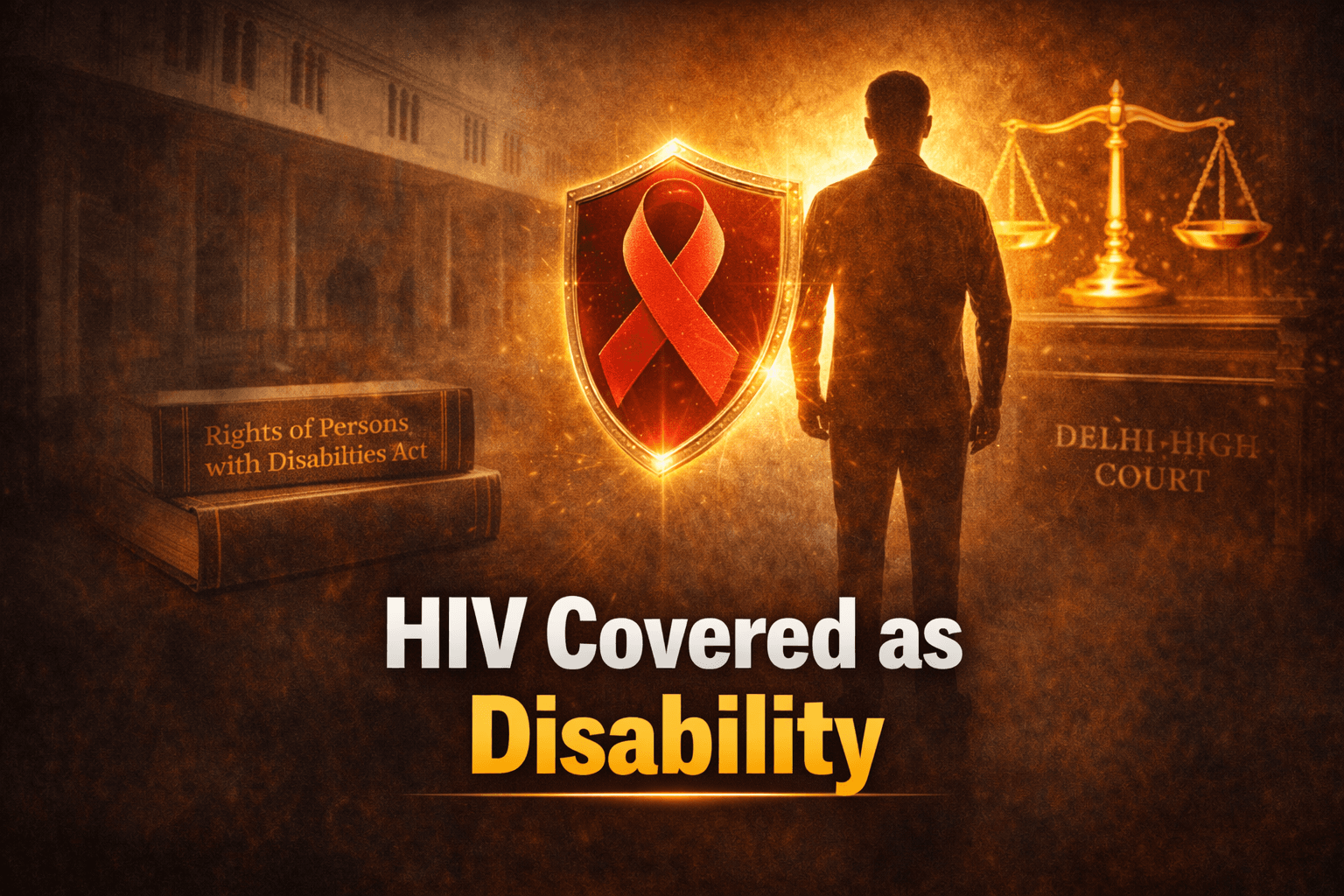
In a landmark judgment reinforcing the rights of persons living with HIV/AIDS, the Delhi High Court has ruled that a person cannot be terminated from service or treated as "unfit" solely because of their HIV-positive status. The Court emphasized that both the HIV Act of 2017 and the Rights of Persons with Disabilities (RPWD) Act, 2016, provide a strong legal shield against such discrimination in the workplace.
The Division Bench, comprising Justice C. Hari Shankar and Justice Om Prakash Shukla, set aside the discharge of a Border Security Force (BSF) Constable, ordering his immediate reinstatement with continuity of service.
The case dates back to April 2017, when the petitioner (referred to as Mr. ABC to protect his identity) was appointed as a Constable (General Duty) in the BSF. However, his career hit a major roadblock just months into his training. In July 2017, it was discovered that he had contracted HIV and was suffering from abdominal Kochs (tuberculosis).
After undergoing treatment and being discharged from the hospital in early 2018, the petitioner was re-examined by a Medical Board. The Board categorized him as "permanently unfit" for recruitment due to his immune-compromised status. Consequently, the BSF issued a show-cause notice and discharged him from service on April 9, 2019.
An internal appeal filed by the petitioner was also dismissed in 2020, forcing him to knock on the doors of the Delhi High Court.
The petitioner’s counsel, Mr. Anuj Aggarwal, argued that the BSF’s decision was in direct violation of Section 3 of the Human Immunodeficiency Virus and Acquired Immune Deficiency Syndrome (Prevention and Control) Act, 2017.
The Court noted that Section 3 of this Act creates an "absolute proscription" (a total ban) against terminating an employee because of HIV, unless two strict conditions are met:
- Written Assessment: The employer must provide a written report from a qualified health provider stating that the person poses a "significant risk" of transmission at the workplace or is physically unable to perform the job.
- Hardship Statement: The employer must provide a written statement explaining why they cannot provide "reasonable accommodation" due to administrative or financial hardship.
In this case, the BSF failed to provide either. The Court observed that because the BSF didn't follow these steps, the law automatically presumes that the petitioner is fit to work and poses no risk to others.
Interestingly, the Court expanded the scope of protection by linking HIV status to the Rights of Persons with Disabilities (RPWD) Act, 2016.
The Bench observed that a person living with HIV suffers from a "long-term physical impairment" that can hinder their full participation in society. Therefore, they fall under the definition of a "person with disability" under Section 2(s) of the RPWD Act.
Section 20(4) of the RPWD Act specifically states that a government establishment cannot dispense with the services of an employee who acquires a disability during their service.
The Court made it clear that even if an employee's medical condition prevents them from performing their original role (in this case, the strenuous duties of a Constable GD), the employer cannot simply throw them out.
Instead, the employer is legally bound to provide "reasonable accommodation." This includes:
- Offering an alternate, equivalent post that the employee is suitable for.
- If no such post is available, creating a "supernumerary post" (an extra post) until a suitable one opens up or the employee retires.
Quashing the discharge orders, the Court held:
"Whether one views the case from the point of view of the HIV Act or the RPWD Act, the petitioner could not have been treated as unfit to discharge his duties in the BSF solely on the ground that he was HIV positive."
The Court ordered that the petitioner be reinstated with:
- Continuity of Service: He will be treated as if he never left, for the purpose of seniority and retirement benefits.
- Fixation of Pay: His salary will be adjusted as per current scales.
- No Back Wages: The Court did not grant pay for the period he was out of service but ensured his future career remains intact.
This judgment serves as a powerful reminder to government agencies and private employers alike that medical conditions, especially HIV, cannot be used as a tool for exclusion. By invoking both the HIV Act and the RPWD Act, the Delhi High Court has sent a clear message: the law values the dignity and livelihood of an individual over outdated medical prejudices.
Case Title: Mr. ABC v. Border Security Force & Ors.
Citation: 2025:DHC:11494-DB
Court: High Court of Delhi
Coram: Justice C. Hari Shankar and Justice Om Prakash Shukla
Date of Judgment: December 16, 2025
Judgment Link : https://images.assettype.com/barandbench/2025-12-18/tdmocqm9/Mr_ABC_v_Border_Security_Force.pdf