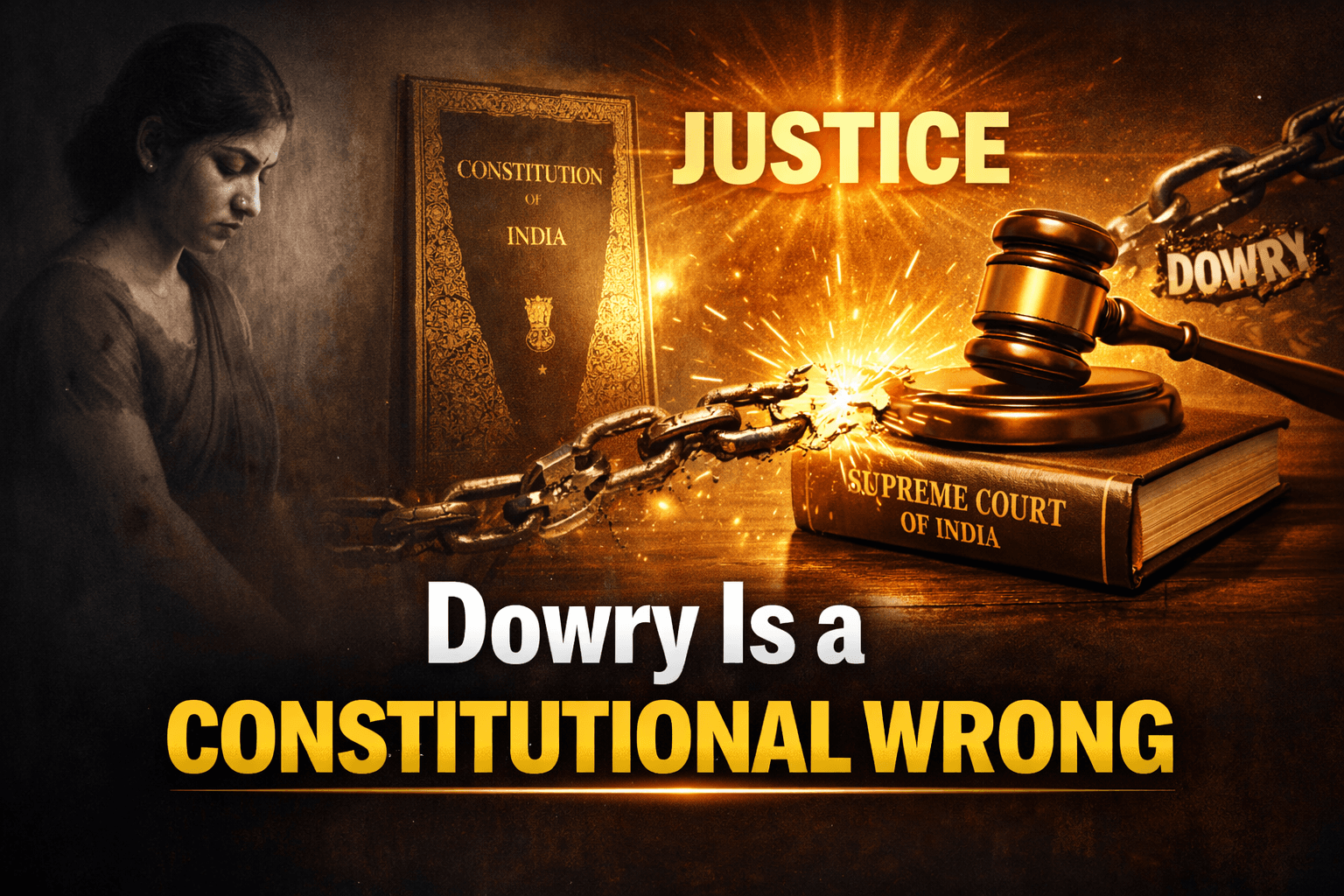
In a landmark judgment that redefines the fight against the social evil of dowry, the Supreme Court of India has declared that the practice is not just a statutory offense but a "Constitutional Wrong." The Court emphasized that dowry violates the fundamental rights of equality, dignity, and liberty, undermining the very promise of the Republic that women should enter marriage as equal citizens.
A Bench comprising Justice Sanjay Karol and Justice N. Kotiswar Singh delivered this significant ruling while deciding an appeal filed by the Uttar Pradesh government. The case involved the tragic death of a woman within just one year of her marriage back in 2000.
While restoring the conviction and life sentence of the husband, the Court used the opportunity to address why the Dowry Prohibition Act, 1961, has failed to curb the practice and issued a set of mandatory directions to the Union and State governments.
The Case: 24 Years to Reach Finality
The case, State of Uttar Pradesh vs Ajmal Beg & Ors, dates back to the year 2000. A young woman died under suspicious circumstances shortly after marriage due to alleged dowry demands. While the Trial Court had originally convicted the husband and his mother, the Allahabad High Court later acquitted them.
The Supreme Court, however, found the High Court’s reasoning flawed. It restored the conviction and life imprisonment of the husband, Ajmal Beg. Considering the advanced age of the mother-in-law (94 years), the Court spared her from returning to prison but maintained the gravity of the offense.
The Bench expressed deep concern that the case took nearly a quarter of a century to conclude, highlighting the "judicial tension" and delays that often plague dowry-related litigation.
Why Does Dowry Persist? The Court’s Analysis
The Court observed that despite being illegal for over six decades, dowry remains deeply rooted in Indian society. The Bench identified several reasons for this persistence:
- Social Camouflage: Dowry is often disguised as "voluntary gifts" or justified through social expectations, allowing it to escape the grip of the law.
- Dual Enforcement Problem: The Court flagged a "seesaw" effect in enforcement. On one hand, the Dowry Prohibition Act is often poorly implemented. On the other hand, provisions like Section 498A IPC are sometimes misused for ulterior motives. This oscillation makes it difficult for the judiciary to balance justice.
- Financial Extraction: The Court noted that women are still viewed as a "source of financial extraction," which reinforces structural discrimination and violates Article 14 (Equality before Law) of the Constitution.
- Beyond Religion: The Bench clarified that dowry is a cross-cultural evil not confined to any one religion. It specifically noted that in many Muslim marriages, while Mehr (a gift from the groom to the bride) is formally mentioned, it is often nominal, while massive financial transfers actually flow from the bride’s family to the groom.
A New Constitutional Perspective
The most striking part of the judgment is the Court's elevation of the issue from a "criminal act" to a "constitutional failure."
The Bench stated:
"The persistence of dowry undermines the Republic’s promise that women enter marriage as equal citizens and not as bearers of financial burden."
By linking the practice to Article 21 (Right to Life and Dignity), the Court has signaled that the State has a proactive duty to eliminate the practice, rather than just reacting to crimes after they occur.
The Supreme Court’s Directions
To ensure this judgment doesn’t remain a mere piece of paper, the Court issued a series of binding directions:
- Educational Reform: The Union and State Governments are directed to consider incorporating the harms of dowry and the principle of marital equality into school and college curricula.
- Strengthening Enforcement: States must ensure that Dowry Prohibition Officers are not only appointed but are also properly trained and adequately funded.
- Judicial & Police Training: Regular workshops must be conducted for police and judicial officers to help them understand the social and psychological nuances of dowry cases.
- Expeditious Trials: High Courts have been requested to assess the pendency of cases under Section 304B (Dowry Death) and 498A (Cruelty) and take steps for their fast disposal.
- Grassroots Awareness: District administrations and Legal Services Authorities must collaborate with NGOs and social activists to conduct regular awareness programs.
Conclusion and Follow-up
The Supreme Court has directed the Registrars General of all High Courts and Chief Secretaries of all States to circulate this judgment for immediate action.
The matter is not closed; the Court has listed the case again in four weeks to review the "compliance reports" from the States and High Courts. This proactive "monitoring" approach shows the Court's determination to see a real change in how India handles the dowry menace.
As the Court rightly remarked, the goal is to ensure that a marriage is a union of two equals, not a commercial transaction.
Judgment Link :- https://api.sci.gov.in/supremecourt/2013/41190/41190_2013_11_1501_66938_Judgement_15-Dec-2025.pdf