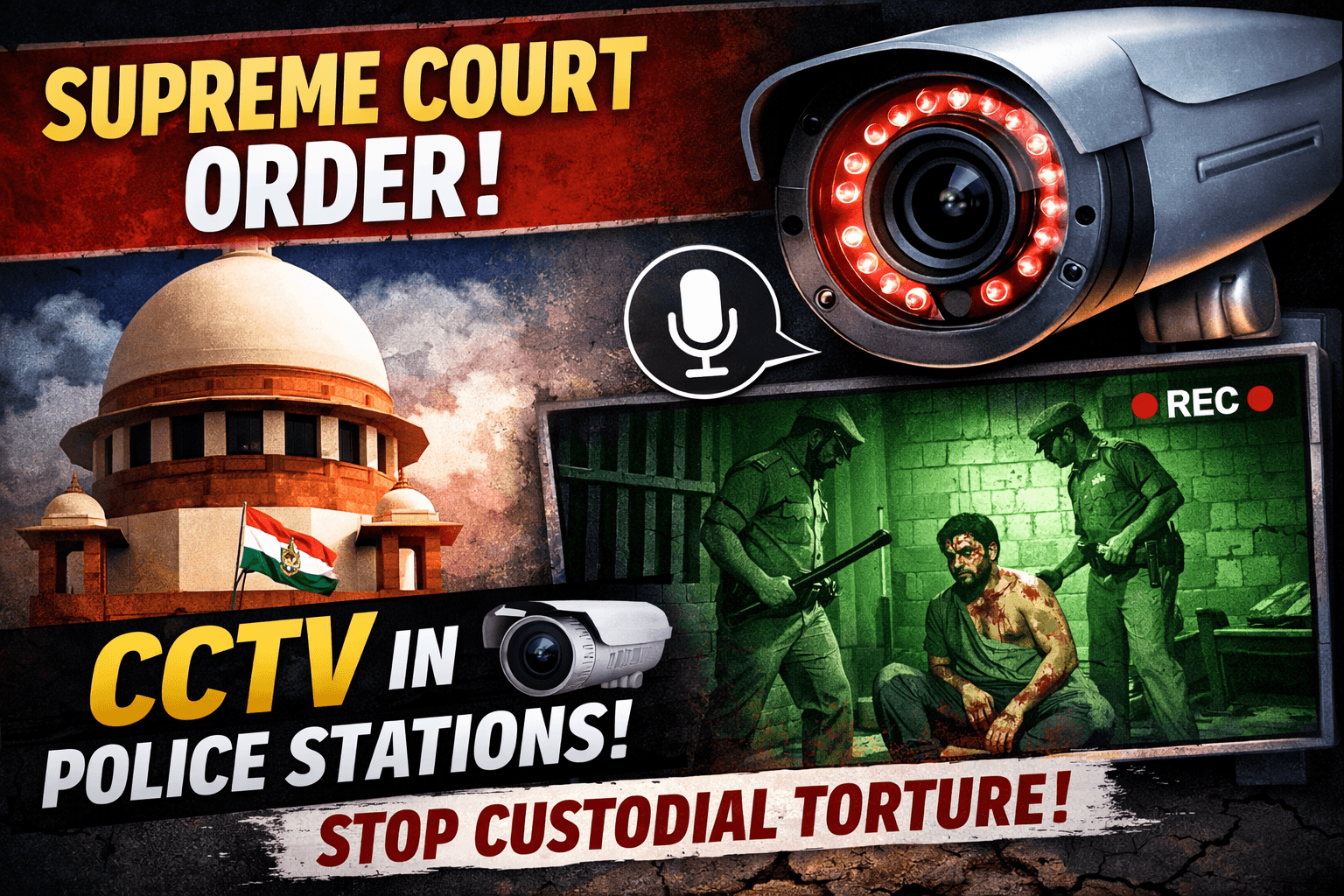
In a significant move to protect the fundamental rights of citizens and ensure transparency in police conduct, the Supreme Court of India has issued a set of historic directions in the case of Paramvir Singh Saini v. Baljit Singh & Others (2020). The court has made it mandatory for every police station across the country to be equipped with high-definition CCTV cameras, night vision, and audio recording facilities.
This judgment is being hailed as a major step toward ending "custodial torture"—the physical or mental abuse of people in police custody—and ensuring that the rule of law prevails even within the four walls of a police station.
The issue of police accountability has been a long-standing concern in India. While earlier judgments like D.K. Basu v. State of West Bengal and Shafhi Mohammad v. State of Himachal Pradesh had laid the groundwork for using technology to monitor investigations, the Supreme Court noted that very little had actually changed on the ground.
During the hearing, a bench comprising Justice R.F. Nariman, Justice K.M. Joseph, and Justice Aniruddha Bose observed that many States and Union Territories had failed to provide clear details about the status of CCTV installations. In response, the Court decided it was time to issue strict, non-negotiable timelines to ensure these changes become a reality.
The Court has not just asked for cameras; it has specified exactly where they must be placed. To ensure there are no "blind spots" where illegal activities or abuse could take place, the Court directed that CCTVs must be installed at:
All entry and exit points.
The main gate of the police station.
Every single lock-up.
All corridors and lobbies.
The reception area.
Inspector and Sub-Inspector rooms.
Duty Officer’s room.
The station hall and compound.
Areas outside (not inside) washrooms/toilets.
Crucially, the Court emphasized that these cameras must have Night Vision and Audio Recording capabilities. This means that even in total darkness or in cases where the visual is blocked, the sound can provide evidence of what happened during an interrogation.
One of the biggest hurdles in fighting custodial abuse has been the "disappearance" of evidence. Often, when a victim complains of torture, they are told that the CCTV footage was deleted or overwritten.
The Supreme Court has fixed this by directing that all footage must be preserved for a minimum period of 18 months. If the current technology available in the market only allows for a shorter duration, the government must purchase the best available equipment that stores data for at least one year.
The Court recognized that it isn't just the local police who conduct interrogations. Central agencies often handle high-profile cases and have the power to arrest and question people. Therefore, the Court extended these directions to the offices of:
Central Bureau of Investigation (CBI)
Enforcement Directorate (ED)
National Investigation Agency (NIA)
Narcotics Control Bureau (NCB)
Department of Revenue Intelligence (DRI)
Serious Fraud Investigation Office (SFIO)
Any agency that has the power to arrest and interrogate must follow these rules in the same manner as a local police station.
To ensure that these orders aren't ignored, the Court has created a clear chain of command:
The Station House Officer (SHO): The SHO is personally responsible for the working and maintenance of the cameras. If a camera breaks, the SHO must report it immediately.
District Level Oversight Committee (DLOC): This group, including the District Magistrate and Superintendent of Police, will monitor the functioning of CCTVs at the district level.
State Level Oversight Committee (SLOC): This committee will handle the budget, purchase equipment, and perform overall monitoring.
The judgment isn't just about cameras; it's about empowering the common man. Every police station is now required to display large posters in English, Hindi, and the local language at the entrance. These posters must inform the public that:
The premises are under CCTV coverage.
Footage is preserved for a specific period.
The victim has a right to have the footage secured if their human rights are violated.
Complaints can be made to the State Human Rights Commission or Human Rights Courts.
Under Article 21 of the Constitution of India, every person has the right to life and liberty. This includes the right to be free from torture. By making CCTV recording mandatory, the Supreme Court has provided a "silent witness" to every interaction between the police and the public.
In cases of serious injury or "custodial death" (death while in police custody), the Human Rights Commission or the courts can now immediately summon this footage. This ensures that the truth comes out and the guilty officers are held accountable.
The Paramvir Singh Saini judgment is a powerful reminder that "custodial rooms are not zones of darkness." By using technology to bridge the gap between law and practice, the Supreme Court has taken a giant leap toward a more humane and transparent justice system.
The States and Union Territories have been given a six-week window to file their action plans. As these cameras go live across the country, India moves one step closer to ensuring that the rights of its citizens are protected, even behind closed doors.
Judgment Link : https://api.sci.gov.in/supremecourt/2020/13346/13346_2020_33_1501_24909_Judgement_02-Dec-2020.pdf