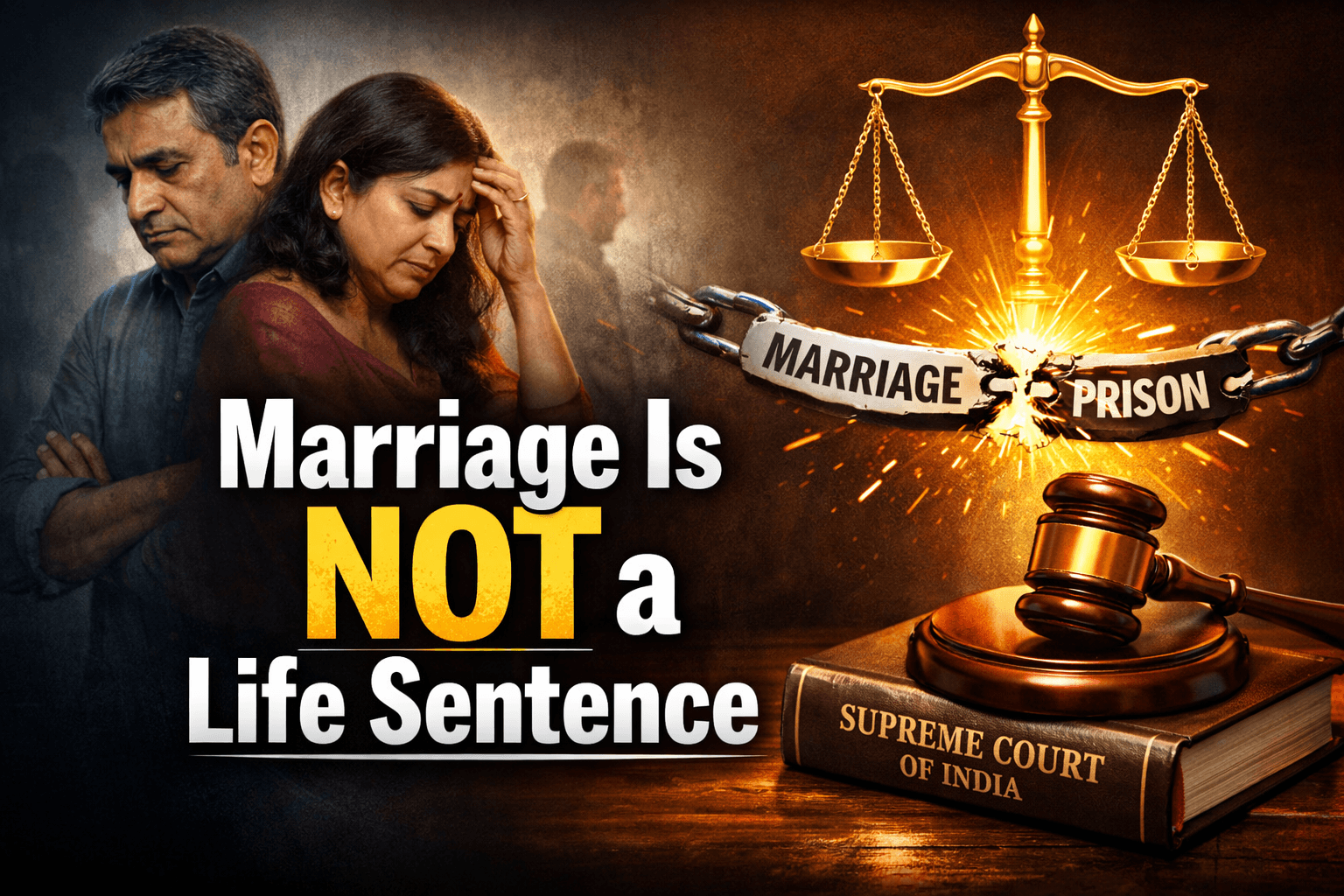
In a landmark ruling that prioritizes human dignity and practical reality over legal formalities, the Supreme Court of India has declared that "marriage is not a life sentence." A Bench comprising Justice Manmohan and Justice Joymalya Bagchi dissolved a marriage that had been effectively dead for over two decades, emphasizing that keeping a "marriage on paper" serves no social purpose when the emotional bond has completely vanished.
The Court’s observations come as a significant reminder that while the law aims to preserve the sanctity of marriage, it cannot be used to force two individuals to remain tied to a relationship that has irretrievably broken down.
A Relationship Stuck in Time: The Background
The story traces back to August 4, 2000, when Nayan Bhowmick (the appellant) and Aparna Chakraborty (the respondent) were married in Shillong. Interestingly, both were colleagues, working as Development Officers for the Life Insurance Corporation (LIC) since 1992.
However, the domestic bliss was short-lived. By 2001—just a year after the wedding—Aparna left the matrimonial home. Her reasons were deeply personal and reflected a common societal struggle: she claimed her husband and his family pressured her to quit her job, despite her need to support her elderly mother and dependent brother.
What followed was a marathon of legal battles that lasted longer than the marriage itself. A divorce suit was filed as early as 2003. Although a trial court eventually granted a divorce in 2010 on grounds of desertion, the Gauhati High Court reversed this in 2011, believing the marriage could still be saved. The case then moved to the Supreme Court, where it remained pending for over a decade.
"Cruelty" Redefined: Irreconcilable Views
One of the most profound aspects of this judgment is how the Supreme Court interpreted "cruelty." Traditionally, cruelty in matrimonial law often required proof of physical or severe mental abuse. However, Justice Manmohan, writing the judgment, noted:
"In matrimonial disputes... courts should not sit in judgment over which spouse’s approach to marriage is right or wrong. What assumes significance is the fact that both spouses have strongly held positions and have refused to adjust or accommodate each other for a long period, which itself constitutes cruelty."
The Bench observed that both parties had become so detached that despite working in the same LIC branch, they had not interacted for years. This "prolonged separation and unending litigation," the Court said, had reduced the marriage to a mere "legal fiction."
The Power of Article 142
The Supreme Court invoked its extraordinary powers under Article 142 of the Constitution, which allows it to pass any order necessary to do "complete justice."
The Court referred to the 2023 Constitution Bench decision in Shilpa Sailesh vs. Varun Sreenivasan, which clarified that the Supreme Court is not strictly bound by the "fault-based" rules of the Hindu Marriage Act. In other words, the Court doesn't always need to find one person "guilty" of a mistake to grant a divorce; the simple fact that the marriage is "dead" and beyond repair is enough.
Key Takeaways from the Bench
- Sanctity vs. Reality: While courts should ordinarily try to save marriages, this principle shouldn't be applied mechanically. If people have lived apart for decades (in this case, 24 years), there is no "sanctity" left to protect.
- No Third-Party Impact: The Court noted that since there were no children from the marriage, dissolving it would not adversely affect any third party.
- Social Purpose: Keeping a "dead" marriage alive on paper serves no social or emotional purpose and only causes further misery to the individuals involved.
- End to Litigation: The Court emphasized that continuing a 22-year-old legal battle would be a waste of judicial time and a source of constant torment for the spouses.
The Verdict
The Supreme Court set aside the Gauhati High Court’s 2011 order and restored the original decree of divorce. By doing so, the Court finally ended a 25-year-old legal and emotional entanglement.
In its concluding remarks, the Bench made it clear: when a relationship has reached a point where reconciliation is "not in the realm of possibility," the law must step in to grant the parties the freedom to move on with their lives.
Case Details:
- Case Title: Nayan Bhowmick vs. Aparna Chakraborty
- Case Number: Civil Appeal No. 5167 of 2012
- Bench: Justice Manmohan and Justice Joymalya Bagchi
- Date of Judgment: December 15, 2025