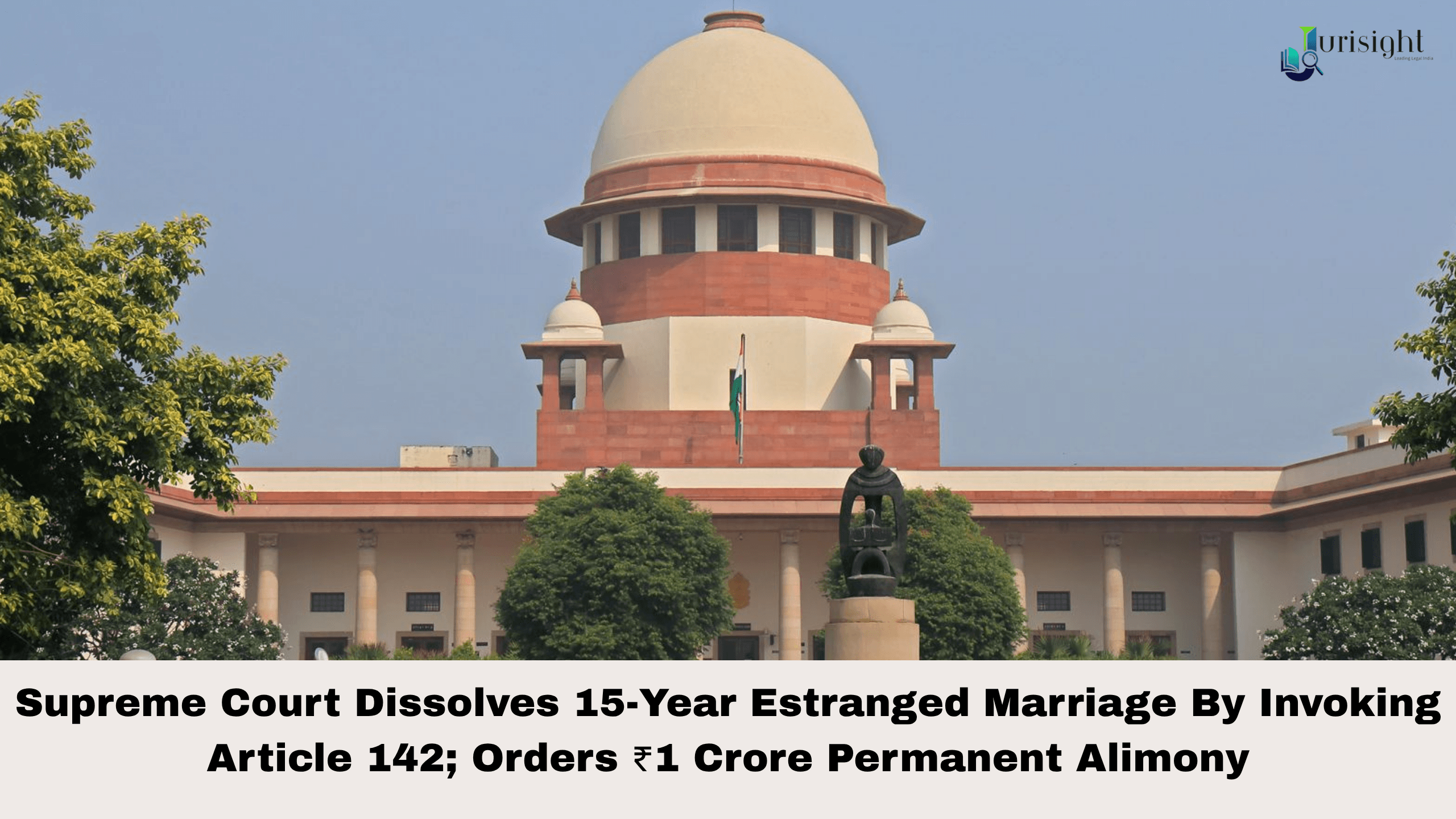
New Delhi: The Supreme Court of India, in the exercise of its exceptional jurisdiction under Article 142 of the Constitution, has granted a decree of divorce to an estranged couple, observing that their marital relationship had been “irretrievably broken down” for over fifteen years.
A Bench of Justices Vikram Nath and Sandeep Mehta passed the order on October 29, 2025, in the matter of Rekha Minocha Vs Amit Shah Minocha & Ors. (Criminal Appeal No. 1595 of 2025). The dissolution was granted despite the appellant-wife's contest, citing that prolonging the legally dead marriage would only perpetuate "years of acrimony and bitterness."
The Matrimonial and Legal History
The couple was married on October 5, 2009. The appellant-wife left the matrimonial home on April 15, 2010, alleging mental and physical harassment. She gave birth to their son in December 2010.
The separation led to a decade-and-a-half of litigation:
- Maintenance: The wife filed an application under Section 125 of the CrPC in 2013 and a complaint under the Protection of Women from Domestic Violence Act, 2005 (DV Act) in 2019.
- Trial Court Relief: The Trial Court, on January 16, 2019, directed the husband to pay a total of ₹25,000 per month (including maintenance for the wife and child, education expenses, and rent/utilities) and awarded ₹4,00,000/- as compensation under Section 22 of the DV Act.
- High Court Revisions: The legal tussle continued until the Rajasthan High Court in July 2023 set aside the subsequent order of the Family Court granting an additional allowance under CrPC and also quashed the ₹4 lakh compensation granted under the DV Act.
Article 142 Invoked for Complete Justice
When the matter reached the Supreme Court in 2024, the husband’s separate petition challenging other directions was dismissed in March 2025, and directions were issued for clearing arrears of maintenance.
During the final hearings, following the failure of reconciliation through the Supreme Court Mediation Centre, the husband proposed a lump sum settlement of ₹1 Crore as permanent alimony and full settlement of all pending dues.
The Bench, noting the 15-year separation, concluded that the relationship had "irretrievably broken down".
"The relationship between the parties has irretrievably broken down... there is no purpose in perpetuating a legal relationship that has ceased to have any meaning,” the Bench observed while finding the proposed ₹1 crore settlement “just, fair and reasonable” based on the financial standing of the parties.
Final Directions and Settlement Terms
In its decree, the Supreme Court mandated the following:
- The husband shall pay a sum of ₹1,00,00,000/- (Rupees One Crore Only) to the appellant-wife within a period of three months.
- This amount is specified as a full and final settlement of all claims between the parties, including those of the minor child, who was represented by the mother.
- Significantly, the Bench clarified that the settlement shall not preclude the respondent-father from contributing for the child’s education voluntarily.
- All pending civil or criminal proceedings arising out of the marriage, by virtue of this order, stand quashed and closed.
- The Registry was directed to draw up the decree of divorce upon receiving proof of payment from the husband.
The judgment underscores the Supreme Court's robust application of Article 142 to provide a conclusive resolution in matrimonial matters where the marriage is dead in fact, even when statutory grounds for divorce might be contested.
JUDGEMENT LINK :
https://api.sci.gov.in/supremecourt/2023/48594/48594_2023_5_1501_65240_Judgement_29-Oct-2025.pdf