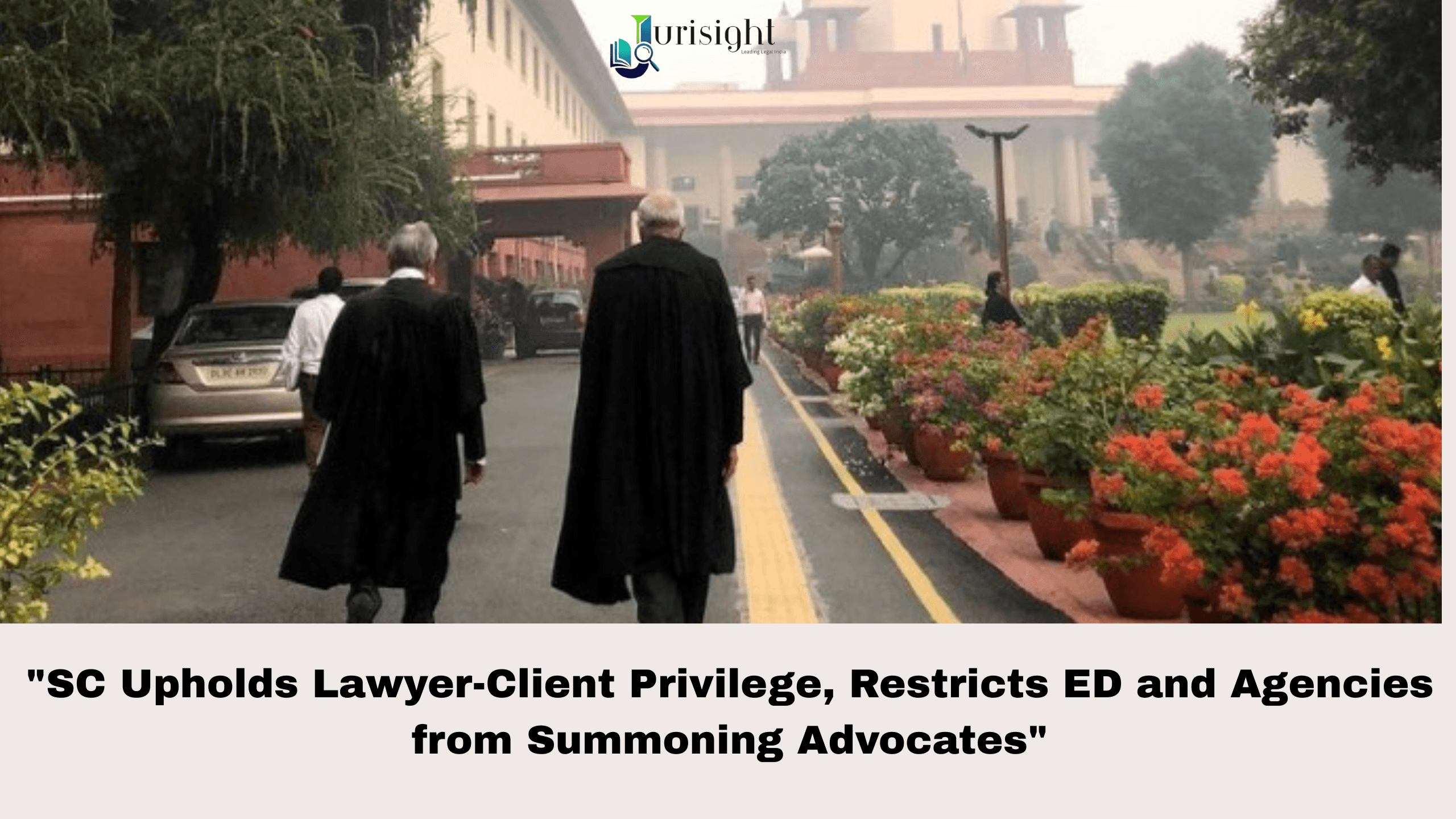
New Delhi: In a landmark ruling reinforcing the sanctity of lawyer-client privilege, the Supreme Court of India on Friday held that investigating agencies, such as the Enforcement Directorate (ED), cannot routinely summon advocates in connection with professional advice rendered to their clients.
The Bench, comprising Chief Justice of India (CJI) B.R. Gavai and Justices K. Vinod Chandran and N.V. Anjaria, clarified that the shield of attorney-client confidentiality remains robust, even as the country transitions to the new criminal laws.
Summoning Lawyers is the Exception, Not the Rule
The Court's decision makes it clear that summoning a lawyer must be considered an exceptional measure. Agencies can only exercise this power under the specific conditions detailed in Section 132 of the Bharatiya Sakshya Adhiniyam (BSA), 2023, which replaces Section 126 of the repealed Indian Evidence Act, 1872.
Section 132 of the BSA governs privileged communications. It essentially prohibits a lawyer from disclosing any communication made to them by or on behalf of their client, or any advice given by the lawyer in the course of their employment, unless the client expressly permits it.
The Scope of Section 132 of BSA, 2023
While the full judgment detailing the exceptions is awaited, Section 132 of the BSA is structured to protect professional communication but typically allows for disclosure in limited scenarios, such as:
- Any communication made in furtherance of an illegal purpose.
- Any fact observed by the lawyer in the course of employment showing that any crime or fraud has been committed since the commencement of employment.
The Supreme Court’s ruling ensures that investigating bodies must strictly adhere to these narrow exceptions before compelling a lawyer to testify or produce documents relating to their professional services.
Impact on Investigating Agencies
This pronouncement comes as a significant safeguard for the legal profession against what many lawyers consider to be unwarranted overreach by investigating agencies like the ED, which frequently seek to use an advocate’s communications to build a case against a client.
By explicitly linking the power to summon lawyers to the exceptional circumstances under Section 132 of the BSA, the Supreme Court has set a high threshold, protecting the foundational principle that a client must feel safe and secure in confiding completely in their legal counsel.
The ruling reaffirms the principle that the relationship between a lawyer and a client is not just contractual but fiduciary and privileged, essential for the effective administration of justice and safeguarding the rights of the accused.
JUDGEMENT LINK :
https://api.sci.gov.in/supremecourt/2025/35619/35619_2025_1_1503_65372_Judgement_31-Oct-2025.pdf