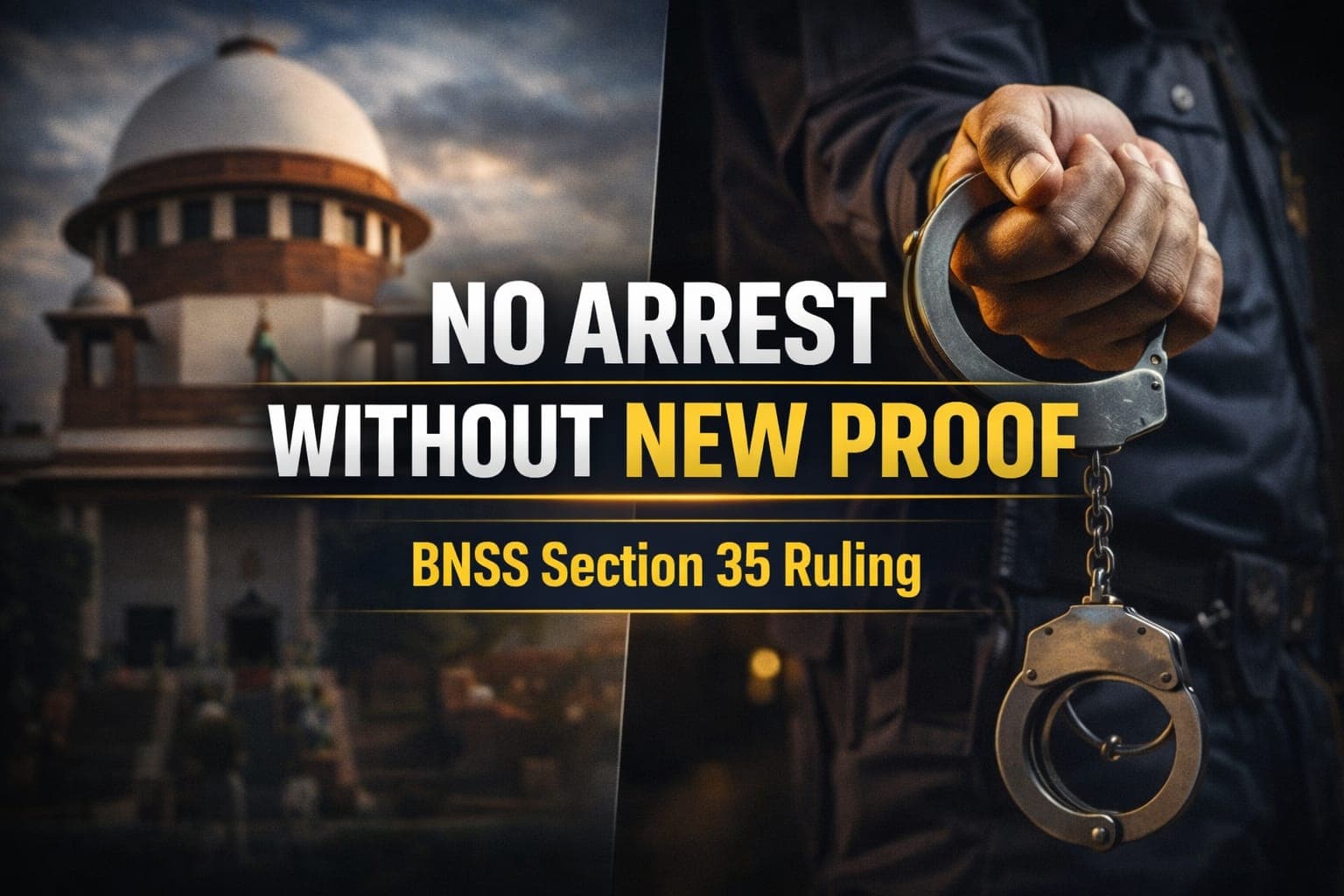
In a significant judgment protecting personal liberty, the Supreme Court of India has tightened the rules for police arrests under the new criminal code, the Bharatiya Nagarik Suraksha Sanhita (BNSS), 2023.
The Court has ruled that if the police want to arrest a person under Section 35(6) of the BNSS after issuing a notice for appearance, they cannot rely on the same old reasons they had earlier. There must be "fresh material" or new evidence to justify the arrest.
This ruling comes as a major relief for citizens and legal practitioners, clarifying ambiguities in the new law that replaced the Code of Criminal Procedure (CrPC). The judgment was delivered by a bench comprising Justice M.M. Sundresh and Justice N. Kotiswar Singh in the case of Satender Kumar Antil v. Central Bureau of Investigation.
Here is a detailed breakdown of what this judgment means, why it matters, and how it protects you from arbitrary police action.
Understanding the Law: Section 35 of the BNSS
To understand the verdict, we first need to look at the law itself in simple terms. Under the old law (CrPC), there was Section 41A. Under the new BNSS, we have Section 35, which deals with the powers of arrest.
1. The Mandatory Notice (Section 35(3)): For offenses where the punishment is imprisonment of less than seven years, the police cannot simply barge into your house and arrest you. The law says they must issue a "Notice of Appearance" first. This notice asks the accused to appear before the police officer and cooperate with the investigation. This is found in Section 35(3) of the BNSS.
2. The Power to Arrest (Section 35(6)): However, the law also gives the police a loophole. Section 35(6) states that if a person fails to comply with the notice (doesn't show up) or refuses to identify themselves, the police can arrest them.
The problem arises when police officers use this power routinely. Sometimes, even if a person cooperates, the police might find a minor excuse to claim "non-compliance" and arrest them using the original evidence they already had.
The Core Issue:
The question before the Supreme Court was crucial:
Can a police officer arrest someone under Section 35(6) using the exact same evidence and facts that were available when they issued the initial notice?
For example, imagine the police suspect Mr. X of a minor fraud case. They issue a notice to him on January 1st based on Evidence A and Evidence B. Mr. X appears before them. A week later, the police decide to arrest him under Section 35(6), citing Evidence A and B again as the reason.
The Supreme Court has said NO. This is not allowed.
The Supreme Court’s Ruling:
In today's judgment, the bench clarified that the power of arrest is not a tool for harassment. They laid down a clear "Fresh Material" doctrine.
The Court stated:
"While making an arrest under Section 35(6) of the BNSS... the circumstances and factors that were in existence at the time of issuing the said notice shall not be taken into consideration by a police officer while making an arrest subsequently."
What does this mean in simple English? It means that once the police decide to issue a notice instead of arresting you, they have essentially admitted that the evidence they currently have is not enough to warrant an immediate arrest. Therefore, they cannot turn around later and use that same evidence to arrest you.
To arrest you later under Section 35(6), they need something new—new evidence, a new discovery, or a specific act of non-cooperation that happened after the notice was given.
Arrest is an Exception, Not the Rule
The judges emphasized that the power to arrest under Section 35(6) must be exercised "sparingly". It is not a routine procedure.
The Court observed:
"The power of arrest under Section 35(6)... is not a matter of routine, but an exception, and the police officer is expected to be circumspect and slow in exercising the said power."
This is a strong warning to law enforcement agencies. Just because the law allows an arrest for non-compliance, it does not mean the police should arrest in every case. They must apply their mind and ask: Is this arrest absolutely necessary?
The Legacy of the Satender Kumar Antil Case
This judgment is the latest in a series of orders in the famous Satender Kumar Antil case, which has become the "Bible" for bail and arrest guidelines in India.
In a previous order (Satender Kumar Antil - II), the Court had already ruled that just because someone technically fails to comply with a notice, it doesn't automatically justify throwing them in jail. Arrest is always a measure of "last resort."
Today's ruling (Satender Kumar Antil - III) takes it a step further by adding the procedural safeguard of "fresh material." It prevents the police from keeping the threat of arrest hanging over a citizen's head based on old facts.
Why This Matters for the Common Citizen
This judgment is a shield against abuse of power. Here is why it is important for you:
- Prevents Harassment: Police often use the threat of arrest to intimidate people even in minor cases. This ruling restricts that power.
- Encourages Fair Investigation: It forces the police to actually investigate and find new evidence rather than relying on lazy shortcuts to arrest people.
- Protects Liberty: In India, "bail is the rule, and jail is the exception." This judgment reinforces that principle by making it harder to arrest people for crimes with less than seven years of punishment.
Conclusion
The transition from the old CrPC to the new BNSS brought many fears about potential police overreach. However, the Supreme Court has stepped in as a guardian of civil liberties.
By ruling that arrests under Section 35(6) cannot be based on stale or old grounds, the Court has drawn a clear "Lakshman Rekha" for the police. For an arrest to be legal, the police must show that something has changed since the time they issued the notice.
This decision ensures that the process of law is used to find the truth, not to punish the accused before a trial even begins.