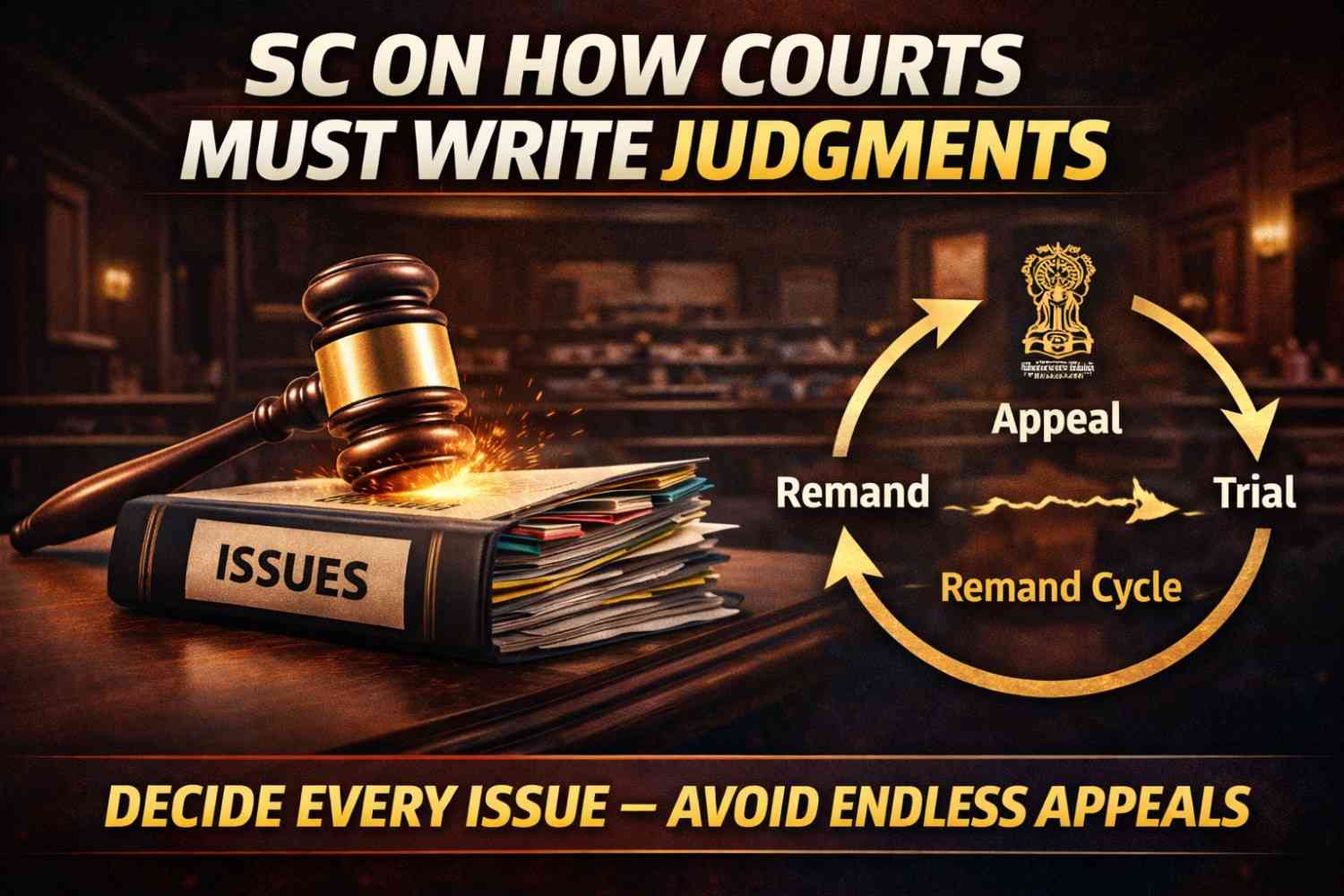
In an important ruling on judicial discipline and reasoning in judgments, the Supreme Court of India has held that courts should ideally decide every issue raised in a case, rather than disposing of matters based only on a single decisive ground.
The Court observed that while deciding a case on one determinative point may technically conclude litigation, failure to address remaining issues often leads to appeals, remands, and prolonged disputes — ultimately defeating the purpose of justice.
The Case Before The Court
The matter arose from a civil dispute where lower courts had resolved the case by answering only one principal legal question. Other contested issues — including factual findings and alternative legal claims — were left undecided.
The aggrieved party argued that such a judgment was incomplete because, if the primary finding was later overturned in appeal, the entire matter would have to be retried.
The Supreme Court agreed that this approach creates procedural inefficiency and uncertainty.
“Courts must ideally answer every issue raised instead of focusing only on a single decisive point.”
Key Observations by the Court
The Court explained that judicial decisions serve two purposes:
- Resolve the present dispute
- Prevent future litigation
When courts leave issues undecided, appellate courts face a dilemma — either remand the case or adjudicate facts without trial court findings.
“Non-adjudication of material issues compels remand, prolonging litigation and burdening litigants.”
The Bench emphasised that comprehensive adjudication strengthens judicial finality and improves confidence in the justice system.
Doctrine of Complete Adjudication
The ruling reinforces a long-standing procedural principle:
A judgment must contain findings on:
- Issues of fact
- Issues of law
- Alternative claims and defences
- Relief entitlement
Even if one issue disposes of the case, deciding remaining issues helps appellate courts if the main finding is reversed.
The Court noted that the approach becomes particularly important in:
• Property disputes
• Contract litigation
• Service matters
• Constitutional challenges
This ruling is significant for judicial practice across India.
For Trial Courts:
They must frame and answer all issues instead of delivering narrow rulings.
For Litigants:
It prevents cases from restarting years later after appeals.
For the Justice System:
It reduces remands and backlog — a major structural problem in Indian courts.
Ultimately, the judgment promotes finality, efficiency, and fairness in adjudication.
Rather than winning a battle only to fight again in appeal, parties should ideally obtain a complete resolution in one judicial cycle.
The Supreme Court’s message is clear: justice is not just about deciding — it is about deciding completely.