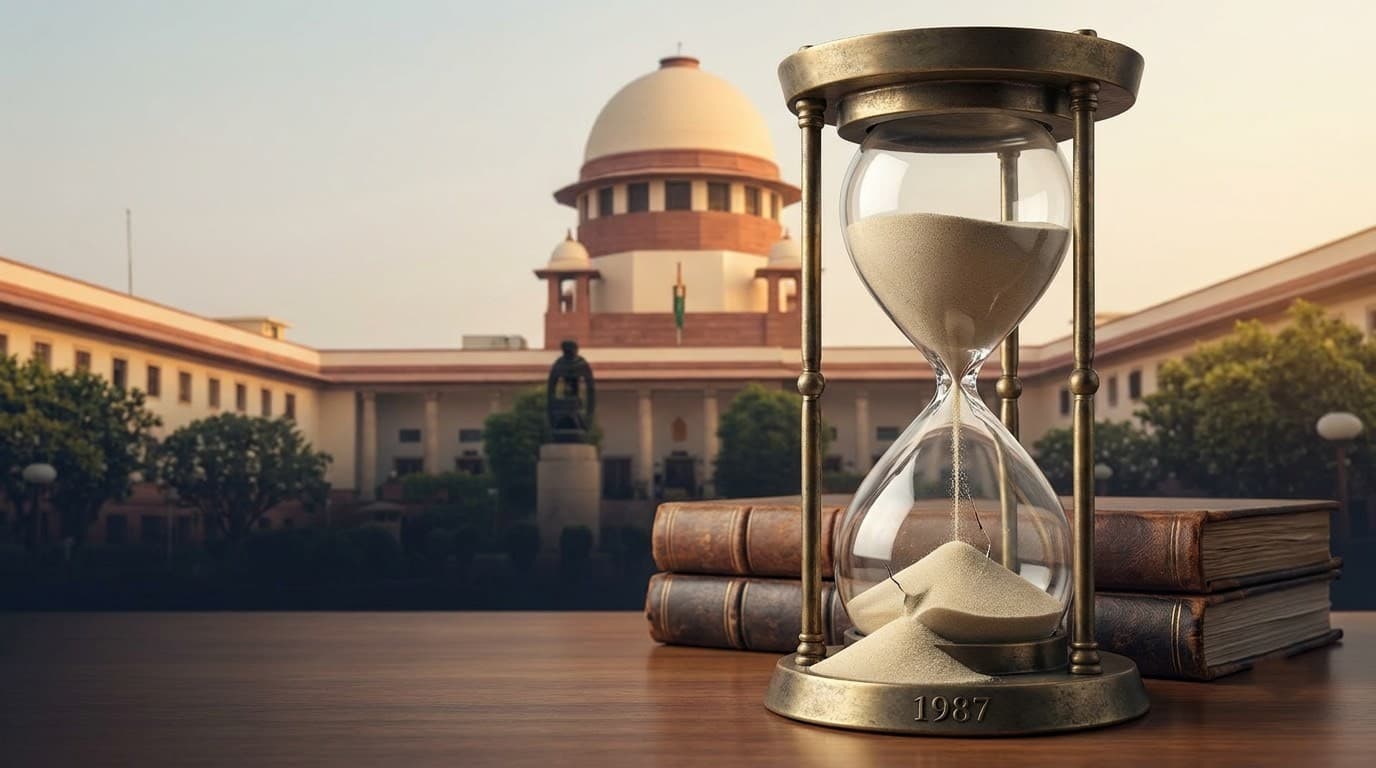
The Supreme Court on Friday expressed disapproval of its own 1987 judgment in Collector, Land Acquisition v. Katiji, stating that the decision, which condoned a mere four-day delay, has driven the nation backwards by encouraging litigants to seek condonation of delay as a matter of course.
A Bench comprising Justices Dipankar Datta and Sheel Nagu made the observation while dismissing appeals filed by Karvy Stock Broking Limited and its former Chairman and Managing Director, C Parthasarathy, challenging orders of the Securities Appellate Tribunal (SAT) that refused to condone delays in filing appeals against penalties imposed by the Securities and Exchange Board of India (SEBI).
The Bench remarked that the 1987 judgment, which advocated a liberal approach favouring substantial justice over technical considerations, had been treated as a panacea for all delays in legal proceedings. It noted that the judgment had been relied upon repeatedly, despite being based on a minimal delay of only four days.
The Court referred to subsequent judgments, including Sheo Raj Singh, to clarify that different principles apply when a court exercises its discretion to condone delay compared to when an appellate court reviews another forum’s exercise of such discretion. It emphasised that the 1987 ruling should not be extended indiscriminately to justify delays in all cases.
The Bench further clarified that regulatory authorities and private litigants would be treated equally in matters concerning delayed appeals. It stated that it would be equally strict with SEBI when it appears before the Court with time-barred appeals, and that no distinction would be made between a private litigant, a public litigant, or a government entity.
‘From now onwards, you will come in time,’ the Bench warned, signalling a shift towards stricter adherence to limitation periods in legal proceedings.
The dispute originated from an SEBI order dated April 28, 2023, which found that Karvy Stock Broking had misused clients’ securities to raise funds and diverted approximately ₹1,442.95 crore to related group companies. SEBI imposed penalties of ₹13 crore on Karvy and ₹8 crore on Parthasarathy, besides restraining both from accessing the securities market for seven years.
The appellants filed appeals against the SEBI order, but the SAT, on September 9, 2026, refused to condone the delay in filing those appeals. The Supreme Court, in dismissing the appeals, left the SAT’s order undisturbed without examining the merits of SEBI’s findings.
The appellants were represented by Senior Advocates Mukul Rohatgi and Balbir Singh, while SEBI was represented by Additional Solicitor General N Venkataraman.
The Court’s observation underscores its concern that the liberal stance taken in 1987 has been misapplied over the years, leading to a culture of delay in litigation. By distancing itself from that precedent in the context of appellate review of discretionary condonation, the Bench aims to restore rigour in adherence to timelines, particularly in regulatory and economic offences where timely action is critical.