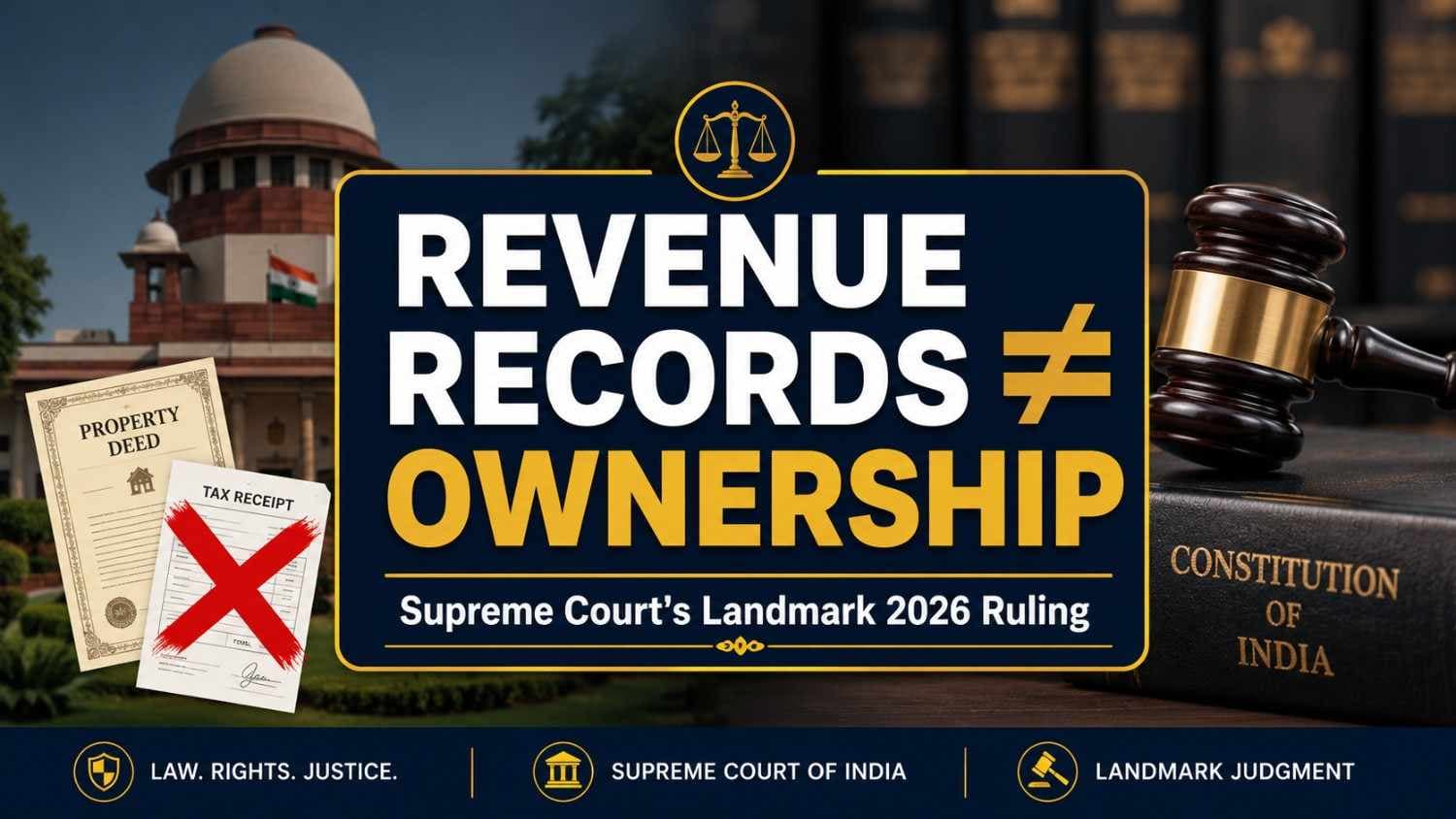
In a significant judgment that clarifies decades of property law disputes, the Supreme Court of India has reiterated that entries in revenue records do not confer ownership (title) over land. The Court emphasized that revenue records serve a "fiscal purpose"—primarily for the collection of land revenue—and cannot be used as a substitute for a registered sale deed or a 'Patta' (title deed).
The Division Bench, comprising Justice Pankaj Mithal and Justice S.V.N. Bhatti, delivered this ruling in the case of Vadiyala Prabhakar Rao & Ors. v. The Government of Andhra Pradesh & Ors. The judgment serves as a vital reminder to litigants and legal practitioners that relying solely on revenue entries like Pahanies, Faisal Pattis, or Jamabandi is insufficient to establish legal ownership in a court of law.
The case dates back to a 1950 notification issued under the Hyderabad Forest Act, which proposed to include approximately 787 acres of land in Kalvalanagaram Village (Telangana) as a reserve forest. The appellants claimed that 600 acres of this land belonged to them, asserting that the Nizam of Hyderabad had granted 'Pattas' (land grants) to their predecessors in 1931-32.
However, the appellants could not produce the original Patta certificates. Instead, they relied on various revenue extracts, land ceiling proceedings, and reports from Mandal Revenue Officers (MRO) which suggested that their names were recorded in the revenue registers.
While a Single Judge of the High Court had originally ruled in favor of the claimants, the Division Bench of the High Court later reversed that decision. The Supreme Court has now upheld the Division Bench’s view, dismissing the appellants' claims due to a lack of "primary documents of title."
Justice S.V.N. Bhatti, writing the judgment, summarized the settled legal position regarding revenue entries. The Court noted that for over a century, Indian jurisprudence has maintained a clear distinction between "possession for tax purposes" and "legal ownership."
The Court summarized six foundational principles that every landowner should know:
- Fiscal Purpose Only: Entries in revenue records or Jamabandi are meant only for fiscal purposes. Their primary function is to identify who is responsible for paying land revenue to the State.
- No Conferment of Title: A revenue record is not a document of title. It does not create or extinguish ownership rights.
- Presumptive Value: Mutation (changing a name in the records) has no presumptive value regarding the legal title of the property.
- State's Right to Challenge: Even if a person has paid municipal taxes or secured a bank loan based on revenue records, the State is not stopped from challenging that person's ownership of the land.
- Presumption of Possession: While these records don't prove who owns the land, they can sometimes raise a presumption about who is in possession of the land.
- Risk of Fabricated Records: The Court warned that revenue records are often managed by local officials (like the Patwari) and can be subject to tampering. Therefore, the government is not bound by fabricated or collusive records.
The Supreme Court highlighted that the appellants' case was built on "truncated and contradictory" evidence. While they claimed the land was private, the revenue records for 1954-55 (Khasra Pahanie) actually recorded the land as UFTADA (waste/uncultivated land) covered in thick forest growth.
The Court observed:
"The law is well settled that, through Revenue entries, the claim to title is not proved... These entries are not supported by a patta or an Order lawfully made, authorising mutation as per the extant procedure."
The judgment also touched upon a crucial procedural point: Can a High Court declare someone the owner of land in a Writ Petition under Article 226?
The Supreme Court answered with a firm "No." It held that "serious disputes concerning questions of fact and title to property" cannot be resolved in a summary writ proceeding. Such matters must be decided by a Civil Court through a regular suit where witnesses can be examined and original documents can be scrutinized.
The Court criticized the Single Judge's earlier decision to declare the appellants' title, stating that the judge had expanded the scope of judicial review beyond its legal limits.
By dismissing the appeal, the Supreme Court has sent a clear message: in the eyes of the law, being a "recorded holder" in the revenue office is not the same as being the "legal owner." To win a title dispute, especially against the State or Forest Department, a claimant must produce the root document of their ownership—the original grant or a registered deed—rather than relying on the "ipse dixit" of revenue entries.
This judgment reinforces the security of public lands, particularly forest areas, ensuring they are not lost to private claims based on weak or inconsistent administrative records.
Case Details: Vadiyala Prabhakar Rao & Ors. v. The Government of Andhra Pradesh & Ors. Citation: 2026 INSC 450 Court: Supreme Court of India Bench: Justice Pankaj Mithal and Justice S.V.N. Bhatti