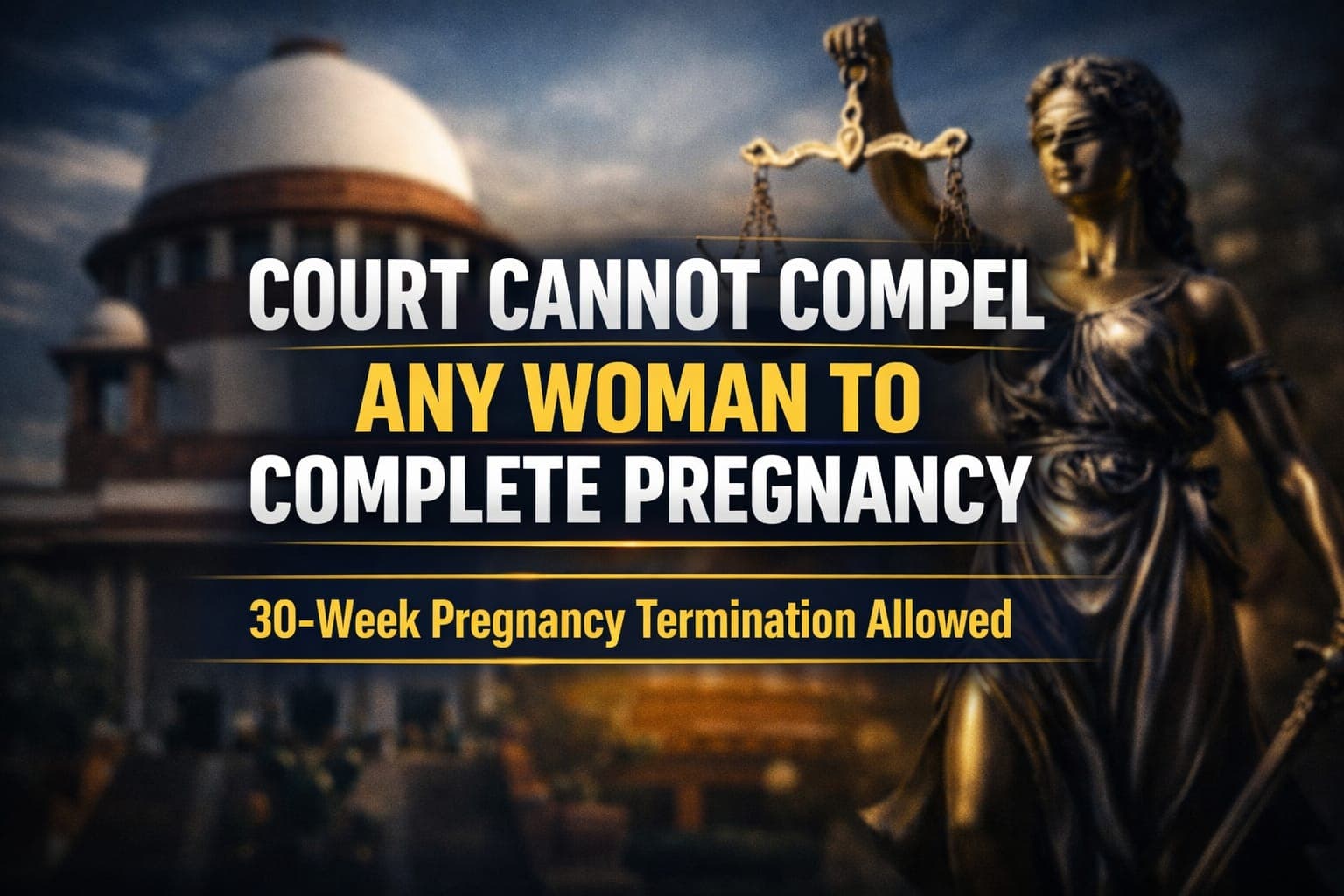
In a landmark decision that reaffirms the principles of reproductive autonomy and bodily integrity, the Supreme Court of India has ruled that no woman—especially a minor—can be forced by a court to continue an unwanted pregnancy. The decision came while the Court was hearing a plea for the medical termination of a 30-week pregnancy of a young girl.
The Bench, comprising Justice B.V. Nagarathna and Justice Ujjal Bhuyan, emphasized that a woman's right to choose whether to carry a pregnancy to term is a fundamental aspect of her reproductive freedom.
The case reached the apex court after a mother filed a petition on behalf of her minor daughter, identified as 'X'. The girl had become pregnant following a relationship while she was still a minor. By the time the matter reached the legal stage of seeking a termination, the pregnancy had progressed to 30 weeks—well beyond the 24-week limit generally prescribed under the Medical Termination of Pregnancy (MTP) Act, 1971.
The central conflict involved the late stage of the pregnancy versus the absolute unwillingness of the minor to give birth. The court had to balance the medical risks of a late-term abortion against the mental and physical trauma of forcing a young girl to undergo childbirth against her will.
The Supreme Court’s observations in this case are expected to set a major precedent for future cases involving late-term abortions. Justice Nagarathna, known for her progressive stance on women's rights, noted that the minor's "unwillingness" was the most decisive factor.
The Bench stated:
"What has to be considered in the instant case is the right of the minor child to continue a pregnancy which is ex facie illegitimate, inasmuch as she is a minor and has to face this unfortunate situation... The court cannot compel any woman, much less a minor child, to complete her pregnancy if she is otherwise not intending to do so."
The Court clarified that the nature of the relationship (whether consensual or otherwise) was secondary to the fact that the "mother-to-be" did not want to bear the child. By focusing on the intent of the pregnant individual, the Court moved away from purely clinical or moralistic arguments, placing the individual's agency at the center of the legal discourse.
During the proceedings, the Bench acknowledged the gravity of the situation. Justice Nagarathna candidly remarked on the difficulty of the decision, noting that the birth of a child ultimately results in a life. However, she raised a poignant legal question: If the law allows termination at 24 weeks because a woman doesn't want the pregnancy, why should the logic change at 30 weeks if her unwillingness remains the same?
The "bottom line," according to the Court, was the minor's consistent refusal to give birth. Compelling her to do so would constitute a violation of her fundamental rights and could lead to lifelong psychological impact.
Given the advanced stage of the pregnancy, the Supreme Court directed JJ Hospital in Mumbai to immediately undertake the medical termination procedure. The Court emphasized that all necessary medical safeguards must be followed to ensure the safety of the minor.
This direction bypasses the standard 24-week ceiling of the MTP Act, utilizing the Court's extraordinary powers to ensure justice in a situation where the "mental health" and "social circumstances" of the minor outweighed the age of the fetus.
This judgment aligns with previous rulings by the Supreme Court, such as the 2022 decision which expanded abortion rights to unmarried women, stating that the distinction between married and unmarried women for the purpose of the MTP Act was unconstitutional.
By allowing a 30-week termination, the Court has sent a clear message:
- Age of Fetus vs. Rights of Mother: The rights and mental well-being of the pregnant woman take precedence over the biological progression of the fetus in cases of unwanted pregnancy.
- Minor’s Rights: Minors deserve even greater protection and sensitivity regarding their reproductive choices.
- No Compulsion: The state or the judiciary cannot act as a "moral guardian" to force motherhood upon an individual.
The ruling in A (Mother of X) vs. State of Maharashtra is a victory for bodily autonomy in India. It reinforces the idea that motherhood must be a choice, not a legal obligation. For the legal community, this case serves as a reminder that the law must evolve to protect the dignity of individuals facing extraordinary and "unfortunate" life circumstances.
As the minor undergoes the procedure at JJ Hospital, the legal world looks at this judgment as a definitive shield against forced pregnancies, ensuring that the "right to choose" is not just a theoretical concept but a protected reality.
Case Details:
- Case Title: A (Mother of X) Vs State of Maharashtra
- Case Number: SLP(C) No. 4774/2026
- Bench: Justice B.V. Nagarathna and Justice Ujjal Bhuyan
- Key Law: Medical Termination of Pregnancy (MTP) Act, 1971; Article 21 of the Constitution.