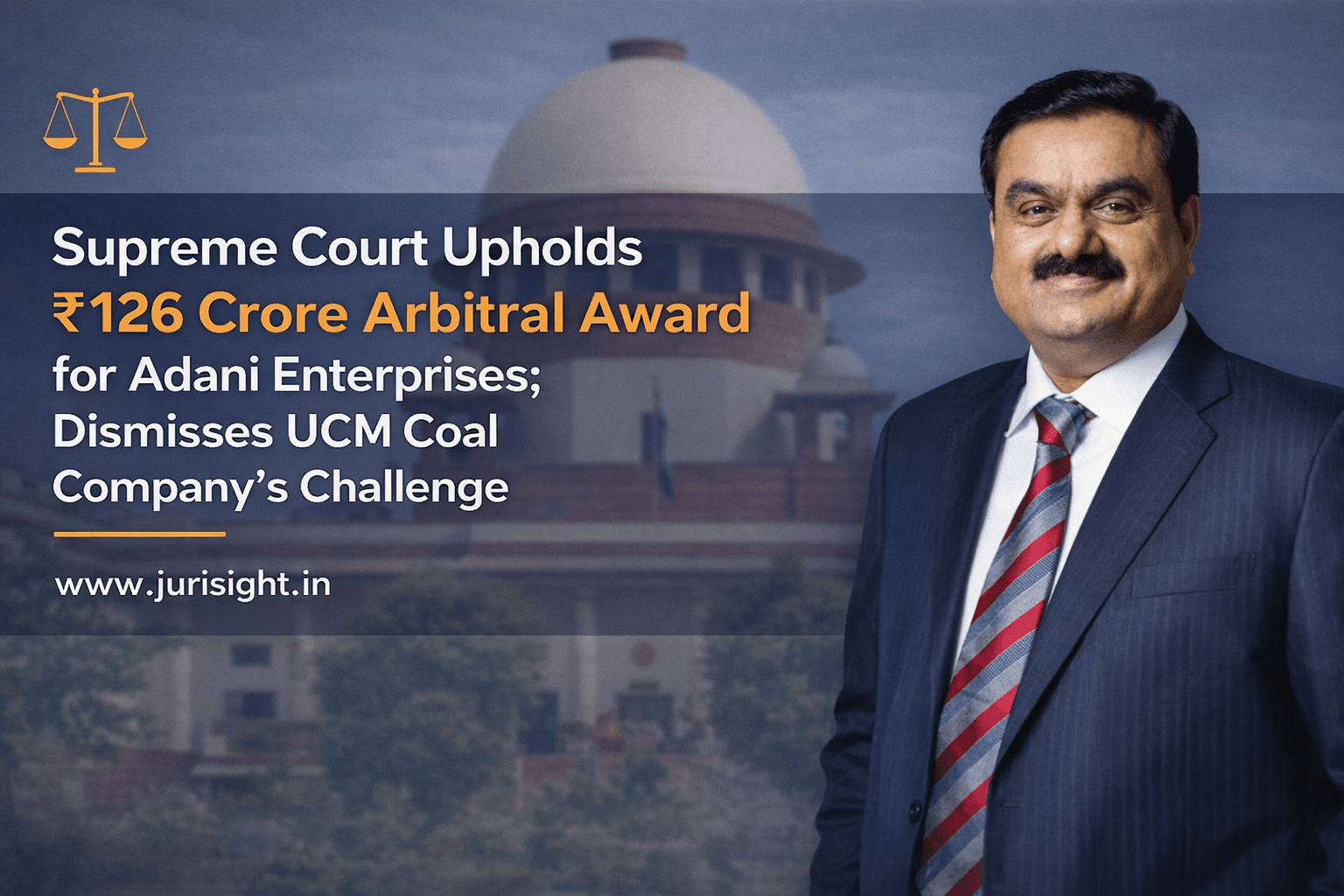
In a significant boost for the finality of arbitral awards in India, the Supreme Court has dismissed a challenge filed by UCM Coal Company Ltd. against an order of the Allahabad High Court. The High Court had earlier upheld a massive ₹126 crore arbitral award in favor of Adani Enterprises Ltd., putting an end to a decade-long commercial dispute.
A bench comprising Justice J.K. Maheshwari and Justice Atul S. Chandurkar passed the order after hearing arguments from some of the country’s top legal minds. The dismissal essentially confirms that the Arbitral Tribunal’s findings were well within the legal framework and that Courts should be slow to interfere with the "plausible interpretation" of contracts by arbitrators.
The Background:
The roots of the dispute date back to 2010. UCM Coal Company Ltd.—a joint venture involving state power corporations from Uttar Pradesh (UPRVUNL), Chhattisgarh (CMDC), and Maharashtra (MAHAGENCO)—had been allocated the Chhendipada and Chhendipada-II coal blocks.
To develop these mines, UCM Coal floated international tenders, and Adani Enterprises emerged as the successful bidder. The parties signed a formal mining contract in February 2011, designating Adani as the 'Mine Developer and Operator' (MDO).
However, the project hit a major roadblock when the Supreme Court, acting on a Public Interest Litigation (PIL), cancelled the allocation of several coal blocks across the country, including those allotted to UCM Coal. This cancellation effectively "frustrated" the contract, making it impossible to perform.
Following the cancellation, Adani Enterprises raised a dispute to recover the heavy expenses it had already incurred. These costs included land acquisition, setting up mine infrastructure, mobilizing assets, and significant advances paid to consultants and capital commitments.
The Arbitral Award and the 'PMC' Link
An Arbitral Tribunal was constituted to settle the claims. After evaluating the evidence, the Tribunal allowed Adani Enterprises' claims and awarded a sum of ₹126,63,21,441/- along with interest at the rate of 11% per annum.
A key part of Adani’s claim involved payments it owed to PMC Projects (India) Pvt. Ltd. Adani had engaged PMC for project management consultancy. Interestingly, Adani’s liability to pay PMC had been settled in a separate, previous arbitration. The Tribunal in the UCM case used that previous award as a "credible piece of evidence" to verify that Adani had indeed incurred these liabilities for the work done at the coal blocks.
The Legal Battle in the High Court
UCM Coal first challenged the award before the Commercial Court in Lucknow under Section 34 of the Arbitration and Conciliation Act, but the challenge was dismissed. They then approached the Allahabad High Court, raising two primary objections:
- Hiring of Sub-contractors: UCM argued that Adani had hired third-party agencies (like PMC) without their prior written consent, which was a violation of the contract.
- Misinterpretation of Evidence: They claimed the Tribunal wrongly relied on the previous PMC award and other documents to decide the claim.
The Lucknow Bench of the Allahabad High Court, however, rejected these arguments. Referring to the Supreme Court’s landmark rulings in Batliboi Environmental Engineers Ltd. v. HPCL and AC Chokshi Share Broker (P) Ltd. v. Jatin Pratap Desai, the High Court noted that while there was a bar on hiring sub-contractors, there was no bar on hiring consultants.
The High Court observed that:
- Witnesses confirmed the agencies were "consultants," not sub-contractors.
- UCM Coal never objected to these consultants during the actual progress of the work.
- The Arbitral Tribunal is not bound by the strict "Rules of Evidence" and can rely on previous awards to crystalize liability.
Supreme Court’s Final Word
Aggrieved by the High Court's decision, UCM Coal moved the Supreme Court. Representing the petitioners, Solicitor General Tushar Mehta and Advocate Adarsh Tripathi led the arguments. On the other side, Senior Advocates Mukul Rohatgi and Vikram Nankani, along with Advocate Mahesh Agarwal, appeared for Adani Enterprises.
After hearing both sides, the Supreme Court found no reason to interfere with the High Court’s well-reasoned order. By dismissing the Special Leave Petition (SLP), the Apex Court has reaffirmed the principle that as long as an Arbitral Tribunal’s view is "prudent" and based on "overwhelming evidence," it cannot be set aside merely because a second view is possible.
This judgment is significant for three reasons:
- Consultants vs. Sub-contractors: It clarifies the distinction between domain-specific consultants and operational sub-contractors in large infrastructure projects.
- Admissibility of Prior Awards: It confirms that an arbitral award from one proceeding can be used as evidence in another to prove the crystallization of a liability.
- Judicial Restraint: It reinforces the "hands-off" approach that Indian Courts are adopting toward arbitration, ensuring that India remains a pro-arbitration jurisdiction.
With the dismissal of this challenge, the ₹126 crore award (plus accumulated interest) stands finalized, marking a major legal victory for Adani Enterprises.
Case Details:
- Case Title: UCM COAL COMPANY LTD. v. ADANI ENTERPRISES LTD.
- Case Number: SLP(C) No. 2954/2026
- Bench: Justices J.K. Maheshwari and Atul S. Chandurkar
- Representing Petitioners: SG Tushar Mehta, Mr. Adarsh Tripathi (AOR)
- Representing Respondents: Mr. Mukul Rohatgi (Sr. Adv.), Mr. Vikram Nankani (Sr. Adv.), Mr. Mahesh Agarwal, Mr. E.C. Agrawala (AOR)