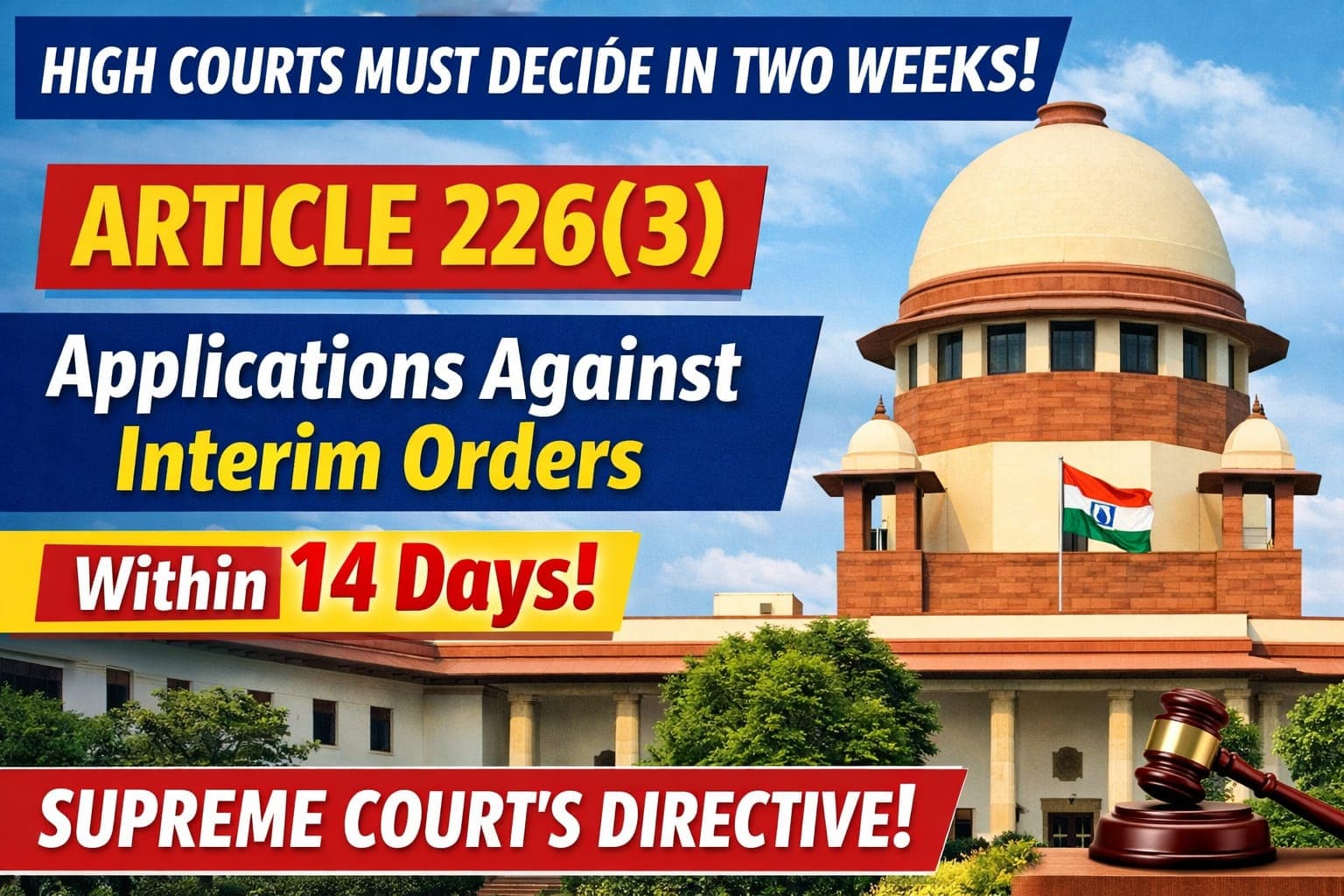
The Supreme Court of India has recently reiterated a critical constitutional mandate, reminding High Courts of their obligation to dispose of applications seeking the vacation of interim orders within a strict two-week timeline.
While dealing with a Special Leave Petition (SLP) challenging an interim status quo order from the Allahabad High Court, a Bench comprising Justice Aravind Kumar and Justice Prasanna B. Varale emphasized that Article 226(3) of the Constitution is not merely a procedural suggestion but a mandatory constitutional requirement.
The matter reached the Apex Court via an SLP (Diary No. 55304/2025) titled Giriraj and others v. Mohd. Amir and others. The petitioners were aggrieved by a "status quo" order passed by the High Court of Judicature at Allahabad in December 2024.
According to the petitioners, although the interim order was affecting them, their application to vacate or set aside that order had been languishing in the High Court for a significant period. Specifically, the counsel for the petitioners submitted that the application for vacating the interim stay had been pending since January 2025—nearly a full year without a final decision on the stay's merits.
During the hearing, the Supreme Court took serious note of the delay. The Bench pointed directly to the text of the Constitution to highlight why such a delay is problematic.
Article 226(3) was inserted into the Constitution to prevent "injustice by delay." It states that when an interim order (like a stay or injunction) is passed against a party without hearing them first (ex-parte), and that party files an application to vacate the order, the High Court must dispose of that application within two weeks from the date it is received (or from the date it is served to the other side).
The Supreme Court observed:
"At this stage it would be apt and appropriate to note Sub-Article (3) of Article 226 of the Constitution of India which mandates that upon such an application being filed, the High Court would be required to dispose of the same within a period of two weeks."
The significance of Article 226(3) lies in its self-executing nature. The provision specifies that if the application is not disposed of within the two-week window, the interim order "shall stand vacated." This is intended to ensure that a party does not enjoy the benefits of an ex-parte stay indefinitely while the affected party waits for a hearing.
In the present case, the Bench noted that the matter was already scheduled for a hearing before the High Court on January 19, 2026. Taking this into account, the Supreme Court requested the High Court to prioritize the application.
"In the teeth of the said provision... we request the High Court to take up the said application and dispose of the same on its own merits," the Bench ordered.
The Supreme Court was careful to clarify that its intervention was strictly regarding the procedural delay and the constitutional timeline. It did not delve into whether the "status quo" order itself was right or wrong.
The Bench stated, "We make it clear that we have not expressed any opinion on the merits of the rival submissions." By doing so, the Apex Court ensured that the High Court remains the master of the facts in the original writ petition, while simply urging it to follow the clock set by the Constitution.
This ruling serves as a vital reminder to litigants and legal practitioners across India. Often, interim orders in writ petitions can stall infrastructure projects, business operations, or personal rights for years. By invoking Article 226(3), the Supreme Court has signaled that High Courts must balance their power to grant stays with the duty to hear the opposing side promptly.
For the common man, this means that "justice delayed" by way of a pending stay application is a violation of a specific constitutional protection. If a High Court fails to hear a challenge to an interim order within 14 days, the law provides a remedy that is meant to be automatic.
The Special Leave Petition was disposed of with these directions, and the file was consigned to the record. The case now moves back to the Allahabad High Court, where the bench is expected to decide the fate of the interim order in accordance with the two-week rule emphasized by the Supreme Court.
Case Details:
- Case Title: Giriraj and others v. Mohd. Amir and others
- Case Number: SLP (Civil) Diary No. 55304/2025
- Bench: Justice Aravind Kumar, Justice Prasanna B. Varale
- Court: Supreme Court of India