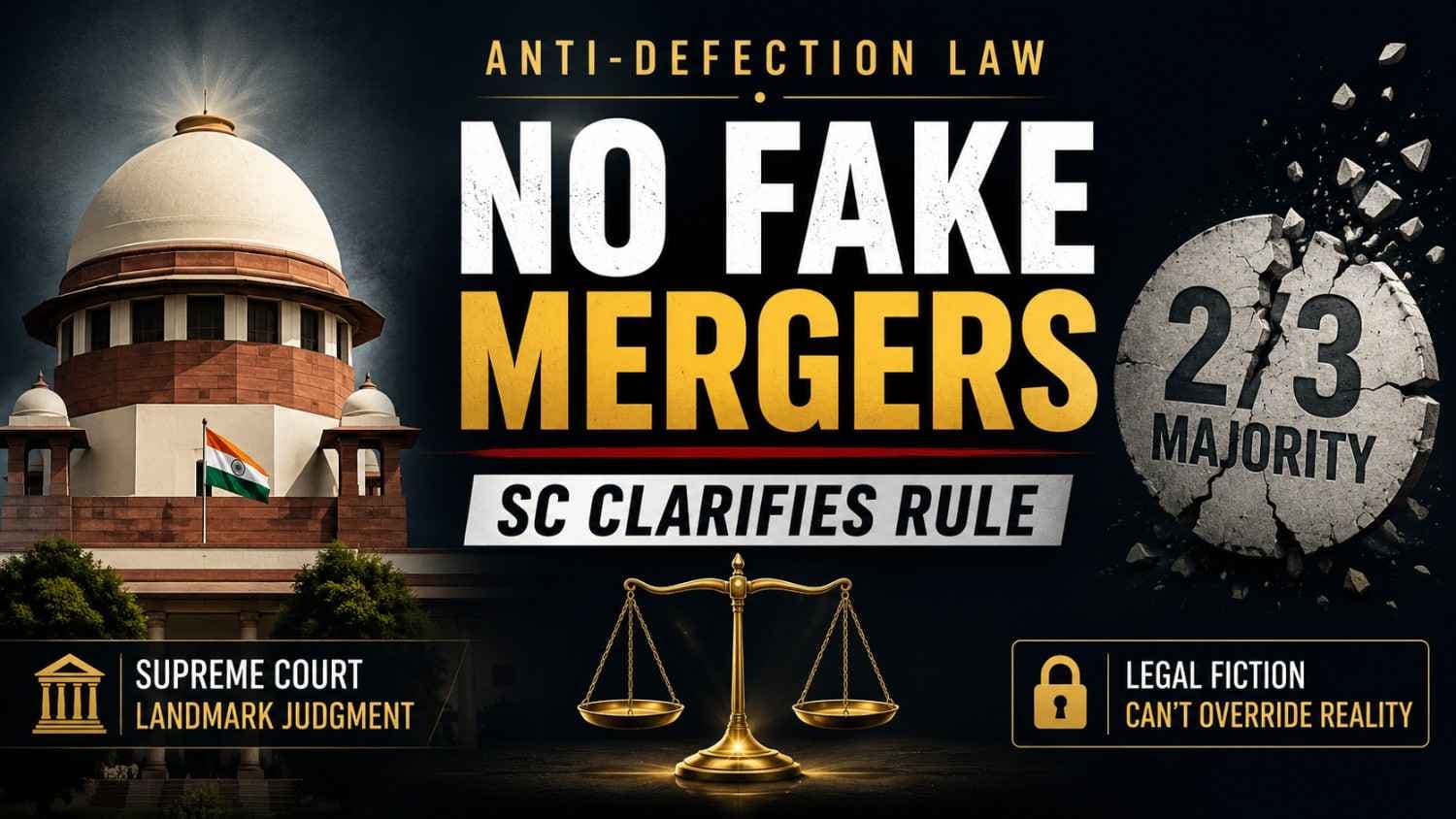
In a landmark clarification of the Tenth Schedule, the Supreme Court has reined in the use of "legal fiction" to justify political maneuvers. The Court recently observed that the "deeming clause"—which treats a split group as a merged entity—must be strictly confined to its intended purpose. This is a significant blow to the practice of manufacturing "mergers" solely through legislative numbers, reaffirming that a merger is not a creature of the assembly floor but an event that must originate within the organizational structure of the political party itself.
The concept of legal fiction is a tool where the law assumes a fact to be true (such as treating a corporation as a "person") to achieve a specific legal result. However, the Court warned that this "pretence" cannot be stretched to override the reality of political defection. By limiting this fiction, the judiciary has ensured that legislators cannot simply use a two-thirds majority to "deem" themselves a new party without a formal merger of the parent organizations, thereby closing a sophisticated loophole used to bypass disqualification.
This ruling reinforces the "Twin Test" for mergers: first, the original political party must decide to merge, and second, at least two-thirds of its legislators must agree. The Court made it clear that the legislative test cannot exist in a vacuum; without the organizational merger, the actions of the legislators remain individual acts of defection. This restoration of the "parent party's" supremacy is a vital step in maintaining the discipline and integrity of the multi-party system in India.
Strategically, the judgment prevents the "cannibalization" of smaller parties by larger ones through mere numerical poaching. It protects the identity of political parties as distinct entities that exist beyond the walls of the House. For a democracy where floor-crossing has often been incentivized by legal technicalities, the Court’s insistence on "purposeful interpretation" acts as a firewall against opportunistic shifts that ignore the mandate of the voters who elected a candidate under a specific party symbol.
Furthermore, the Court addressed the role of the Speaker in these transitions. By limiting the scope of legal fiction, the judiciary has provided a clearer roadmap for Presiding Officers, who are often caught in the crossfire of partisan claims. The ruling suggests that the Speaker's role is not to "create" a merger through legal interpretation but to "verify" a merger that has already occurred in the real world. This reduces the subjective discretion that has historically led to long delays and controversial rulings.
The broader constitutional implication is a shift toward "substantive democracy" over "procedural maneuvering." The Supreme Court is signaling that the Anti-Defection Law was designed to deter, not legitimize, the act of leaving one's party. By stripping away the legal disguises used by defecting factions, the Court is forcing a return to ideological loyalty. It sends a message to all political stakeholders: if you wish to merge, you must do so through the front door of organizational consensus, not the back door of legislative math.
In the final analysis, the SC's reaffirmation of anti-defection limits is a safeguard for the Indian voter. It ensures that when a citizen votes for a party, that vote cannot be traded away under the guise of a "legal fiction." As the political landscape continues to evolve, this judgment stands as a sentinel, protecting the fundamental structure of representative government. To understand this ruling is to realize that in the eyes of the law, the truth of a party's identity is more important than the fiction of its numbers.