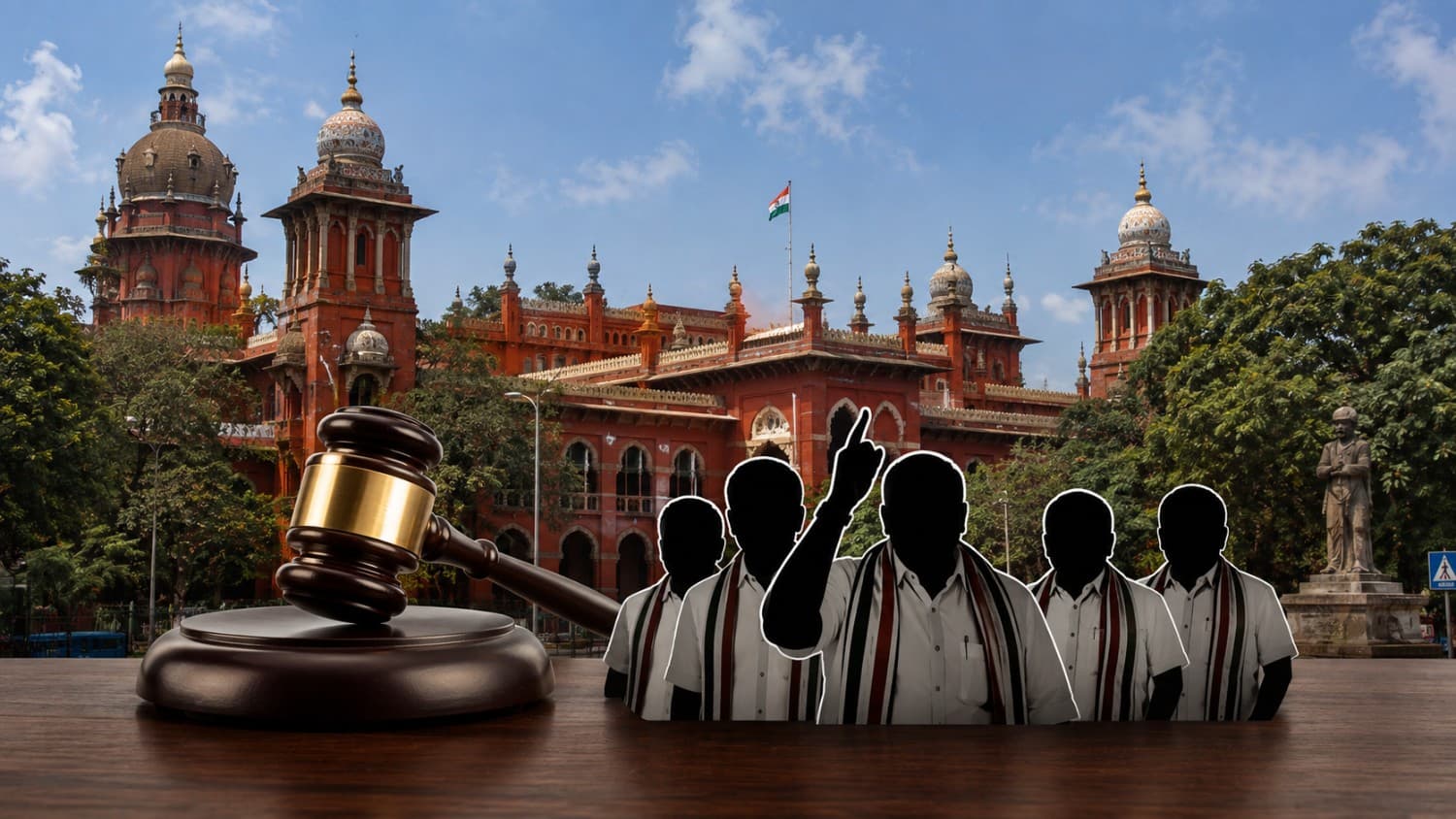
Madras High Court Dismisses Challenge to Speaker's Order
The Madras High Court has dismissed a public interest litigation (PIL) that sought to challenge the Tamil Nadu Speaker's order to cease disqualification proceedings against 21 Members of Legislative Assembly (MLAs) belonging to the All India Anna Dravida Kazhagam (AIADMK) party. These MLAs had voted against their party's directive during a confidence motion in favour of the Tamilaga Vettri Kazhagam (TVK) government, led by Chief Minister Joseph Vijay.
A bench comprising Chief Justice SA Dharmadhikari and Justice G Arul Murugan delivered the dismissal on Tuesday, August 18. The PIL was filed by Advocate PV Selvakumar, who contended that the petition aimed to uphold constitutional governance, enforce constitutional accountability, and safeguard the constitutional framework governing electoral mandates and the disqualification of elected representatives under the Tenth Schedule of the Constitution.
Background to the Disqualification Proceedings
The political context originated from the 2026 State Legislative Assembly Elections, where the TVK party secured 108 votes. As this tally fell short of the 118-seat majority required to form a government, the TVK sought support from other political entities. Following the formation of the government, a confidence motion was conducted in the assembly on May 13, where the TVK garnered 144 votes in its favour.
Prior to the confidence motion, the AIADMK party's General Secretary, through the party whip Agri SS Krishnamurthy, had issued a directive instructing its members to vote against the TVK government. However, on the day of the motion, 25 AIADMK MLAs, including SP Velumani and C Vijayabhaskar, voted in support of the TVK, thereby defying the party whip. Consequently, on May 14, 2026, proceedings were initiated against these MLAs under the Tenth Schedule of the Constitution of India for voting against the party mandate.
Speaker's Decision and Subsequent Resignations
During the period when disqualification proceedings were active, four AIADMK MLAs namely S Jayakumar, Maragatham Kumaravel, P Sathyabama, and Dr Esakki Subbaya, tendered their resignations from the party, which the Speaker subsequently accepted. Following these resignations, Edappadi Palaniswamy, a prominent leader within the AIADMK, submitted a letter to the Speaker requesting the discontinuation of disqualification proceedings against the remaining 21 MLAs. The party had decided to condone the actions of these MLAs. In response to this request and the party's decision, the Speaker accepted the letter and dropped the ongoing proceedings.
Subsequent to the condonation, two additional AIADMK MLAs, C Vijayabhaskar and MR Vijayabhaskar, also resigned from the party. The acceptance of these six MLAs' resignations is currently awaiting judicial consideration. The present PIL specifically challenged the Speaker's decision to drop the disqualification proceedings against the aforementioned 21 MLAs.
Petitioner's and Advocate General's Submissions
Advocate Selvakumar, representing the petitioner, argued that once MLAs vote against the party whip, disqualification proceedings are initiated under Section 2(1)(a) and 2(1)(b) of the Tenth Schedule. He contended that by their conduct, the concerned MLAs had forfeited their primary membership of the party. The petitioner asserted that the political party lacked the authority to pardon or withdraw such disqualification proceedings, and therefore, the Speaker's acceptance of the request, without first determining the party's power to do so, was illegal and ought to be set aside. The petitioner further submitted that disqualification proceedings involve the constitutional integrity of the legislative house and are not merely an internal party dispute. He characterised the Speaker's acceptance of the party's changed stance as a “constitutional farce.”
Conversely, Advocate General Vijay Narayan, representing the state, submitted that the matter pertained to an internal affair between a political party and its members. He argued that since the General Secretary of the party had chosen to pardon the MLAs, they retained their membership, and consequently, no third party possessed the standing to challenge this decision.
High Court's Observations and Dismissal
During the hearing, the Madras High Court raised questions regarding the maintainability of the present petition. The bench observed that the MLAs in question had not resigned from the party and that the AIADMK had condoned their actions within the 15-day period prescribed by law. The court therefore questioned the basis upon which a third party could challenge a decision made by the political party concerning its own members, especially when the party had acted within the legal framework for condonation. Following these observations, the High Court dismissed the public interest litigation. The detailed order copy is currently awaited.