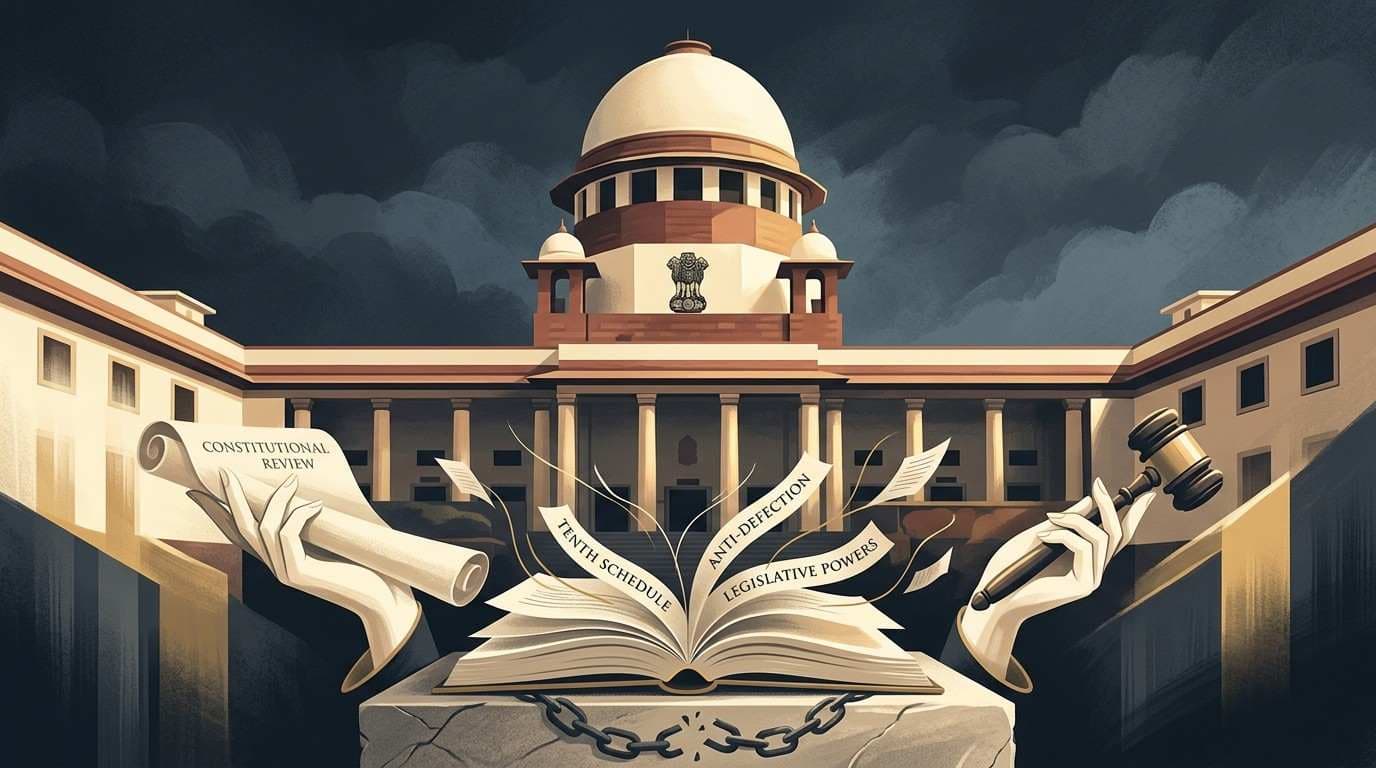
In the Shiv Sena disqualification matter, Justice Joymalya Bagchi of the Supreme Court on August 19, 2026, questioned whether the Court could directly declare Eknath Shinde disqualified as an MLA under the Tenth Schedule if the Maharashtra Speaker’s order refusing to disqualify him is set aside. The bench, comprising Chief Justice Surya Kant, Justice Joymalya Bagchi, and Justice V Mohana, was hearing a petition filed by Sunil Prabhu of the Uddhav Thackeray faction challenging the Speaker’s refusal to disqualify MLAs of the Eknath Shinde faction.
Justice Bagchi posed the query to Senior Advocate Devadatt Kamat, representing the UBT faction alongside Senior Advocate Kapil Sibal, asking whether the Court could 'declare him (Shinde) disqualified today' and 'assume the role of Speaker and hold him disqualified' despite the Speaker not having disqualified Shinde and Shinde having been re-elected in subsequent polls.
The judge drew a parallel to disciplinary proceedings where disproportionate punishment is awarded, stating that while the Court could quash such punishment, it could not impose it directly and must remand the matter to the competent authority. He extended this analogy to the Speaker’s function under the Tenth Schedule, suggesting that the Court’s role may be limited to correcting errors rather than stepping into the Speaker’s shoes.
Justice Bagchi further examined the temporal aspect of legislative majority, observing that while there is no dispute that Shinde had the legislative majority, the key question is whether he remained in the party when he assumed that majority. This reflects the legal test under paragraph 2(1)(a) of the Tenth Schedule, which disqualifies a member who voluntarily gives up membership of their political party.
In response, Kamat argued that if the Speaker’s order suffers from perversity — equating the Speaker to an Election Tribunal — the Court must intervene through judicial review. He cited precedent where tribunals acting perversely are corrected by the Court, and relief can be granted accordingly. Kamat added that if the Speaker’s order is set aside, the findings would directly impact the parallel dispute over the election symbol, which is also pending before the same bench.
He emphasized that the Court has already recognized that the final verdict on disqualification is an ex post facto recognition, and if the Tribunal (here, the Speaker) acts perversely, the Court can correct it in judicial review and grant appropriate relief.
Justice Bagchi acknowledged this submission, agreeing that if the Speaker’s approach disregards the law and the principles laid down in the Subhash Desai case — decided by a Constitution bench — the order could be set aside. However, he reiterated his doubt on whether the Court could then go on to declare Shinde and other MLAs disqualified as a consequential outcome.
Kamat clarified that in past judicial precedents where disqualifications were upheld, the concerned MLAs were indeed declared disqualified by the Court. He maintained that setting aside the Speaker’s flawed order would logically lead to such a declaration if the materials on record support it.
The hearing also included a separate petition filed by Uddhav Thackeray challenging the Election Commission of India’s decision to recognize the Eknath Shinde faction as the legitimate Shiv Sena and allow it the use of the ‘bow and arrow’ symbol. Both matters were listed before the same bench.
The case is registered as Sunil Prabhu v. Eknath Shinde SLP(C) No. 1644-1662/2024, with connected proceedings. The bench indicated that the matter would be updated further as arguments proceed.