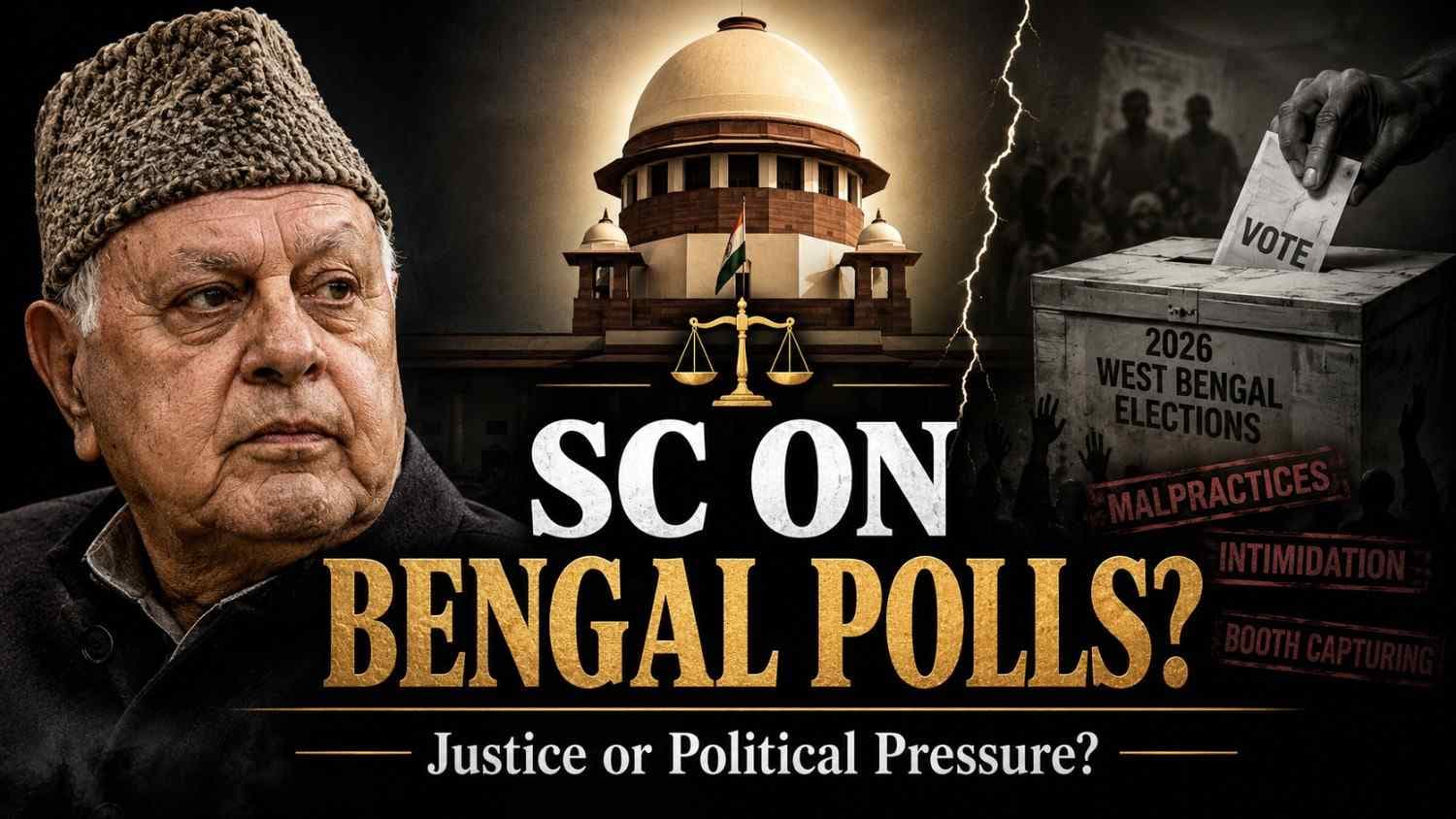
In a striking moment of political cross-pollination, Dr. Farooq Abdullah, the veteran leader of the Jammu & Kashmir National Conference, has turned his gaze toward the eastern frontier of West Bengal. His recent statement expressing "hope" that the Supreme Court will deliver justice regarding alleged malpractices during the 2026 West Bengal elections is more than a casual observation. It represents a significant alignment of regional forces, signaling that the conduct of elections in one state has now become a benchmark for the democratic health of the entire Union.
Abdullah’s appeal to the judiciary highlights a growing trend where regional leaders are increasingly vocal about the "sanctity of the ballot" beyond their own borders. By invoking the Supreme Court, he is framing the alleged irregularities in Bengal not as a local law-and-order issue, but as a constitutional crisis that requires the intervention of the "Sentinel on the Qui Vive." This intervention sought by Abdullah is a testament to the fact that when trust in local administrative machinery falters, the highest court remains the final repository of democratic hope.
The context of this statement is deeply rooted in the contentious atmosphere of the 2026 polls, which were marred by reports of booth capturing, intimidation, and the use of "proxies." For a leader like Abdullah, who has navigated the complex electoral landscape of Kashmir, the nuances of "malpractice" are familiar. His public stance serves to internationalize and nationalize the Bengal narrative, ensuring that the judicial proceedings are conducted under a spotlight of multi-party scrutiny rather than within a localized vacuum.
Strategically, this move fosters a sense of "federal solidarity" among opposition parties. By standing with those who claim to be victims of electoral fraud in Bengal, Abdullah is reinforcing a collective demand for a more robust and independent Election Commission. This discourse aligns with the broader legal challenges currently facing the Supreme Court regarding the appointment and autonomy of Election Commissioners, suggesting that the "malpractices" in Bengal are symptoms of a deeper, systemic vulnerability in the nation's polling architecture.
The mention of "justice" in this context is multifaceted. It refers not only to the punishment of offenders but also to the potential for repolls, the disqualification of candidates, and the establishment of new protocols for central force deployment. Abdullah’s rhetoric suggests that if the Supreme Court fails to act decisively in Bengal, it could set a dangerous precedent for future elections in other sensitive regions, including his own home turf in Jammu & Kashmir. It is a cautionary tale told through the lens of another state's turmoil.
From a constitutional standpoint, the "hope" expressed by Abdullah places an immense moral burden on the judiciary. In a polarized political environment, the Court must navigate between genuine evidence of fraud and the "political theater" that often accompanies election losses. The challenge for the justices will be to distill the truth from the noise, ensuring that the "will of the people" is neither subverted by local strongmen nor dismissed by executive apathy.
As the legal petitions regarding the West Bengal elections climb the judicial ladder, Abdullah’s voice adds a layer of moral urgency to the proceedings. It serves as a reminder that the eyes of the nation—from the mountains of the North to the deltas of the East—are fixed on the Supreme Court. The pursuit of "justice" in this theater is about more than just one election; it is about reinforcing the belief that in the Indian Republic, the power of the citizen’s vote remains superior to the influence of the "machine."
In the final analysis, Farooq Abdullah’s intervention is a masterclass in political cross-regionalism. He has successfully linked the fate of the Bengali voter to the broader survival of Indian federalism. Whether the Supreme Court delivers the "justice" he hopes for remains to be seen, but the dialogue he has sparked ensures that the accountability for electoral conduct will no longer be confined to state boundaries. The ballot box, it seems, is a shared temple, and its desecration anywhere is a concern everywhere.