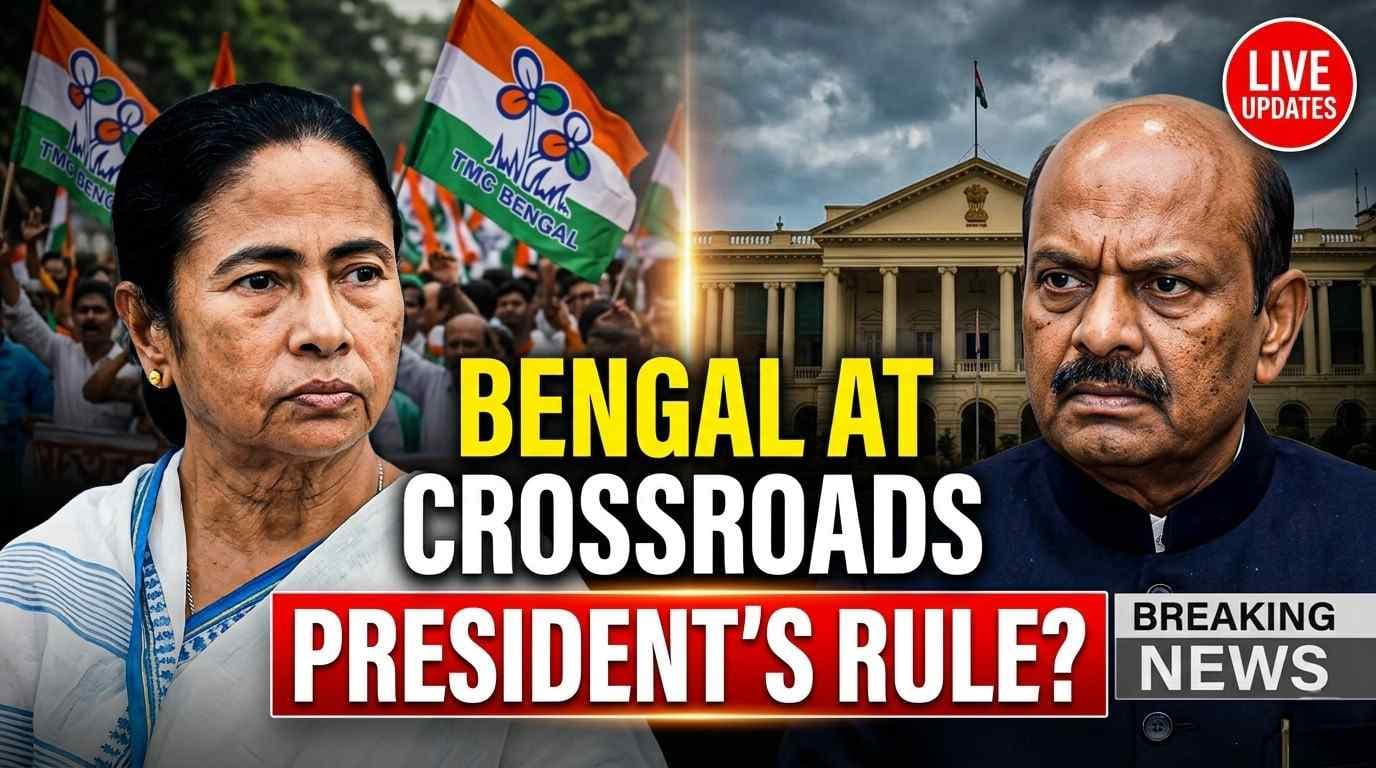
West Bengal is currently witnessing an unprecedented constitutional standoff that has left the state’s political future hanging in the balance. In the wake of a highly polarized election mandate and mounting pressure from the opposition, Chief Minister Mamata Banerjee has reportedly refused to resign, leading to a direct confrontation between the state executive and the Raj Bhavan. This refusal has "left the door open" for a potential breakdown of constitutional machinery, a scenario that could trigger the imposition of President’s Rule.
The crisis stems from a narrow electoral outcome and a series of post-poll disputes regarding the validity of votes in several key constituencies. While the opposition has called for a transition of power based on the latest ECI trends, the incumbent Trinamool Congress (TMC) maintains that the democratic process is still being adjudicated in the courts. The Chief Minister's stance is rooted in the argument that until all legal challenges—specifically those regarding the "missing voters" and roll revisions—are resolved, the current government remains the legitimate representative of the people’s will.
Under Article 356 of the Indian Constitution, the President can assume the functions of the State Government if they receive a report from the Governor stating that the government of the state cannot be carried on in accordance with the provisions of the Constitution. Governor CV Ananda Bose has been in constant communication with the Ministry of Home Affairs, and his recent statements suggest that the current "administrative paralysis" is being monitored with "grave concern."
The legal community is divided on the threshold for such an intervention. In the landmark S.R. Bommai v. Union of India case, the Supreme Court laid down strict guidelines for the use of Article 356, emphasizing that the floor of the Assembly is the only place to test a government’s majority. However, the current crisis is unique because it involves a refusal to demit office during a disputed transition, rather than a simple loss of majority on the floor.
Critics of the potential move argue that invoking President’s Rule would be an "undemocratic shortcut" that bypasses the judicial review of the election results. Conversely, proponents argue that a state cannot function without a clear executive head who commands the confidence of the constitutional process. The situation is further complicated by the ongoing protests across the state, which the Governor’s office has cited as evidence of a "failure of public order."
If President’s Rule is imposed, the State Assembly will either be dissolved or placed under "suspended animation," and the Governor will exercise executive authority on behalf of the President. This would be a drastic step in Bengal’s political history, marking the first time in decades that the state’s autonomy has been superseded by central intervention due to an electoral deadlock.
As the legal teams for both the TMC and the BJP prepare to move the Supreme Court, the state remains in a state of suspended tension. The "crisis door" remains open because the Constitution does not provide a specific timeline for a Chief Minister to resign after a disputed election, leaving a gray area that is now being tested in real-time.
In conclusion, West Bengal is at a crossroads where political tenacity is clashing with constitutional protocol. The coming 48 hours will be decisive in determining whether the state finds a democratic resolution through the Assembly or enters a period of direct rule from New Delhi. For the citizens of Bengal, the hope remains that the rule of law will prevail over political brinkmanship.