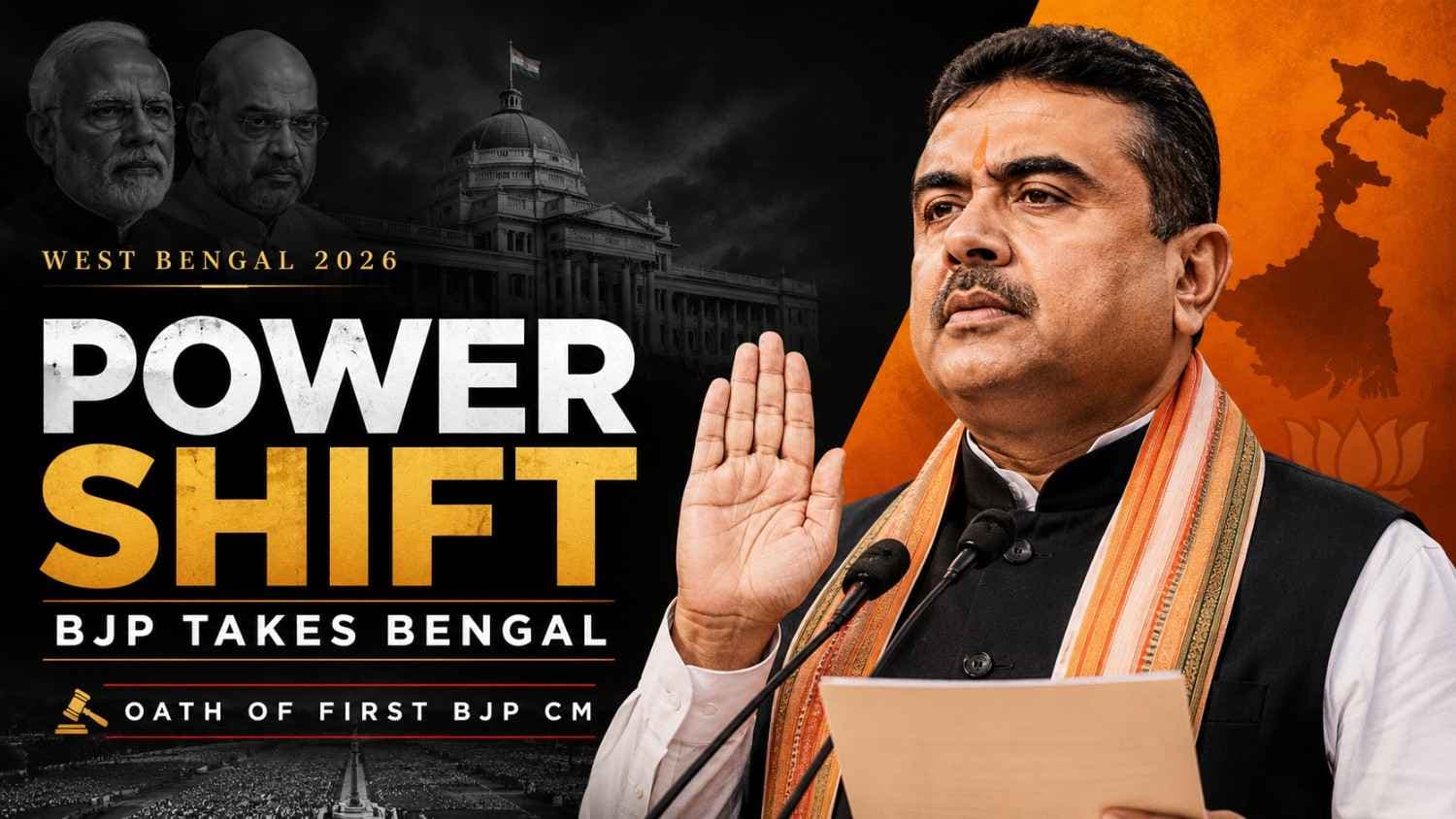
In a watershed moment for Indian politics, Suvendu Adhikari has officially been sworn in as the first Bharatiya Janata Party (BJP) Chief Minister of West Bengal. The high-profile ceremony, held today at the iconic Brigade Parade Ground in Kolkata, was attended by Prime Minister Narendra Modi, Union Home Minister Amit Shah, and several other top NDA leaders. Governor R.N. Ravi administered the oath of office and secrecy, marking the end of the Trinamool Congress’s 15-year tenure and the beginning of a new administrative era in the state.
The transition follows a decisive mandate in the 2026 Assembly elections, where the BJP secured 207 seats in the 294-member house. Adhikari, who was unanimously elected as the leader of the BJP legislature party, has positioned his government as a "double-engine" administration aimed at rebuilding "Sonar Bangla." Alongside the Chief Minister, five cabinet ministers—including Dilip Ghosh, Agnimitra Paul, and Nisith Pramanik—also took their oaths, reflecting a strategic regional and social balance in the new council.
During his inaugural address, Adhikari emphasized that his primary focus would be restoring law and order and fulfilling the "Modi Guarantees" promised during the campaign. He announced the formation of a judicial commission to investigate allegations of corruption and crimes against women from the previous regime. The Chief Minister also vowed to transform West Bengal into a national hub for culture and industry, signaling a proactive approach to economic revitalization.
The swearing-in ceremony was more than a mere formality; it was a demonstration of the BJP's growing influence in eastern India. Prime Minister Modi’s presence underscored the central government’s commitment to the state’s development. The event also included a symbolic tribute to Rabindranath Tagore on his birth anniversary, blending the new political narrative with Bengal’s deep-rooted cultural heritage.
However, the new government assumes power amidst a tense atmosphere. The period following the election results was marred by instances of post-poll violence, including the tragic killing of Adhikari’s personal assistant. Addressing these challenges, the Chief Minister stated that his administration would adopt a zero-tolerance policy toward political violence, ensuring the security of all citizens regardless of their political affiliation.
From a political science perspective, Adhikari’s elevation is significant as he becomes the first Chief Minister in over five decades to hail from the state's rural heartland rather than Kolkata. His deep grassroots connections, particularly in the Medinipur region and his high-profile victory in Bhabanipur, provide him with a unique mandate. This shift suggests a possible change in the state's governance priorities, focusing more heavily on rural development and agrarian reform.
International and national analysts are closely watching how the "Adhikari Model" will interact with the central government’s policies. With the BJP now controlling the state, there is an expectation of smoother coordination on national security issues, particularly regarding border management. Home Minister Amit Shah noted that this victory is crucial for plugging security gaps in the region, hinting at a more robust approach to internal and external security.
Ultimately, Suvendu Adhikari’s oath represents a fundamental realignment of West Bengal's political identity. As the state moves forward under its first BJP-led government, the focus remains on whether the new leadership can translate its massive electoral mandate into tangible governance. The coming months will be a litmus test for the "Sonar Bangla" vision, as the administration begins the complex task of reshaping one of India's most politically vibrant states.