Skip to content

    Why Do Judges Wait While EC Appointments Happen Fast?

    SC News

    1. Home
    2. /SC News

    Why Do Judges Wait While EC Appointments Happen Fast?

    An analytical exploration of the Supreme Court's observations regarding the disparity in appointment speeds between Election Commissioners and High Court Judges

    Hydar Choudhury
    May 8, 2026·4 min read
    Why Do Judges Wait While EC Appointments Happen Fast?

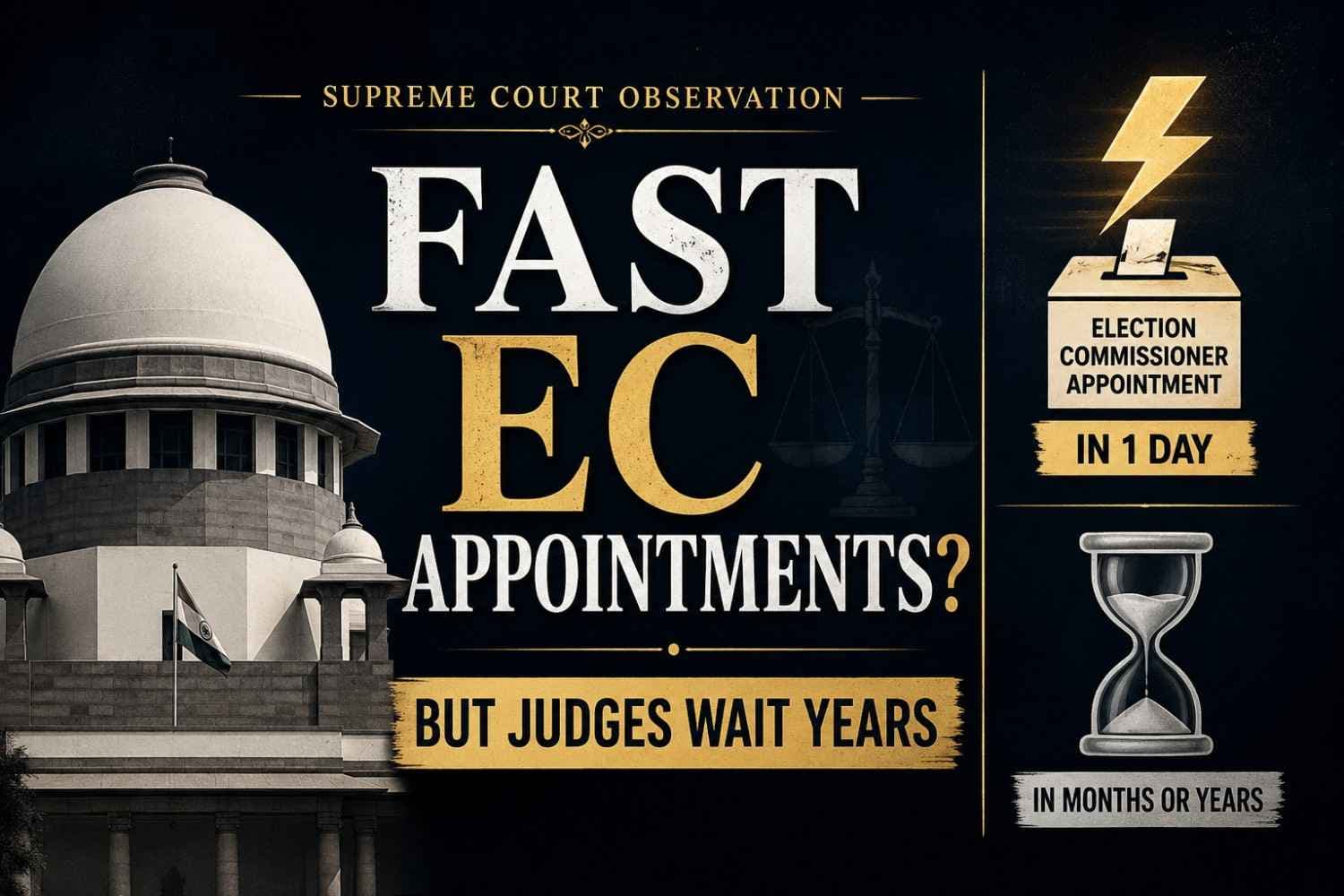
    ​In the quiet, deliberate atmosphere of the Supreme Court, a sharp observation recently cut through the legal arguments, highlighting a profound irony in the functioning of the Indian state. While hearing challenges to the new law governing the appointment of Election Commissioners, the bench—led by Justice Dipankar Datta—remarked with pointed wit that they "wish judges were appointed with the same speed" as the poll panel chiefs. This statement is more than a casual grievance; it is a surgical critique of the executive’s selective efficiency, where political imperatives seem to accelerate administrative machinery that otherwise grinds slowly when it comes to the judiciary.

    ​The Court’s observation stems from the recent appointment of two Election Commissioners, a process that was completed with breathtaking velocity—reportedly within a single day of the selection committee meeting. In contrast, the appointment of High Court and Supreme Court judges often languishes in a bureaucratic labyrinth for months, if not years, after the Collegium has made its recommendations. This disparity suggests a hierarchy of urgency within the corridors of power, where the "referees" of the electoral process are seated at lightning speed, while the "arbiters" of justice are forced to wait at the threshold of executive approval.

    ​Behind this judicial irony lies a deeper struggle for institutional equilibrium. By highlighting the speed of EC appointments, the Court is drawing attention to the "legislative vacuum" that the government successfully filled to its own advantage. For decades, the appointment of the Election Commission was left to the sole discretion of the executive, a "tyranny of the elected" that was only recently challenged by the judiciary. The current friction arises because the new law—passed with similar speed—ensures that the executive retains a decisive 2-1 majority in the selection process, effectively sidelining the Chief Justice of India.

    ​From a constitutional perspective, the "speed" mentioned by the Court is a double-edged sword. While efficiency is generally a virtue, in the context of independent institutions, extreme haste can be perceived as a lack of due diligence or a move to preempt judicial scrutiny. The Supreme Court is effectively asking: if the state can mobilize its resources to fill a vacancy in the Election Commission in twenty-four hours, why do judicial files gather dust? This question touches upon the "Memorandum of Procedure," the contested guidebook for judge appointments that remains a focal point of tension between the Law Ministry and the Supreme Court.

    Advertisement

    ​This critique also illuminates the "human cost" of delayed judicial appointments. As of 2026, Indian courts continue to grapple with a staggering backlog of cases, a crisis exacerbated by the hundreds of vacancies across various High Courts. When the executive "sits on files," it indirectly impacts the right to a speedy trial and the overall health of the rule of law. The Court’s remark serves as a reminder that the "spirit of cooperation" between the pillars of democracy must be consistent; one cannot be a marathon runner for administrative posts and a spectator for judicial ones.

    ​Strategically, the Supreme Court is using the theater of the courtroom to hold a mirror to the government's priorities. By contrasting the "hyper-speed" of the 2023 EC Act's implementation with the "lethargy" of the judicial pipeline, the bench is asserting its role as the guardian of institutional parity. It suggests that the health of a democracy is measured not just by who is appointed, but by the transparency and fairness of the timeline itself. In a system of checks and balances, the timing of an appointment can be just as political as the appointment itself.

    ​As the legal battle over the Election Commission's independence continues, the "speed" remark will remain a defining quote of this era. It encapsulates the frustration of a judiciary that feels its own growth is being throttled by the same executive that moves mountains to secure its influence over the electoral machinery. To follow this narrative is to understand the soul of Indian federalism—a constant, often invisible tug-of-war over who gets to sit in the seats of power, and how quickly they are allowed to get there.

    ​In the final analysis, the Supreme Court's wish for "speedy appointments" is a plea for institutional respect. A democracy thrives when its judges are as empowered as its commissioners, and when the process of selection is governed by merit and constitutionality rather than political convenience. The ball is now in the executive's court to prove that its efficiency is not a selective tool, but a universal standard applied to every organ of the Republic. Until then, the gap between the "one-day appointment" and the "one-year wait" will remain a chasm that the law must eventually bridge.

    Explore related legal coverage

    Continue with reporting and analysis connected to this article.

    Browse SC News

    Related legal topics

    • Complaint Against Public Servant Must Follow Mandatory Pre-conditions Under Section 175 BNSS: Supreme Court

      Justice Dipankar Datta

    • "Writ Court is Not a Panacea": SC Dismisses Savukku Shankar’s Plea to Unseal Office

      Justice Dipankar Datta

    • Aland Dargah Dispute: Why Supreme Court Refused Article 32 Relief

      Justice Dipankar Datta

    • Discharged Accused on Better Footing than Acquitted: Supreme Court

      Justice Dipankar Datta

    • SC Declines to Extend Pawan Khera’s Protection in Assam FIR

      Justice Dipankar Datta

    • Tyranny of the Elected: SC Critiques Delayed CEC-EC Appointment Law

      Justice Dipankar Datta

    Advertisement

    Hydar Choudhury

    See more from Hydar →
    Jurisight logoJurisight logo

    Simplifying legal knowledge for professionals and citizens. Your daily source for Supreme Court, High Court, and Business Law updates.

    Platform

    HomeAll ArticlesTop NewsSC UpdatesHC Updates

    Categories

    Business LawConstitutionalCriminal LawCivil LawKnow Your Law

    Weekly Digest

    Join 15,000+ others and get the week's most important legal updates.

    © 2026 Jurisight. All rights reserved.
    Privacy PolicyCookie PolicyCookie ConsentLegal Disclaimer