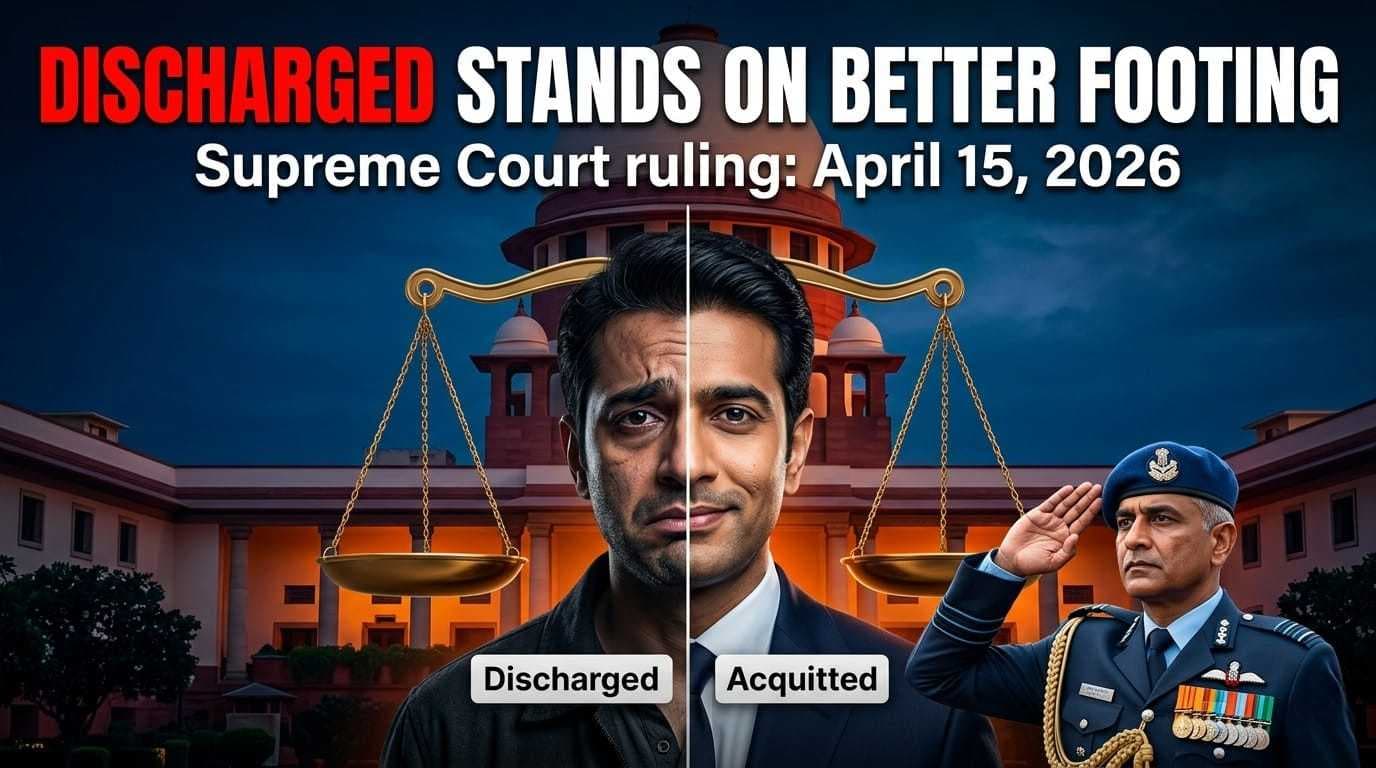
The Supreme Court of India has observed that an individual who is discharged from a criminal case stands on a "better footing" than one who is acquitted after a full-fledged trial. In a judgment delivered on April 15, 2026, a Bench of Justices Dipankar Datta and K.V. Viswanathan clarified that while both outcomes result in freedom, a discharge signifies that the prosecution lacked even the "prima facie" evidence required to frame charges and proceed to trial.
The Court noted that discharge is a pre-trial termination of proceedings, effectively reinforcing the position that there was no material against the accused to justify a trial in the first place. Conversely, an acquittal occurs after a trial where the prosecution fails to prove guilt beyond a reasonable doubt. The Bench emphasized that it would be "fallacious" to place a discharged person in a less advantageous position than an acquitted person, especially regarding post-trial benefits or administrative actions.
The ruling came in the context of a case involving an ex-Air Force personnel who was dismissed from service through a disciplinary inquiry after being discharged by a criminal court. The Supreme Court termed the initiation of such administrative proceedings "bad in law" and "non-est." The Court held that once the authorities elect to have an offense tried by a criminal court, they cannot "fall back" on disciplinary action once the accused is discharged.
To restore the veteran’s honor, the Supreme Court directed the Air Force to organize a formal farewell for the appellant, as is done for any other personnel signing off in the normal manner. The judgment stressed that an accused should not have to "carry the label on his forehead" that he was a criminal suspect once the court has found no grounds to even try him.
This judgment provides a significant shield for government employees and defense personnel against "double jeopardy" in the form of departmental inquiries following a judicial discharge. By equating the benefits of discharge with those of acquittal, the Supreme Court has ensured that the "better footing" of a pre-trial exit is legally protected and recognized across administrative and service law.