Skip to content

    Analysis of Supreme Court’s Evolving Approach to Search and Seizure

    SC News

    1. Home
    2. /SC News

    Analysis of Supreme Court’s Evolving Approach to Search and Seizure

    A critical look at how the Supreme Court's recent judgments on PMLA and UAPA are reshaping the balance between state power and individual liberty.

    Hydar Choudhury
    Apr 16, 2026·3 min read
    Analysis of Supreme Court’s Evolving Approach to Search and Seizure

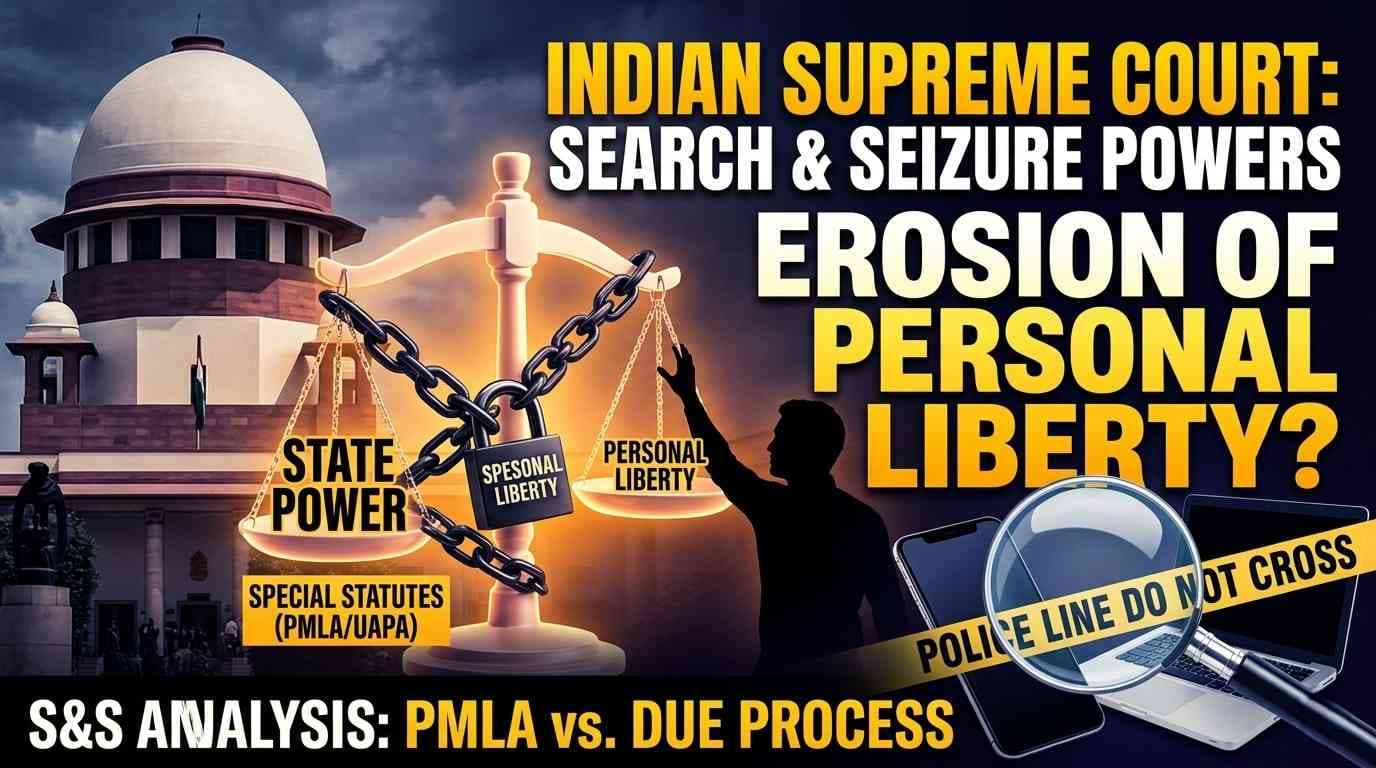
    The Supreme Court of India’s recent approach to the Search and Seizure (S&S) powers under various special statutes has sparked a significant debate regarding the erosion of personal liberty in favor of investigative efficiency. A critical analysis of the Court's recent jurisprudence reveals a shifting trend where the procedural safeguards traditionally associated with the "due process of law" are increasingly being interpreted through a lens of national security and economic integrity, often at the cost of the rights of the accused.

    ​At the heart of this critique is the Court's handling of the Prevention of Money Laundering Act (PMLA) and the Unlawful Activities (Prevention) Act (UAPA). Legal scholars argue that by upholding stringent conditions for bail and expansive powers of arrest without the immediate provision of a formal "grounds of arrest" document, the judiciary has moved away from the "Liberty is the Rule" doctrine. This "Sir" exercise—referring to the Scrutiny, Interpretation, and Review of such powers—suggests that the Court is prioritizing the state's interest in investigating complex crimes over the individual's right against self-incrimination.

    ​One of the most contentious points of analysis is the "Twin Conditions" for bail. Historically, the Supreme Court had struck down such conditions as unconstitutional, only for them to be reintroduced through legislative amendments and subsequently upheld by a larger Bench. Critics argue that this creates a "presumption of guilt" at the pre-trial stage, effectively turning the process into the punishment itself. The analysis suggests that the Court has become increasingly hesitant to interfere with the "subjective satisfaction" of investigating agencies during the initial stages of a search or seizure.

    ​Furthermore, the "Search and Seizure" protocols have come under fire for lacking digital privacy protections. In an era where a person’s entire life is stored on a mobile phone or laptop, the Court’s failure to establish a clear "digital search protocol" allows agencies to conduct "fishing expeditions." The critical analysis points out that without a mandate for "hashed" copies or limited access to relevant files, the current judicial approach allows for an unprecedented invasion of privacy that was never contemplated when the original criminal codes were drafted.

    Advertisement

    ​The analysis also highlights a "doctrinal inconsistency" in how the Court treats different classes of accused. While high-profile corporate cases often receive detailed hearings on procedural lapses, the same standards are not always applied to political activists or marginalized individuals. This "bifurcated jurisprudence" raises questions about the uniformity of the law. The Court is urged to return to the foundational principles of the Maneka Gandhi case, ensuring that every procedure established by law is "just, fair, and reasonable."

    ​Looking forward, the analysis calls for a more robust "Judicial Review" of the materials used to justify a search. Currently, courts often rely on "sealed covers" to deny bail or uphold a seizure, a practice that the Supreme Court itself has criticized in other contexts. Legal experts argue that for the "Sir" exercise to be meaningful, the judiciary must demand higher evidentiary standards before allowing the state to freeze assets or deprive individuals of their freedom for indefinite periods.

    ​In conclusion, while the Supreme Court remains the "sentinel on the qui vive," its recent approach to investigative powers suggests a need for recalibration. The critical analysis serves as a reminder that in the pursuit of curbing money laundering or terrorism, the "basic structure" of individual rights must not be sacrificed. The evolving legal landscape requires a clearer set of guidelines that balance the efficiency of the "search" with the sanctity of the "individual."

    Explore related legal coverage

    Continue with reporting and analysis connected to this article.

    Browse SC News

    More from this court

    • "Arrest and Remand Illegal If Written Grounds of Arrest Not Communicated at Least Two Hours Before Magistrate Appearance: SC"

      Supreme Court of India

    • Adani Enterprises Rs 126 Crore Arbitral Award Upheld By SC

      Supreme Court of India

    • Article 226(3): High Courts Must Decide Stay Pleas In 2 Weeks

      Supreme Court of India

    • Motor Accident Claims: SC Halts 6-Month Limitation Rule

      Supreme Court of India

    Related legal topics

    • Quasi-Judicial Bodies Cannot Review Orders Without Law: SC

      Judicial Review

    • Delhi Riots 2020 Bail Applications: Supreme Court Slams Delhi Police for Delay

      UAPA

    Advertisement

    Hydar Choudhury

    See more from Hydar →
    Jurisight logoJurisight logo

    Simplifying legal knowledge for professionals and citizens. Your daily source for Supreme Court, High Court, and Business Law updates.

    Platform

    HomeAll ArticlesTop NewsSC UpdatesHC Updates

    Categories

    Business LawConstitutionalCriminal LawCivil LawKnow Your Law

    Weekly Digest

    Join 15,000+ others and get the week's most important legal updates.

    © 2026 Jurisight. All rights reserved.
    Privacy PolicyCookie PolicyCookie ConsentLegal Disclaimer