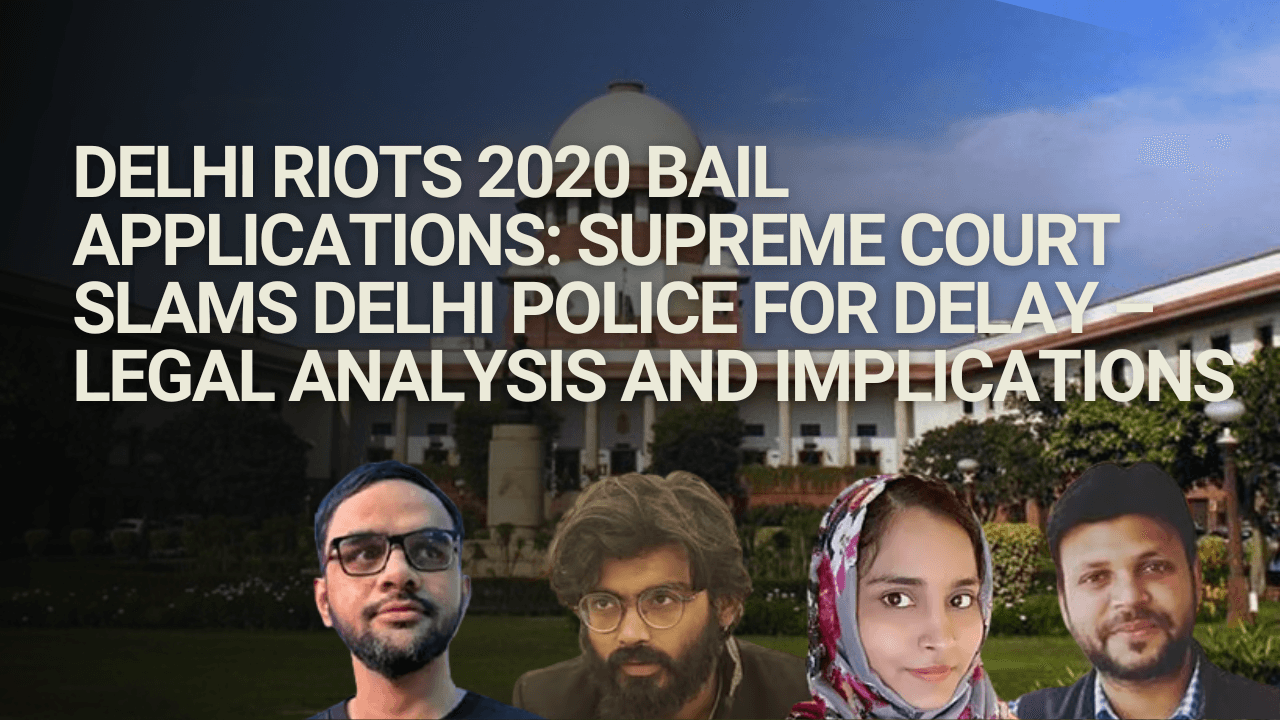
The Supreme Court of India has strongly criticized the Delhi Police for its failure to respond promptly to bail applications filed by activists Umar Khalid and Sharjeel Imam in the Delhi riots conspiracy case. This judicial reprimand highlights serious concerns about procedural delays, the rights of undertrials, and the application of stringent laws like the Unlawful Activities (Prevention) Act (UAPA). This article provides a comprehensive legal analysis of the Supreme Court's observations, the background of the case, and the broader implications for India's criminal justice system.
Background: The Delhi Riots 2020 and UAPA Charges
In February 2020, communal violence erupted in northeast Delhi, resulting in the deaths of 53 people and injuries to hundreds more. The riots occurred during protests against the Citizenship Amendment Act (CAA). Following the violence, Delhi Police filed multiple FIRs and arrested several individuals, including student activists and scholars, alleging a larger conspiracy to incite the riots.
Among those arrested were Umar Khalid, a former Jawaharlal Nehru University (JNU) student, and Sharjeel Imam, a research scholar. Both were charged under the UAPA, a stringent anti-terror law that makes securing bail extremely difficult. Under Section 43D(5) of UAPA, bail can be granted only if the court is satisfied that there are reasonable grounds to believe that the accused is not guilty and is not likely to commit any offense while on bail. This provision creates a presumption of guilt, reversing the normal burden of proof and making pre-trial detention the norm rather than the exception.
Supreme Court's Criticism of Delhi Police
The Supreme Court's reprimand came during hearings on bail applications filed by Umar Khalid and Sharjeel Imam. The Court expressed strong displeasure over the Delhi Police's failure to file timely responses to these bail pleas, despite repeated opportunities and directions from the Court. The delay in filing counter-affidavits and status reports has significantly prolonged the bail hearing process, keeping the accused in prolonged pre-trial detention.
The Court observed that such delays undermine the fundamental right to a speedy trial and access to justice. Justice emphasized that even in cases involving serious charges under UAPA, the prosecution cannot be allowed to indefinitely delay proceedings by failing to file necessary documents. The Supreme Court made it clear that procedural delays by investigating agencies would not be tolerated and that the right to seek bail is a fundamental aspect of personal liberty guaranteed under Article 21 of the Constitution.
Conclusion
The Supreme Court's strong criticism of Delhi Police for delays in responding to bail applications in the Delhi riots conspiracy case highlights critical issues in India's criminal justice system. The prolonged pre-trial detention of Umar Khalid, Sharjeel Imam, and others under UAPA raises serious concerns about the balance between security and liberty. As this case progresses, it will serve as an important test of India's commitment to constitutional values of justice, liberty, and the rule of law. The legal community and civil society must remain vigilant to ensure that procedural delays do not become tools for denying fundamental rights and that the presumption of innocence remains the cornerstone of criminal justice.