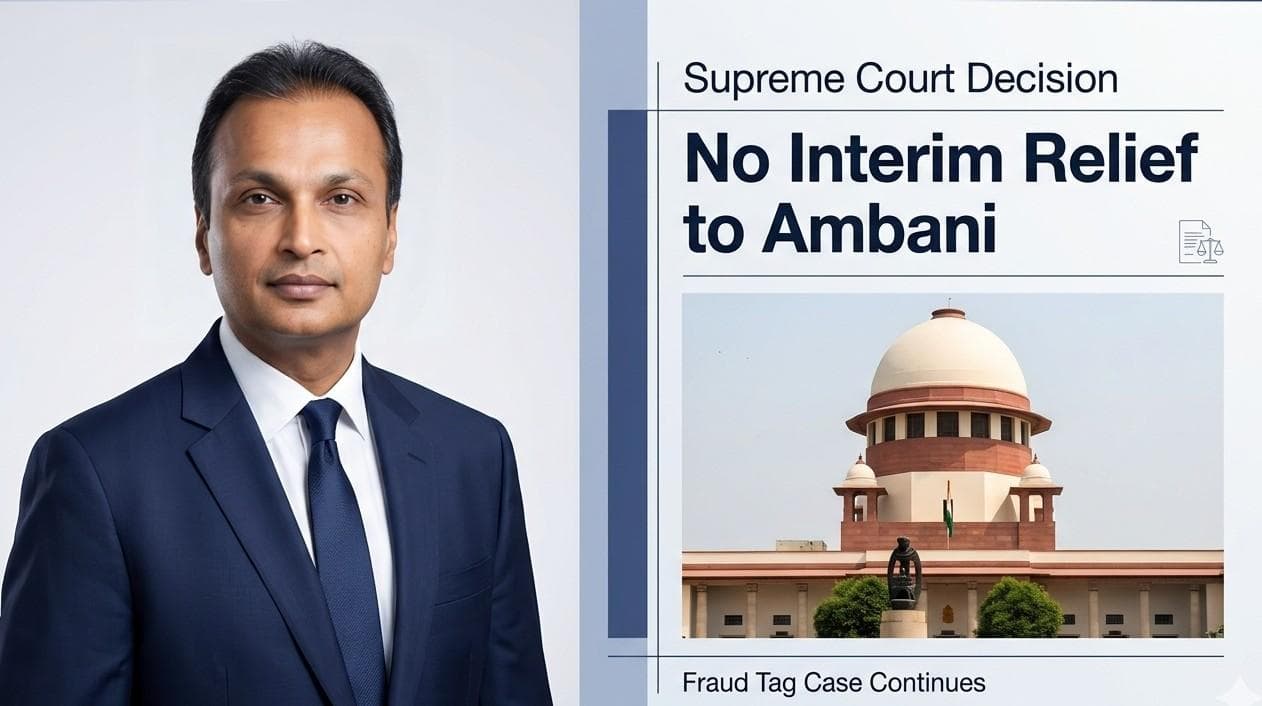
The Supreme Court of India has refused to grant interim relief to industrialist Anil Ambani in a case challenging the classification of his accounts as "fraud" by several major banks. A Bench comprising Chief Justice Surya Kant and Justice K.V. Viswanathan declined to stay the proceedings initiated by lenders under the Reserve Bank of India’s (RBI) master circular on fraud classification. The Court observed that while the petitioner’s concerns regarding natural justice are noted, the judicial process cannot be used to stall the recovery of massive public funds.
The legal battle stems from the RBI's 2016 Master Directions, which allow banks to unilaterally classify accounts as "fraud" if they suspect criminal malfeasance or diversion of funds. Ambani had challenged the process, arguing that being labeled a "fraudster" without a prior hearing or a detailed explanation of the evidence violates the principles of natural justice and causes irreparable damage to his professional reputation. His counsel emphasized that such a classification effectively "blacklists" an individual from the financial system for life.
This development follows a landmark 2023 Supreme Court judgment in the State Bank of India vs. Rajesh Agarwal case, where the Court had ruled that banks must provide a "reasoned order" and an opportunity for the borrower to be heard before declaring an account as fraud. Ambani’s legal team argued that the banks in his case had failed to adhere to this mandatory "pre-decisional hearing," making the classification legally untenable and biased.
The banks, however, countered that the fraud classification is a necessary administrative step to protect the banking sector from wilful defaulters and to alert investigative agencies like the CBI and the ED. They argued that the sheer scale of the defaults associated with the Reliance Group companies necessitated swift action to prevent further asset stripping. The Court noted that the legislative intent behind the RBI circular was to ensure financial discipline and that judicial intervention must be balanced against the risk of systemic financial instability.
The Bench’s refusal to stay the proceedings means that investigative agencies can continue their probe into the alleged diversion of funds from various Reliance Group entities. While the Court has agreed to examine the broader constitutional questions regarding the "Right to be Heard" in financial investigations, it clarified that the ongoing recovery actions and criminal proceedings will not be halted in the interim. The matter has been scheduled for a final hearing in late May 2026.
Legal experts view this as a significant signal that the judiciary is increasingly reluctant to provide protective umbrellas to high-profile borrowers in cases involving large-scale non-performing assets (NPAs). The ruling reinforces the authority of the RBI and commercial banks to act decisively against suspected financial irregularities. For Anil Ambani, the lack of interim relief increases the legal pressure as he navigates multiple insolvency proceedings and investigations simultaneously.
The outcome of this case is expected to set a definitive precedent for how the "Right to be Heard" is applied in high-stakes corporate defaults. It will determine whether the administrative convenience of banks outweighs the individual's right to defend their reputation at the initial stage of a fraud declaration. Until the next hearing, the "fraud" tag remains an active obstacle for the industrialist’s attempts to restructure his remaining business interests.