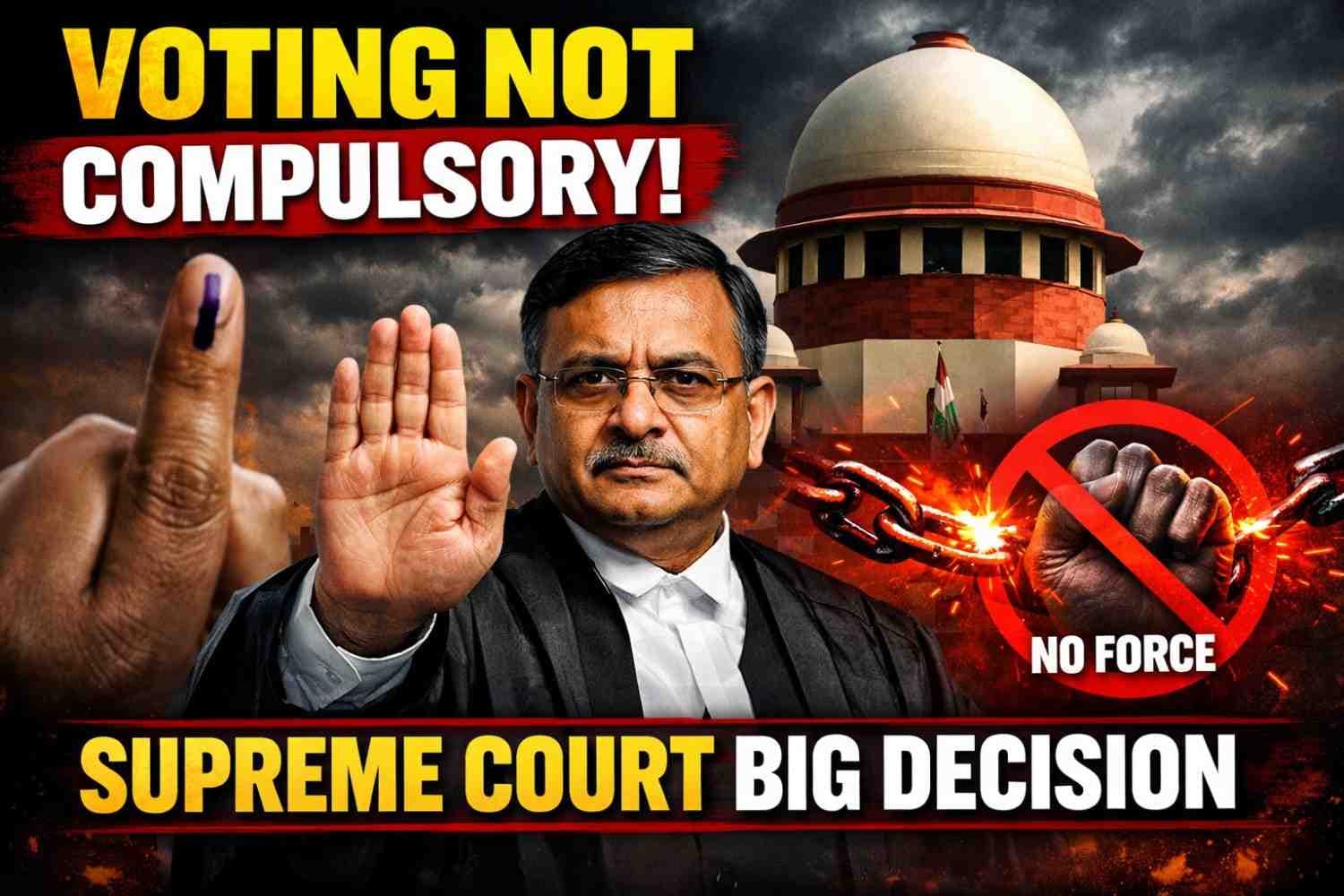
The Supreme Court of India has dismissed a Public Interest Litigation (PIL) that sought to make voting mandatory and requested penal action against citizens who fail to exercise their franchise. A Bench led by Chief Justice Surya Kant and Justice K.V. Viswanathan observed that the right to vote, while a critical civic duty, cannot be transformed into a legal compulsion. The Court held that "coercion has no place in a democracy," emphasizing that the decision to participate in an election is a matter of individual conscience and freedom.
The petitioner had argued that low voter turnout weakens the democratic fabric and suggested that non-voters should face consequences, such as the suspension of certain government subsidies or a small financial penalty. They contended that since the state spends thousands of crores on conducting elections, it is the duty of every citizen to ensure that the process is representative. However, the Bench remarked that such measures would be counterproductive and could unfairly penalize the marginalized sections of society who might face genuine hurdles in reaching polling stations.
The Court further clarified that the Representation of the People Act and the Constitution of India treat the "Right to Vote" as a statutory right that includes the right to refrain from voting. The Bench pointed out that the introduction of the NOTA (None of the Above) option already provides a mechanism for those who are dissatisfied with all candidates, but even choosing NOTA is a voluntary act. "The beauty of democracy lies in the freedom of choice, including the choice to stay away," the Bench noted during the hearing.
Legal experts have hailed the decision, noting that mandatory voting could lead to "disenchantment and resentment" rather than genuine political engagement. The Court suggested that instead of punitive measures, the government and the Election Commission should focus on awareness campaigns and improving accessibility to increase turnout. The Bench highlighted that many citizens, such as migrant laborers and the elderly, often face systemic barriers that penalization would only exacerbate without solving the underlying issues of voter apathy.
By dismissing the plea, the Supreme Court has reaffirmed the principle that civic participation must be fostered through education and trust rather than the fear of the law. This ruling ensures that the "sanctity of the ballot" remains rooted in the willing participation of the electorate. The judgment serves as a definitive closure to the recurring legal debate over compulsory voting in India, maintaining that the state's role is to facilitate the vote, not to demand it under the threat of punishment.