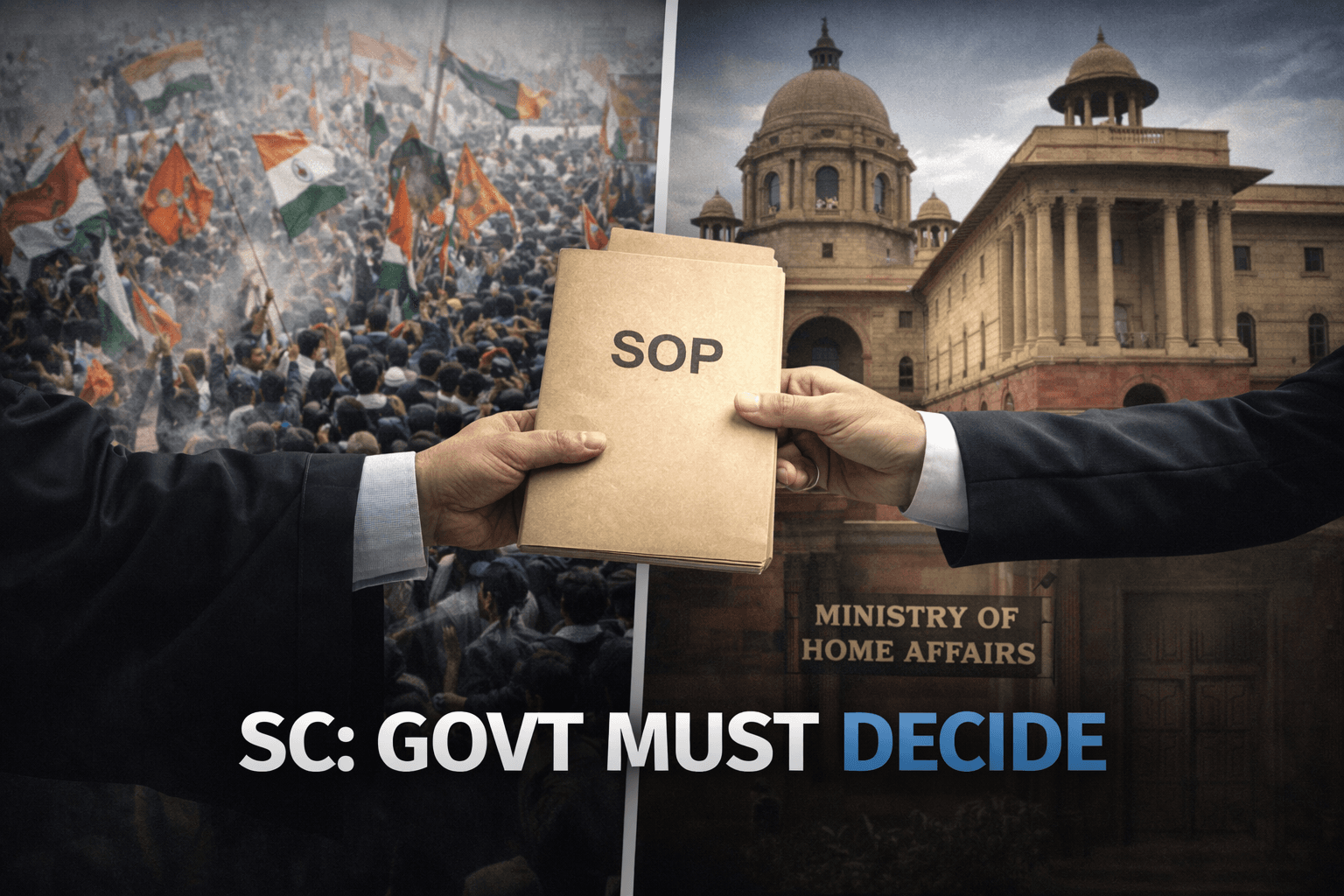
New Delhi: In a pragmatic move acknowledging the complexities of governance, the Supreme Court on Thursday declined to issue a pan-India Standard Operating Procedure (SOP) for managing crowds at political and religious rallies. The Court observed that law enforcement and crowd management are domain-specific issues better handled by the executive branch.
The Bench, led by Chief Justice of India Surya Kant along with Justices Joymalya Bagchi and Vipul Pancholi, disposed of a Public Interest Litigation (PIL) filed by former Rajya Sabha MP Tumbalam Gooty Venkatesh. The petitioner sought mandatory national guidelines to prevent stampedes, citing recent tragedies like the one during an RCB victory rally in Bengaluru and a political rally in Karur.
During the hearing, the Chief Justice expressed skepticism about the feasibility of a "one-size-fits-all" judicial order. He questioned how a court could practically enforce limits on crowd numbers when the reality on the ground is often unpredictable.
"Suppose the rally is to take place in Chennai, we issue direction that ground size can accommodate 10,000 people... If 50,000 people come, what to do? Can you really curtail the right of persons to participate and prevent them? These are all the issues."
The Court emphasized that issuing unmanageable directions would be counterproductive. It noted that the responsibility to maintain law and order lies with the Union and State governments, who possess the necessary domain expertise.
While declining to interfere directly, the Supreme Court did not dismiss the concerns raised. Instead, it directed the petitioner to pursue the representation already submitted to the Ministry of Home Affairs (MHA). The Court also granted liberty to the petitioner to approach the Election Commission of India (ECI) for specific guidelines regarding political roadshows and election rallies.
"We leave it to the competent authorities to consider the petitioner's suggestions and take an appropriate decision, if they deem it appropriate."
This order reflects the Supreme Court's restraint in matters of executive policy. While stampedes are a recurring tragedy in India, the Court recognized that a judicial decree cannot replace administrative planning. By nudging the issue back to the MHA and ECI, the Court has placed the ball in the government's court to develop a specialized "National Crowd Management Code" that can account for local nuances—something a courtroom judgment cannot achieve.