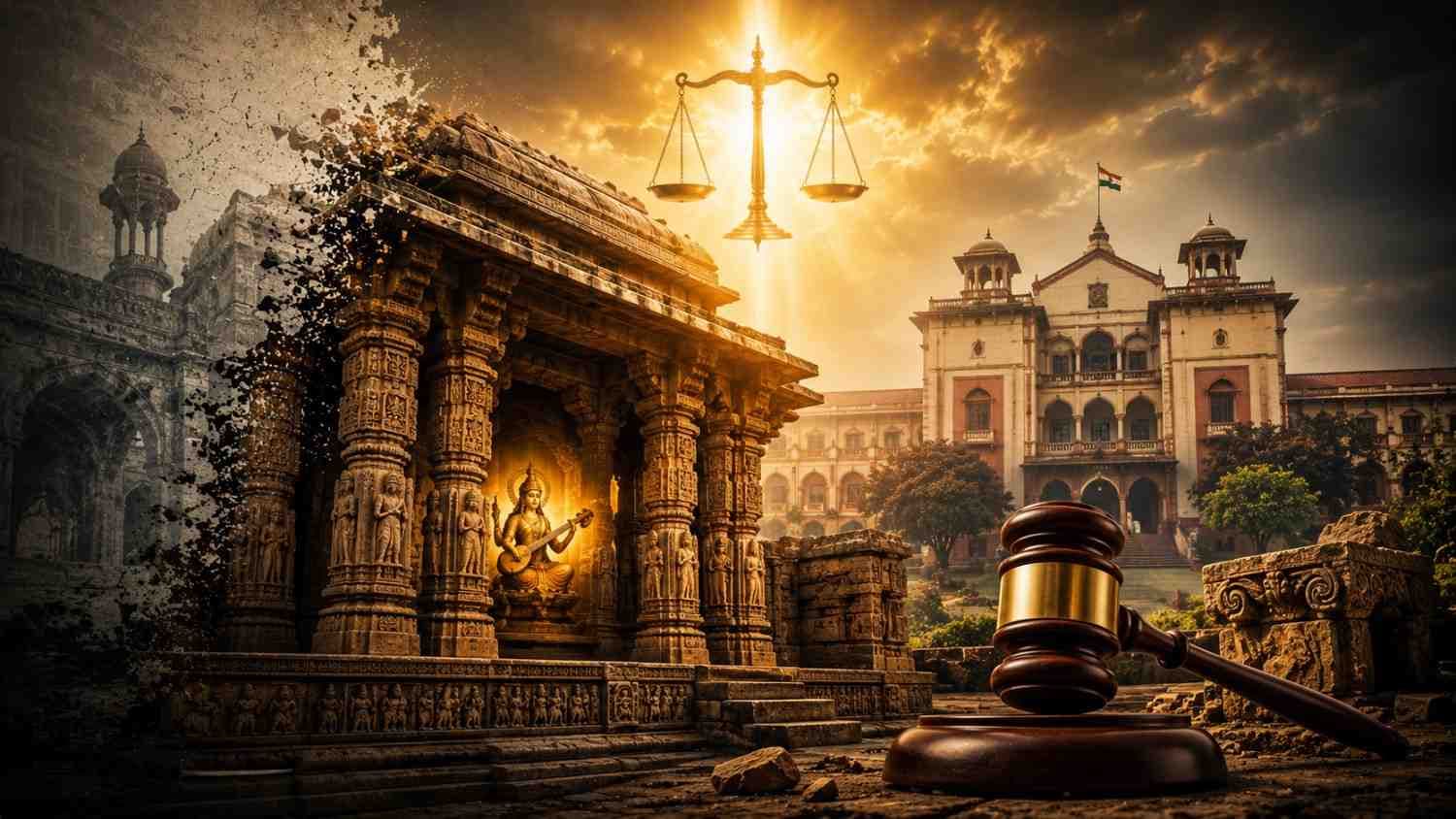
The landmark judgment delivered by the Indore Bench of the Madhya Pradesh High Court on May 15, 2026, marks a pivotal moment in the intersection of property law, archaeological evidence, and constitutional rights. In a highly anticipated ruling, a division bench comprising Justices Vijay Kumar Shukla and Alok Awasthi formally declared the disputed Bhojshala-Kamal Maula Mosque complex in the Dhar district to be a temple dedicated to Goddess Saraswati. This decision effectively reshapes the administrative and religious framework that has governed the protected monument for over two decades.
At the core of the adjudication was a direct challenge to an April 7, 2003, notification issued by the Archaeological Survey of India (ASI). That arrangement had established a shared schedule, permitting Hindus to worship on Tuesdays and Muslims to offer Friday prayers. The High Court has now completely quashed that multi-faith arrangement, ruling that the 2003 order unlawfully restricted the fundamental religious rights of the Hindu community. The bench explicitly declared that the underlying religious character of the entire structure is that of a temple, functioning historically as a prominent center of Sanskrit learning established by King Bhoj in 1034 A.D.
To arrive at this conclusion, the court relied heavily on empirical archaeological findings and historical continuity. A comprehensive multidisciplinary survey executed by the ASI revealed that the existing colonnades and basalt platforms were constructed using structural remnants—such as decorated pillars, pilasters, and defaced images of deities—looted from pre-existing temple structures. Applying the evidentiary standards and judicial precedents set forth by the Supreme Court of India in the Ayodhya verdict, the High Court determined that the historical continuity of Hindu worship at the site had never been legally or factually extinguished, thereby establishing an uninterrupted constitutional entitlement.
From a constitutional standpoint, the judgment carefully balances the enforcement of Articles 25 and 26. While the court asserted an absolute state obligation under the ASI Act to preserve the sanctity, purity, and pristine character of ancient monuments and spiritual deities, it also addressed the equities of the Muslim party. To achieve complete justice, the bench directed the State government to favorably consider any application submitted by the Muslim community for the allotment of an alternative, suitable piece of land within the Dhar district to construct a new mosque.
The operational administration of the site has now been placed under the strict supervision of the Central Government and the ASI. Moving forward, the ASI maintains full supervisory control over the physical preservation, conservation, and regulation of religious practices within the complex. Furthermore, regarding the historic idol of Goddess Saraswati (Vagdevi) which was removed from the complex during the colonial era and is currently housed in a London museum, the High Court directed the Government of India to treat the petitioners' plea for its repatriation as a formal representation for diplomatic action.
This judgment significantly impacts the domestic landscape of disputed religious sites across India. By prioritizing scientific archaeological excavation and structural history over long-standing administrative compromises, the judiciary has set a clear procedural standard. The ruling underscores that statutory protections for ancient monuments must align precisely with their foundational, historical identity rather than contemporary political or social arrangements.