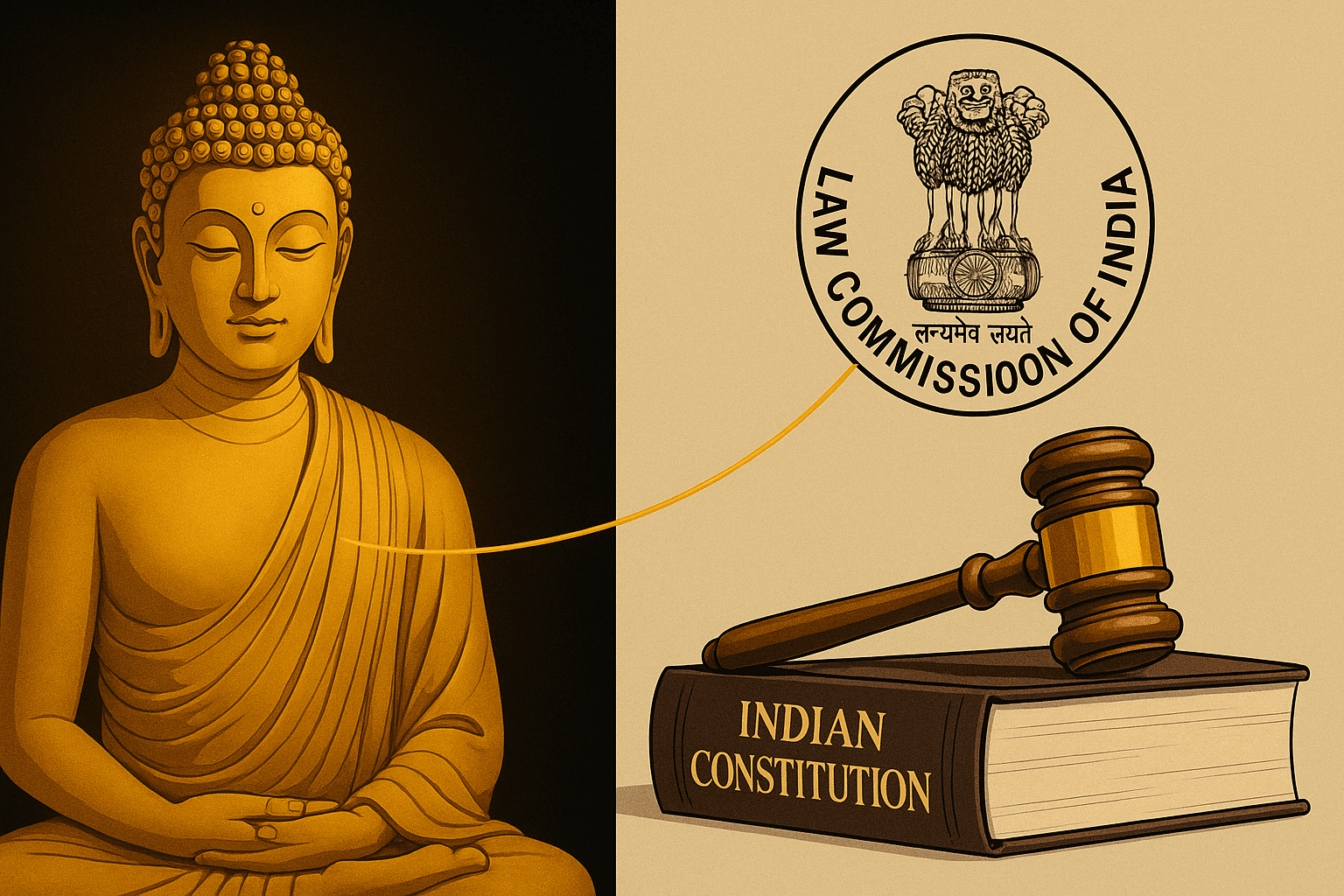
New Delhi — The Supreme Court of India has declined to directly entertain a petition seeking a separate code of personal laws for the Buddhist community, instead referring the matter to the Law Commission of India (LCI) for expert consideration.
A Bench led by Chief Justice of India (CJI) Surya Kant and Justice Joymalya Bagchi heard the Public Interest Litigation (PIL) filed by the Buddhist Personal Law Action Committee. The petitioners argued that subjecting Buddhists to Hindu personal laws undermines their distinct religious identity and fundamental rights.
The Core Grievance
Under the current legal framework, specifically Article 25 of the Constitution, Buddhists, Jains, and Sikhs are legally classified under the broad definition of "Hindu" for the application of personal laws. Consequently, matters regarding marriage, succession, guardianship, and adoption for Buddhists are governed by statutes such as the Hindu Marriage Act, 1955 and the Hindu Succession Act, 1956.
The petitioners contended that this classification dilutes their unique cultural heritage and demanded a separate legal framework similar to those existing for Muslim and Christian communities.
"Parliament's Domain, Not Courts"
While acknowledging the significance of the issue, the Bench clarified that the Judiciary cannot issue a mandamus (command) to Parliament to amend the Constitution or enact new legislation, as this falls strictly within the legislative domain.
"The Court is not in a position to direct an amendment to the Constitution... but the Law Commission has to make recommendations to Parliament," CJI Surya Kant observed during the hearing.
A Holistic Review
The Court disposed of the writ petition by directing the Supreme Court Registry to forward the petitioner’s plea to the Law Commission, treating it as a formal representation. The Bench noted that the Law Commission is already engaged in deliberations regarding the Uniform Civil Code (UCC) and is the appropriate expert body to take a "holistic view" of the matter.
"We request the Law Commission, if it deems appropriate, to invite the petitioner's representative and take their viewpoint on this issue; this will undoubtedly render quality assistance," the Court stated in its order.
This move places the ball in the Law Commission's court, which will now decide whether the demand for a separate Buddhist code warrants a legislative overhaul or can be addressed within the broader scope of upcoming legal reforms.