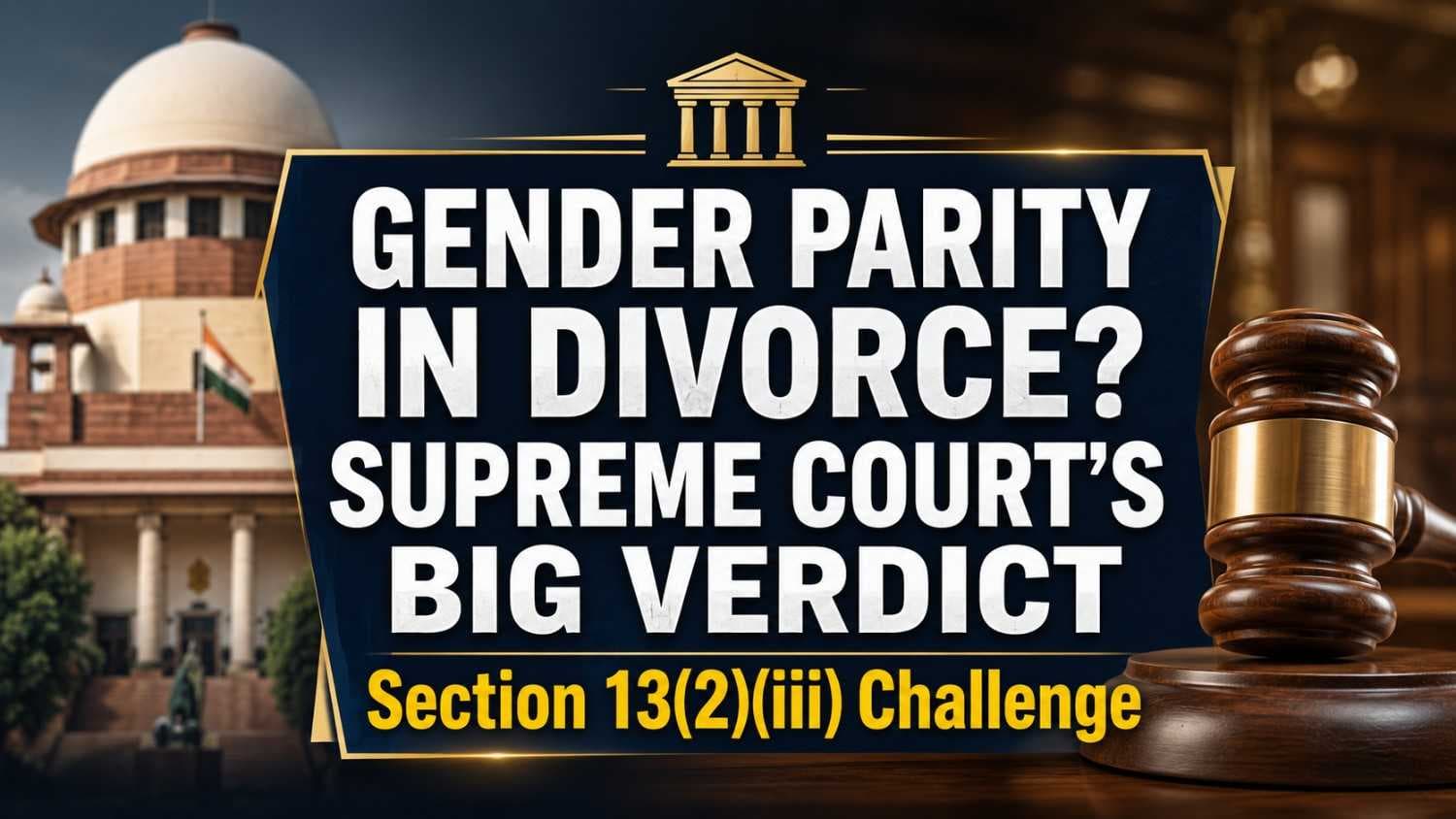
In a significant observation regarding gender-specific laws in India, the Supreme Court recently dismissed a Public Interest Litigation (PIL) that challenged a provision of the Hindu Marriage Act, 1955, which grants only wives the right to seek a divorce under specific circumstances following a maintenance decree.
The Bench, comprising Chief Justice of India (CJI) Surya Kant and Justice Joymalya Bagchi, clarified that the Indian Constitution explicitly allows for special provisions to be made for women, protecting such laws from being struck down on the grounds of gender inequality.
The petition challenged the constitutional validity of Section 13(2)(iii) of the Hindu Marriage Act, 1955. This specific clause allows a wife to present a petition for the dissolution of marriage by a decree of divorce if:
- A decree or order has been passed against the husband awarding maintenance to the wife (under Section 18 of the Hindu Adoptions and Maintenance Act or Section 125 of the CrPC).
- Since the passing of such decree or order, cohabitation (living together as husband and wife) has not been resumed between the parties for a period of one year or upwards.
The petitioner argued that this provision creates a gender imbalance, as it does not provide a corresponding right to the husband to seek divorce on similar grounds. He sought "gender parity," suggesting the law should be "neutral" and available to both spouses.
During the proceedings, the Court grew skeptical of the petitioner’s motives. When the petitioner, appearing in person, argued that the provision "should be open to both male and female," the CJI questioned how the existence of this law was personally affecting him.
The petitioner eventually admitted to being a "personal sufferer" currently embroiled in a matrimonial dispute. This admission drew a sharp rebuke from the Bench.
"This is what I wanted you to confess," the CJI remarked, cautioning the petitioner against using Article 32 (Writ Jurisdiction) of the Constitution to settle personal legal battles under the guise of a PIL. The Court noted that the Supreme Court is not a platform to resolve private grievances or "personal vendettas."
Justice Joymalya Bagchi emphasized the constitutional basis for such gender-specific provisions. He pointed toward Article 15(3) of the Constitution of India, which states: "Nothing in this article shall prevent the State from making any special provision for women and children."
The Court explained that the legislature, in its wisdom, recognized the socially and economically vulnerable position women often find themselves in during matrimonial breakdowns. By allowing a wife to seek divorce after a husband fails to resume cohabitation following a maintenance order, the law provides a exit route for women who are left in a state of "limbo"—neither living with their husbands nor legally free from the marriage.
The Bench suggested that if the petitioner wanted to change the fundamental structure of these laws, he would need to seek a constitutional amendment rather than a judicial strike-down of a protected special provision.
The Court was also informed that the petitioner is currently a law student. Addressing him with a mix of firmness and fatherly advice, CJI Surya Kant stated: "You might be having some genuine grievances. We have sympathy for you. But we have sympathy for your estranged wife also. This does not send a good message for law students. Wait for the right opportunity."
The Bench made it clear that while legal students should be encouraged to challenge the law, they must do so with academic integrity and not out of personal frustration with their own ongoing cases.
By dismissing the plea, the Supreme Court has reaffirmed the validity of "protective discrimination" in Indian matrimonial law. The ruling reinforces the principle that while the Constitution guarantees equality, it also empowers the State to create "special laws" to protect the interests of women, who have historically faced greater hurdles in matrimonial litigation.
For husbands in similar positions, the Court’s message was clear: personal matrimonial disputes must be fought in the appropriate family courts or through standard appellate routes, not by attempting to dismantle gender-specific protections through PILs in the apex court.