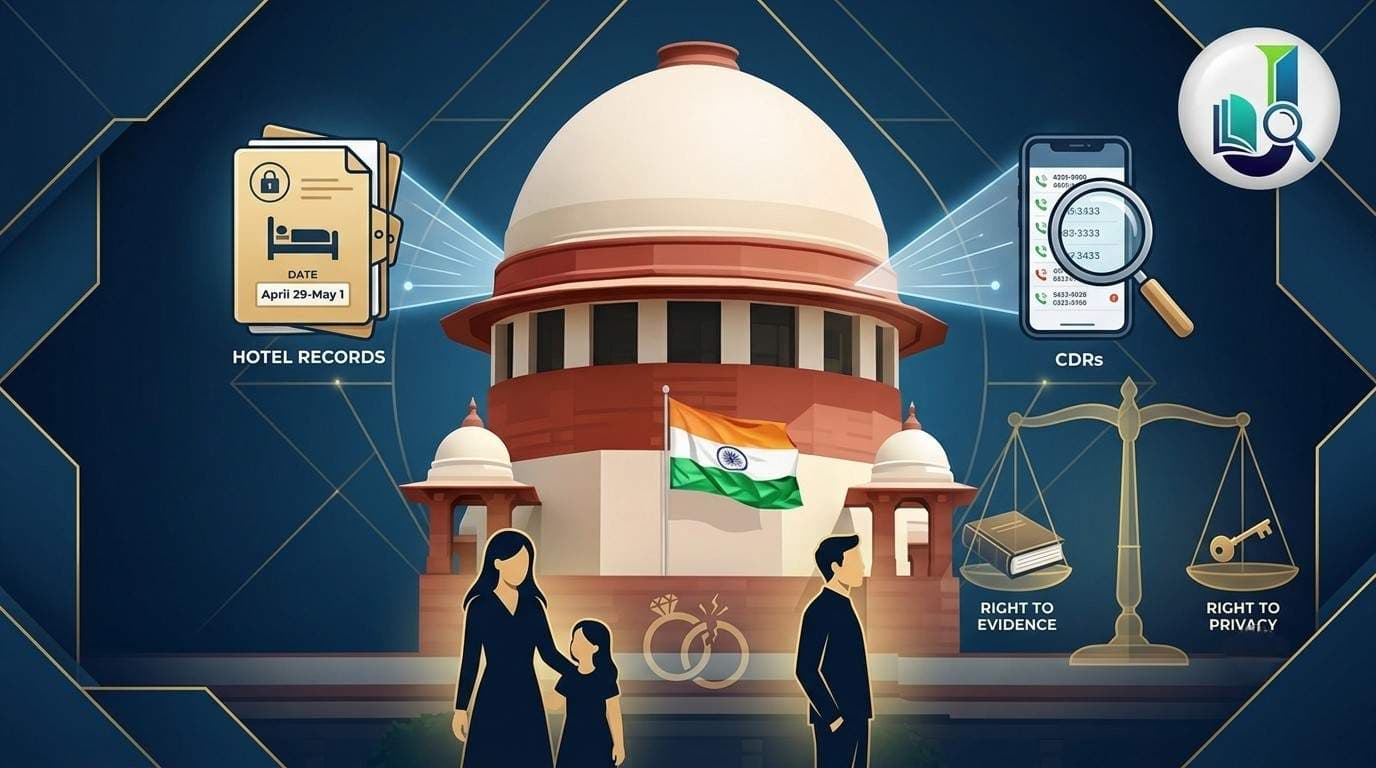
The Supreme Court, comprising Justice Manmohan and Justice K. Vinod Chandran, dismissed a civil appeal filed by a husband who contested a Delhi High Court order permitting his wife to procure his hotel records and call detail records (CDRs) for the purpose of proving adultery. The bench observed that there was no basis to interfere with the concurrent findings of the Family Court and the High Court regarding the production of the said documents.
The dispute originated from divorce proceedings initiated by the wife under Section 13(1)(i) of the Hindu Marriage Act, 1955, on the grounds of cruelty and adultery. She alleged that her husband had stayed at the Hotel Fairmont in Jaipur between 29 April and 1 May 2022 in the company of another woman and her daughter. After attempting to preserve the hotel’s CCTV footage, which was no longer available due to the establishment’s retention policy, she moved an application seeking the production of the hotel’s booking registers, identity particulars of the occupants, payment details concerning the room, and her husband’s call detail records for a specified period.
The Family Court allowed the application and directed that the requested records be produced before it in a sealed cover to preserve confidentiality while enabling the court to consider the material. The husband challenged this order before the Delhi High Court.
The High Court upheld the Family Court’s direction, emphasizing that the right to privacy is not absolute and must be balanced against a spouse’s entitlement to prove allegations in matrimonial litigation. It noted that the wife lacked any other effective means to establish her claim of adultery, and therefore the impugned order was justified. The High Court further observed that when a wife approaches the court for assistance in obtaining evidence that could substantiate adultery on the part of her husband, the court ought to intervene. Such intervention, the High Court held, is consistent with Section 14 of the Family Courts Act, which empowers the family court to consider evidence that may not be admissible or relevant under the Indian Evidence Act.
In its reasoning, the High Court relied on the precedents of K.S. Puttuswamy v. Union of India and Joseph Shine v. Union of India, which recognize that the right to privacy, while fundamental, is not absolute. It concluded that the wife’s right to prove her allegations under the Hindu Marriage Act and the Family Courts Act prevailed over the husband’s privacy claim, particularly because the sought records pertained solely to the husband and did not infringe upon the privacy of any third party.
Aggrieved by the High Court’s ruling, the husband filed a special leave petition before the Supreme Court. After hearing the arguments, the bench comprising Justice Manmohan and Justice K. Vinod Chandran found no merit in the appeal. It stated that there was no reason to overturn the High Court’s conclusion, and consequently dismissed the appeal. The case is recorded as Civil Appeal No. 400 of 2024.
The Supreme Court’s decision reinforces the principle that in matrimonial disputes where one spouse seeks to prove adultery, the court may facilitate the production of otherwise protected records, provided the intrusion is limited and proportionate. The judgment underscores the balancing test between privacy rights and the evidentiary needs of a spouse alleging marital misconduct, and affirms the expansive discretion conferred upon family courts under Section 14 of the Family Courts Act to admit material that assists in the determination of matrimonial claims.