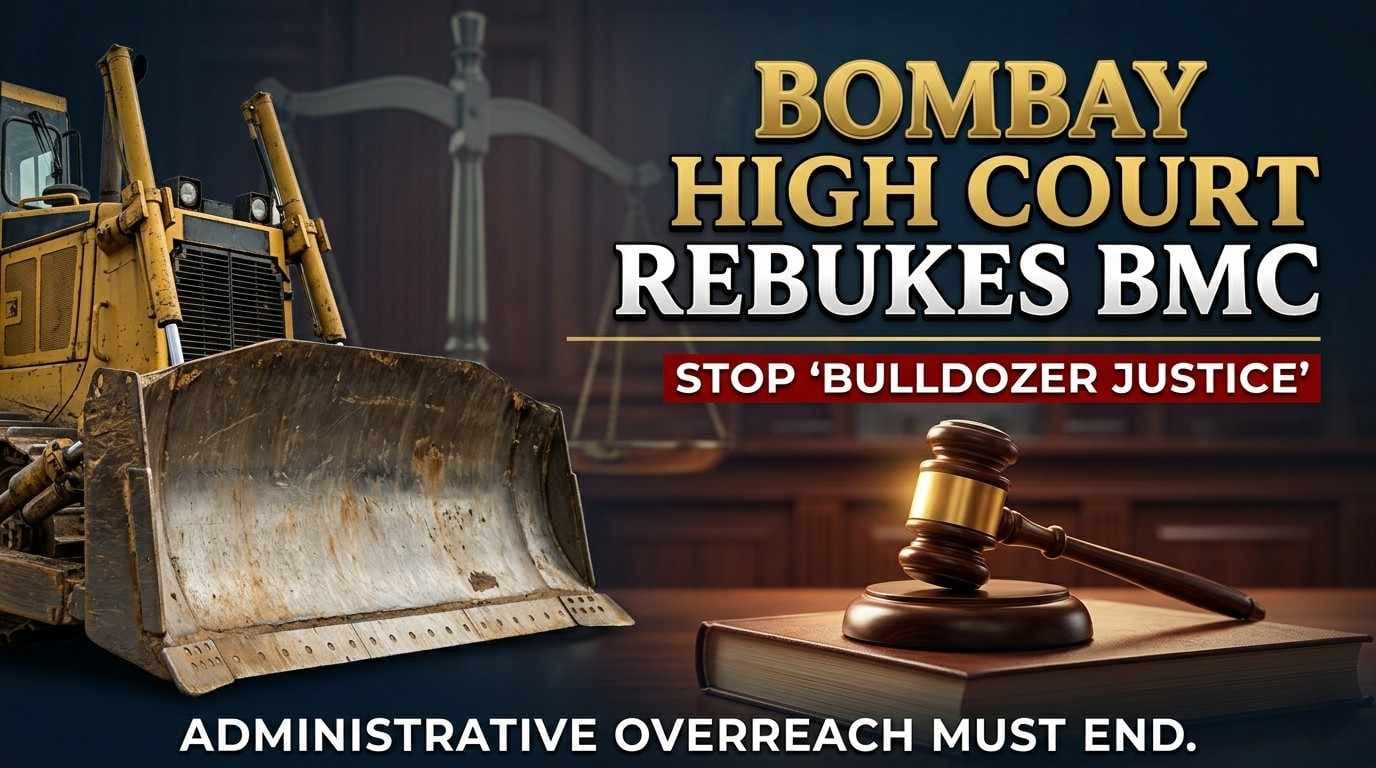
In a stinging rebuke of administrative overreach, the Bombay High Court has sent a clear message to the Brihanmumbai Municipal Corporation (BMC): the era of "high-handed" demolitions must come to an end. Presiding over a case involving the summary destruction of a citizen’s property, the Court expressed deep displeasure at the civic body's aggressive tactics. The bench warned that if municipal authorities continue to bypass the due process of law, the Court will not hesitate to pass unprecedented orders requiring the BMC to rebuild the structures at their own cost.
The controversy arose when the BMC proceeded with a demolition despite the property owner claiming a lack of adequate notice and the existence of protective legal standing. For many Mumbaikars, this scenario is all too familiar. The Court observed that the BMC often acts with a sense of impunity, assuming that once a structure is razed, the matter becomes a fait accompli (a thing done that cannot be undone). However, the High Court’s latest stance signals a shift toward holding individual officers accountable for "bullying" tactics.
Legally, the Court’s frustration stems from the violation of "Principles of Natural Justice." Every citizen is entitled to a fair hearing and a reasonable window of time to seek judicial intervention before their shelter is taken away. By jumping the gun, the BMC is not just clearing encroachments; it is effectively bypassing the judiciary. The Bench noted that the power to demolish is not a license to act arbitrarily, and the "might of the state" cannot be used to steamroll the rights of the common man.
A significant highlight of this hearing was the Court’s focus on the vulnerability of the petitioners. In this specific instance, the victim was a senior citizen whose residence was targeted. The Court highlighted the psychological and financial trauma such actions inflict. By threatening to order the BMC to "reconstruct" the demolished portions, the High Court is moving beyond mere stays and moving toward restorative justice—a move that could cost the municipal treasury dearly if the trend of lawlessness continues.
The "Bulldozer Justice" culture, which has seen a rise across various Indian states, found a firm wall in the Bombay High Court. While the court acknowledges that illegal constructions must be dealt with, it maintains that the manner in which they are dealt with defines a civilized society. The judges remarked that the BMC behaves like a "law unto itself," often ignoring its own statutory requirements under the Mumbai Municipal Corporation Act.
Expert legal analysts view this as a vital protection of Article 300A of the Constitution, which states that no person shall be deprived of his property save by authority of law. While property is no longer a fundamental right, it remains a precious constitutional right. The High Court’s warning serves as a reminder that "authority of law" involves more than just owning a bulldozer; it involves following every procedural step, from the initial show-cause notice to the final order.
Furthermore, the Court hinted at the possibility of imposing personal costs on the municipal officers involved. This is a crucial deterrent. Often, bureaucrats carry out illegal demolitions knowing the Corporation will pay any resulting fines. By suggesting that officers could be held personally liable or tasked with overseeing a rebuild, the Court is targeting the decision-makers directly, ensuring that "high-handedness" carries a personal price tag.
Ultimately, this ruling is a victory for the rule of law over administrative convenience. It reinforces the idea that the municipal corporation is a service provider, not a sovereign entity above the law. As the BMC prepares its response, the legal community and Mumbai residents alike are watching closely. This case marks a line in the sand: the judiciary will no longer stand by while the "King of the City" razes the homes of its citizens without a fair fight.