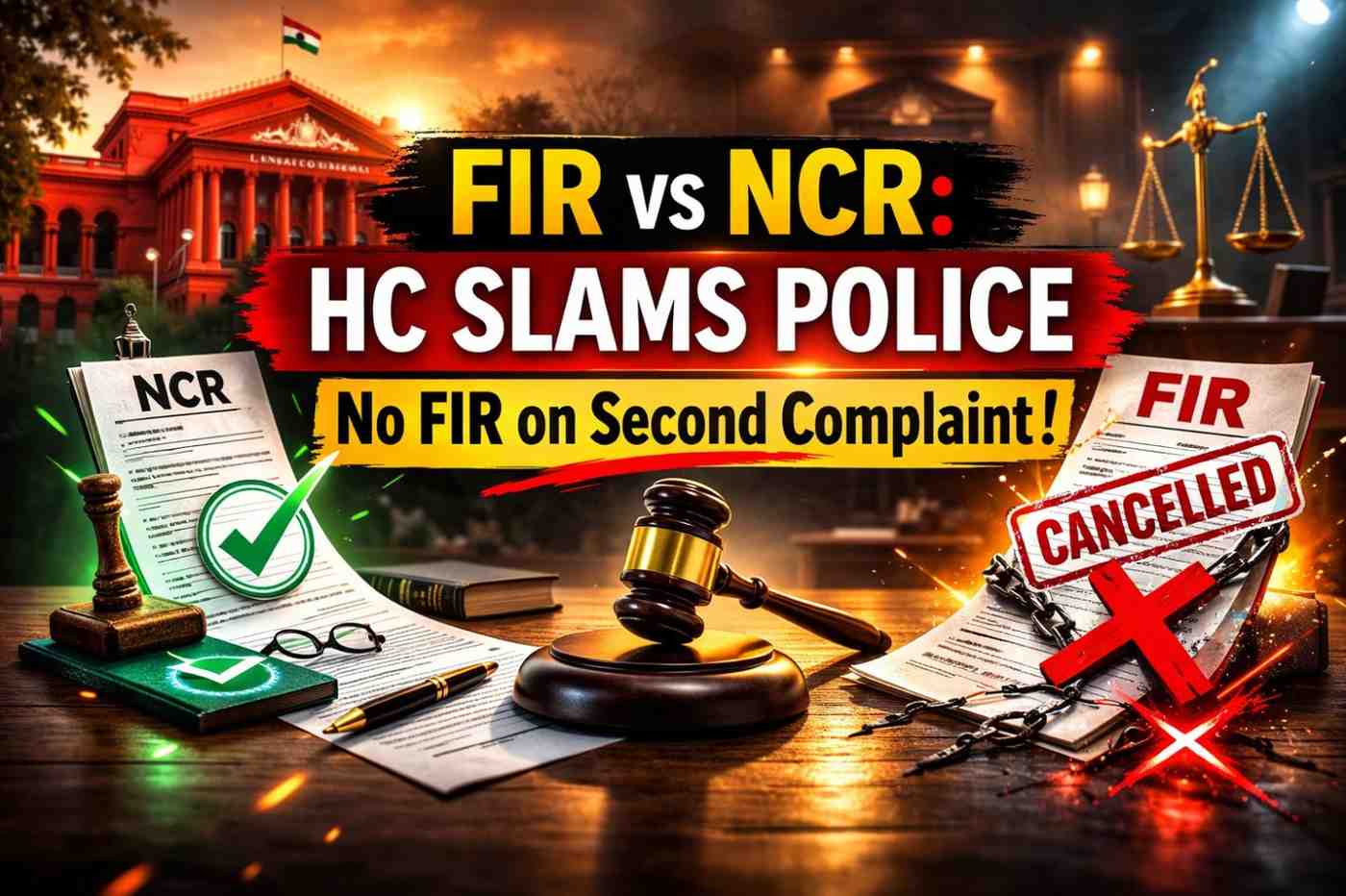
The Karnataka High Court has recently delivered a significant judgment reinforcing the procedural sanctity of the Code of Criminal Procedure (CrPC). The Court observed that the police cannot bypass the mandatory requirement of obtaining a Magistrate's permission for investigating non-cognizable offences by simply registering a First Information Report (FIR) based on a "second complaint" that merely adds a layer of cognizable allegations to an earlier non-cognizable incident.
The ruling comes as a crucial check on "police overreach" and "procedural shortcuts" often employed to convert civil or minor disputes into full-blown criminal investigations without judicial oversight.
The matter reached the High Court through a petition filed under Section 482 of the CrPC, seeking to quash an FIR registered against the petitioners. The dispute originated from a conflict where an initial complaint was lodged with the jurisdictional police.
Upon receiving the first complaint, the police correctly identified the allegations as pertaining to "non-cognizable offences"—crimes for which the police do not have the authority to arrest without a warrant or start an investigation without the express order of a Magistrate. Consequently, the police issued a Non-Cognizable Report (NCR) and advised the parties to seek remedy through the appropriate court.
However, shortly after the NCR was issued, the complainant filed a "second complaint" regarding the exact same incident. In this second iteration, the complainant added certain allegations that fell under "cognizable" categories (where police can arrest without a warrant). Based on this second complaint, the police immediately registered an FIR and commenced a criminal investigation, ignoring the fact that the primary incident had already been recorded as an NCR.
The primary question before the High Court was: Can the police register an FIR on a second complaint for the same incident if the first complaint only resulted in an NCR?
Under Section 155 of the CrPC (and the corresponding provisions in the new Bharatiya Nagrik Suraksha Sanhita (BNSS)), if a police officer receives information about a non-cognizable offence, they must:
- Enter the substance of the information in the station diary.
- Refer the informant to the Magistrate.
- Crucially, they cannot investigate the case without the order of a Magistrate having the power to try the case.
The petitioners argued that the registration of the FIR was an "abuse of the process of law" and a deliberate attempt to circumvent the protections offered by Section 155.
Justice M. Nagaprasanna (or the presiding judge in the specific bench) scrutinized the police action and noted a worrying trend of "colorable exercise of power." The Court’s observations can be broken down into the following key points:
1. The Sanctity of the First Version
The Court emphasized that the first information provided to the police is often the most authentic. When the police initially treat a matter as non-cognizable and issue an NCR, they are legally bound by that classification unless there is substantial, independent, and fresh evidence of a cognizable crime.
2. Prohibition on Bypassing the Magistrate
By registering an FIR on a second, "improved" complaint, the police effectively bypassed the Magistrate. The Court noted that if the police felt the matter required investigation, the correct legal route was to submit a requisition to the Magistrate under Section 155(2) and wait for a reasoned order.
3. Abuse of Process
The Court held that allowing the police to register FIRs based on "improved" second complaints would lead to a situation where every non-cognizable case could be converted into a cognizable one through creative drafting of complaints. This, the Court remarked, would render Section 155 of the CrPC redundant and violate the fundamental rights of the accused.
This judgment is a landmark for several reasons, particularly for the common citizen and legal practitioners:
- Protection Against Harassment: It prevents the police from using the threat of arrest in cases that are essentially civil or minor in nature (such as verbal spats or simple property disputes).
- Judicial Oversight: It reaffirms that the judiciary, not the police, is the ultimate gatekeeper for investigations into non-cognizable offences.
- Procedural Discipline: It sends a stern message to Law Enforcement Agencies to follow the "due process of law" rather than taking shortcuts to show "disposal" of complaints.
The High Court specifically warned against the "Second Complaint Trap." Often, when a complainant fails to get an FIR registered because the offence is minor, they are coached to add allegations of "threat to life" or "outraging modesty" in a subsequent letter to force the police to register an FIR. The Court has now made it clear that the police must look at the "substance" of the incident as a whole and not just the labels used in the second complaint.
Quashing the FIR in question, the Karnataka High Court ruled that the proceedings were a "clear abuse of the process of the law." The Court directed that the police must strictly adhere to the guidelines regarding NCRs and cannot treat a second complaint as a "fresh start" to avoid the Magistrate's scrutiny.
For the legal community, this serves as a reminder that the sequence of events and the nature of the first report (NCR) are vital evidence in quashing petitions. For the public, it provides a shield against arbitrary criminal proceedings stemming from improved or exaggerated complaints.