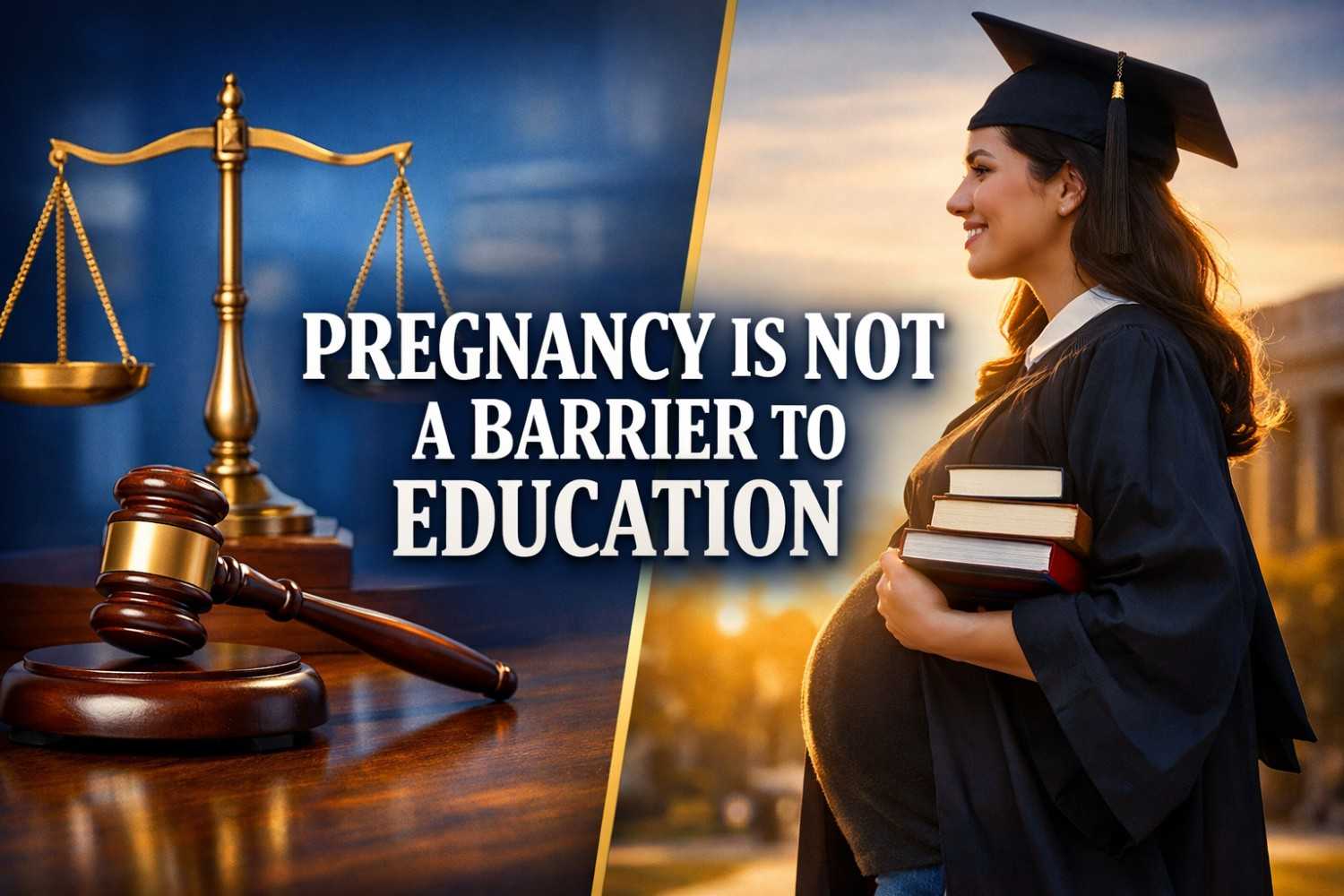
In a landmark judgment that reinforces the educational rights of women, the Madhya Pradesh High Court has ruled that marriage and pregnancy should not act as barriers to a woman’s academic journey. The Court emphasized that educational institutions must accommodate female students by granting maternity and child-care leave, ensuring they are not penalized for life events that are fundamental to their personal lives.
The Division Bench, comprising Justice Vivek Rusia and Justice Pradeep Mittal, observed that the legal protections and maternity benefits available to working women in professional spaces must also extend to women pursuing higher studies.
The petitioner, Rumaisa Arwa, was a student of Bachelor of Unani Medicine and Surgery (BUMS) at the Hakim Syed Ziaul Hassan Government Autonomous Unani College in Bhopal. After completing her first year successfully, she got married and subsequently became pregnant during her second year of study.
Arwa delivered her child on November 20, 2024. Due to her pregnancy and the post-delivery recovery period, she was unable to attend the regular number of classes. While the mandatory attendance requirement was 75%, her attendance stood at 56.64%.
The college management granted her a meager 10% relaxation, which was insufficient to make her eligible for the final examinations. Consequently, she was barred from appearing in the exams, prompting her to approach the High Court for relief.
The High Court took a progressive view, noting that the absence of a specific maternity policy within the college could not be used as a reason to deny a student her right to progress academically.
The Bench highlighted a crucial University Grants Commission (UGC) circular dated October 14, 2021. This circular explicitly directed all higher educational institutions to frame policies for granting maternity and child-care leave to female students.
"During study, marriage as well as pregnancy should not come in their way to complete their education; therefore, they are liable to be accommodated or adjusted to achieve the requisite percentage of attendance for appearance in the final examinations," the Court stated.
The Court further noted that if a woman is forced to choose between her education and her role as a mother, it defeats the constitutional goal of women's empowerment.
Beyond the specific case of the petitioner, the High Court laid down broader expectations for schools and colleges:
- Mandatory Accommodation: Institutions must find ways to adjust attendance for pregnant students or new mothers so they can sit for exams.
- Academic Support: The Court suggested that colleges should provide extra classes, study materials, and necessary academic support to help students bridge the gap caused by maternity leave.
- Policy Implementation: The Court reiterated that the benefits of child-care leave should be extended to students as far as possible, following the spirit of workplace laws.
Treating the petitioner’s situation as a “special case,” the Court directed the college to grant the necessary attendance relaxation to reach the 75% threshold. Since the Court had previously allowed her to sit for the exams via an interim order, it directed the authorities to declare her results without further delay.
This judgment serves as a vital reminder to educational authorities across the country: motherhood is a right, not a disability, and the doors of education must remain open for every woman, regardless of her marital or maternal status.
Case Details:
- Case Title: Rumaisa Arwa vs. The State of Madhya Pradesh and Others
- Case No: Writ Petition No. 5457 of 2025
- Bench: Justice Vivek Rusia and Justice Pradeep Mittal