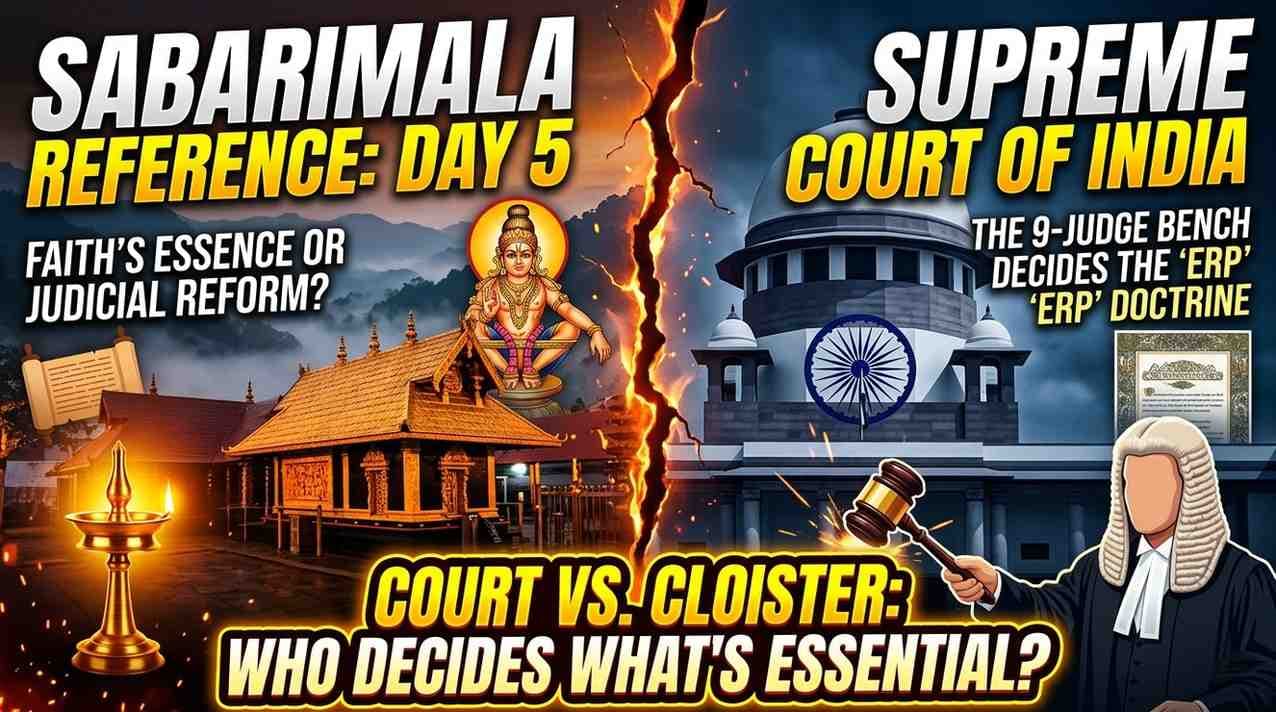
The 9-judge Constitution Bench of the Supreme Court, led by Chief Justice Surya Kant, concluded Day 5 of the Sabarimala reference hearing with a intense focus on the "Essential Religious Practices" (ERP) doctrine. The proceedings delved into the fundamental question of whether a secular court is constitutionally equipped to sit in judgment over what constitutes an "essential" ritual of a religious denomination.
A significant portion of the day’s arguments centered on the tension between Article 25(1) (individual right to freedom of religion) and Article 26 (right of religious denominations to manage their own affairs). The Bench questioned whether the 2018 Sabarimala judgment—which allowed women of all ages to enter the temple—erred by prioritizing individual equality over the collective identity and traditions of the devotees of Lord Ayyappa.
Key legal highlights from Day 5 include:
- The "Internal Standards" Argument: Counsel for the religious groups argued that the "essentiality" of a practice should be determined by the faith's own scriptures and the "conscience of the community," rather than by a judge applying rational logic. They warned that if the Court continues to use the ERP test to "reform" religions, it risks erasing the diversity of Hindu traditions.
- The Role of 'Naishtika Brahmacharya': The Bench discussed whether the deity's status as a perpetual celibate is a "belief" that the Court must accept as a fact. The justices pondered if the exclusion of women was a "discriminatory practice" or a "ritual requirement" inextricably linked to the character of the deity.
- Constitutional Morality vs. Public Morality: The Court grappled with defining "Constitutional Morality." The Bench mused whether this term refers to the specific values of justice and equality in the Constitution, or if it must be expansive enough to include the preservation of pluralistic religious customs.
The Bench expressed concern that a rigid application of "Constitutional Morality" might lead to a "uniformity" that the framers of the Constitution did not intend for a religiously diverse India. Chief Justice Surya Kant remarked that while the Court cannot be a "theological arbiter," it also cannot turn a blind eye if a religious practice violates the core human dignity of a specific class of citizens.
As Day 5 wrapped up, the Court signaled that it might need to refine the ERP test to prevent it from being used as a tool for "excessive judicial overreach." The reference is increasingly moving toward a landmark re-evaluation of how India handles the "Sacred vs. Secular" divide, with potential implications for other pending cases involving the hijab, mosque entries, and Parsi fire temples.