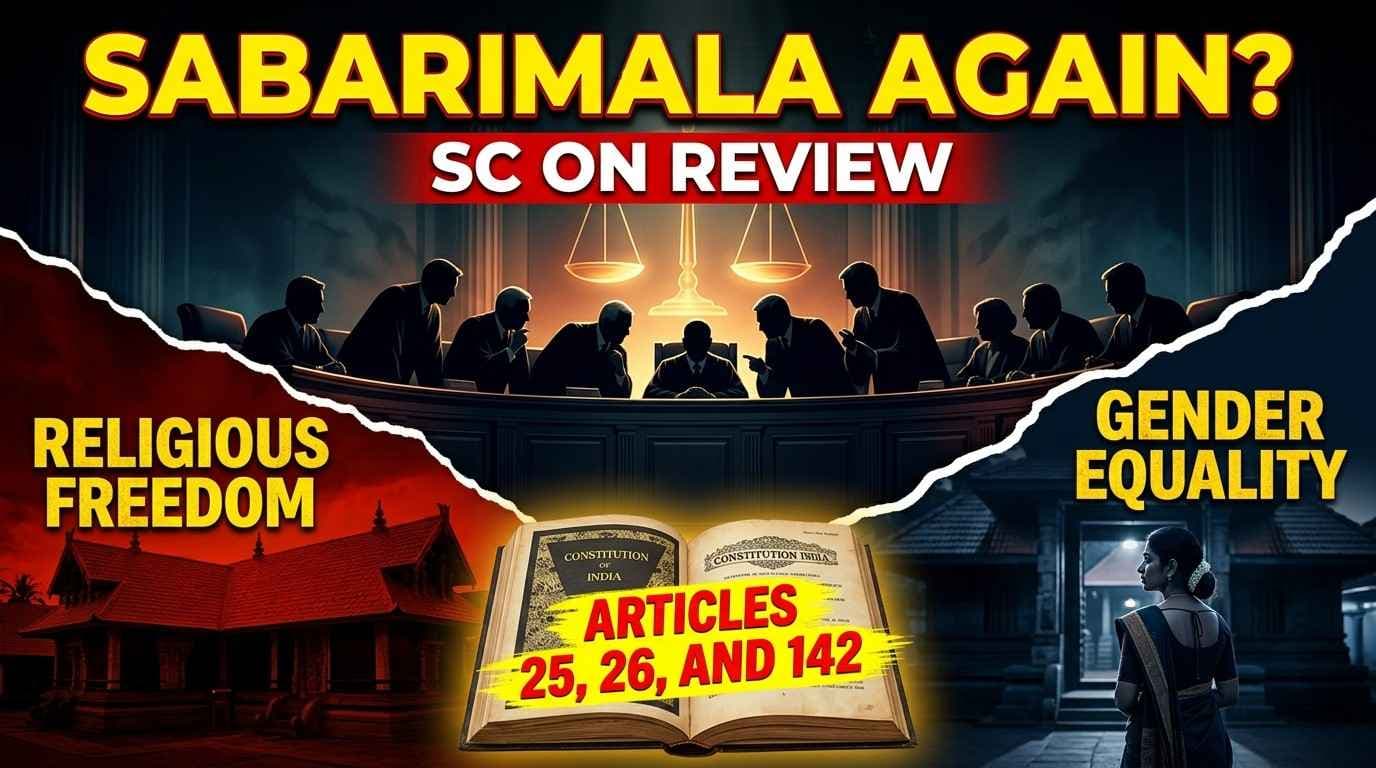
The Day 3 proceedings of the Sabarimala reference hearing before a nine-judge bench of the Supreme Court centered on the critical question of whether a referral to a larger bench is permissible during a review petition. Senior advocates argued extensively on the scope of the Court's powers under Article 142 and whether the 2018 judgment, which allowed women of all ages to enter the temple, could be re-examined through a broader lens of "essential religious practices." The bench sought to define the legal boundaries for questioning settled precedents when they intersect with fundamental rights like religious freedom and gender equality.
A major point of contention during the arguments was the jurisdiction of the Court to refer questions of law to a larger bench while review petitions are still pending. Counsel representing various stakeholders argued that the Court’s primary duty is to correct errors apparent on the face of the record rather than embarking on a fresh constitutional inquiry. However, the bench explored the idea that if a case involves "substantial questions of law" regarding the interpretation of the Constitution, it possesses the inherent authority to ensure legal clarity across multiple similar cases, including those involving mosque entry and Parsi fire temples.
The hearing also delved into the interplay between Article 25, which guarantees the right to practice religion, and Article 26, which protects the rights of religious denominations. The advocates debated whether the "morality" mentioned in these articles refers to individual constitutional morality or the collective morality of a specific religious sect. The judges noted that the outcome of this reference would set a massive precedent for how the state and the judiciary interface with centuries-old traditions, particularly those that are claimed to be "essential" to the identity of a faith.
As the live updates captured a rigorous intellectual exchange, it became clear that the Sabarimala reference is no longer just about one temple, but about the "Essential Religious Practices" test itself. The proceedings highlighted a deep-seated tension between preserving the autonomy of religious institutions and upholding the transformative constitutional vision of equality. The Court's eventual determination on these referred questions will fundamentally reshape the landscape of personal laws and religious rights in India for decades to come.