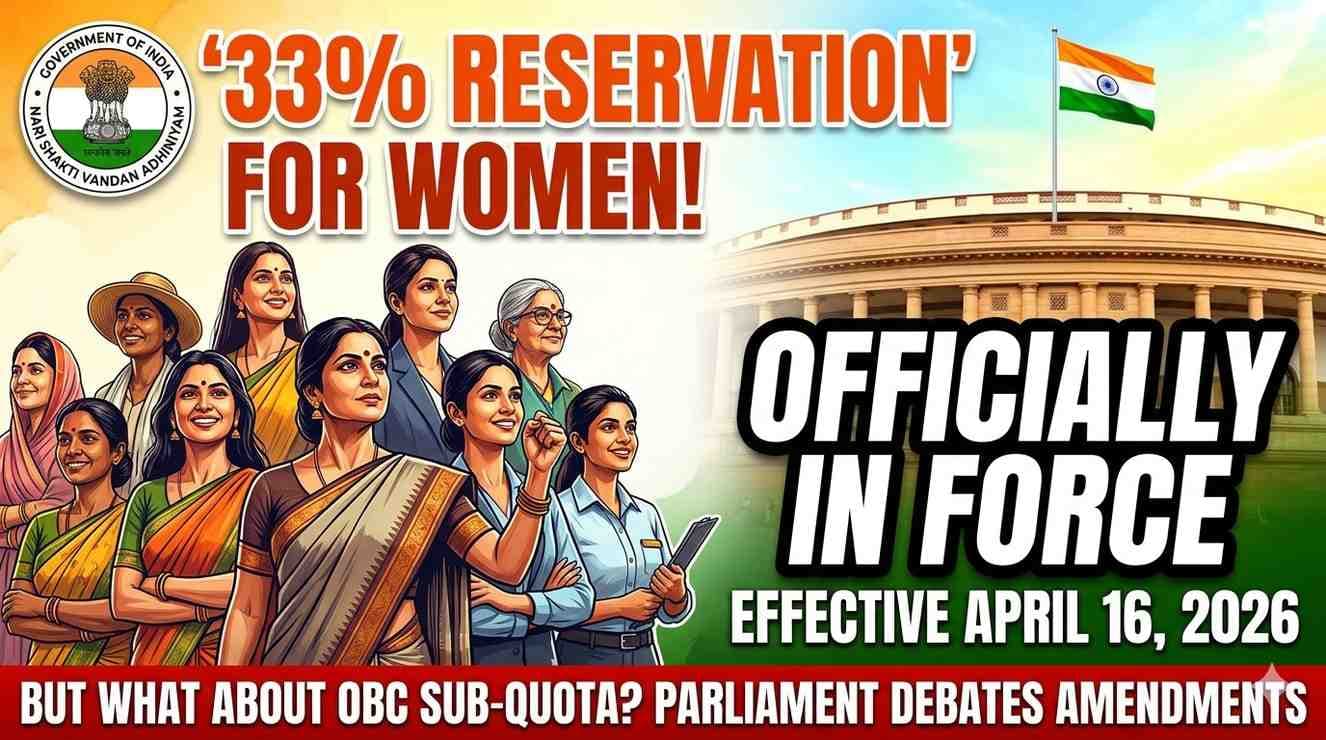
The Government of India has officially brought the Nari Shakti Vandan Adhiniyam (Women's Reservation Act, 2023) into force effective April 16, 2026. This landmark development occurs even as Parliament continues to debate new amendments regarding the inclusion of an "OBC sub-quota" within the reserved seats. By notifying the commencement date, the Centre has effectively set the stage for the implementation of the 33% reservation for women in the Lok Sabha and State Legislative Assemblies.
The 2023 law, originally passed as the 128th Constitutional Amendment, was initially tied to the completion of the next census and subsequent delimitation exercise. However, the recent notification indicates a shift in the implementation timeline, suggesting that the preparatory administrative work—including the mapping of constituencies—is now prioritized to ensure the reservation is active for upcoming state and general elections.
A significant point of contention remains the "Quota within Quota" debate. While the current law provides for the reservation of seats for women belonging to Scheduled Castes (SC) and Scheduled Tribes (ST) within the 33% bracket, several political factions are demanding a specific carve-out for Other Backward Classes (OBC). The Centre’s decision to operationalize the law while these amendments are still under discussion suggests a strategy to establish the legal framework first, leaving specific modifications for future legislative sessions.
Legal experts note that the notification marks a point of no return for the policy. Once the Act is in force, the Delimitation Commission will have a clear constitutional mandate to reserve one-third of seats for women. The move is expected to fundamentally alter the electoral landscape of India, potentially bringing over 180 women into the Lok Sabha. The timing is particularly noteworthy, as it aligns with the government’s broader "Viksit Bharat" agenda, positioning gender parity in governance as a cornerstone of national development.
As the law enters the implementation phase, the focus will now shift to the Delimitation Commission. The Commission will be tasked with the complex exercise of identifying which specific constituencies will be reserved for women, a process that traditionally involves rotation to ensure fair representation across different regions. While the political debate over the OBC sub-quota will likely persist, the legal reality of women’s reservation has now officially become part of the Indian constitutional fabric