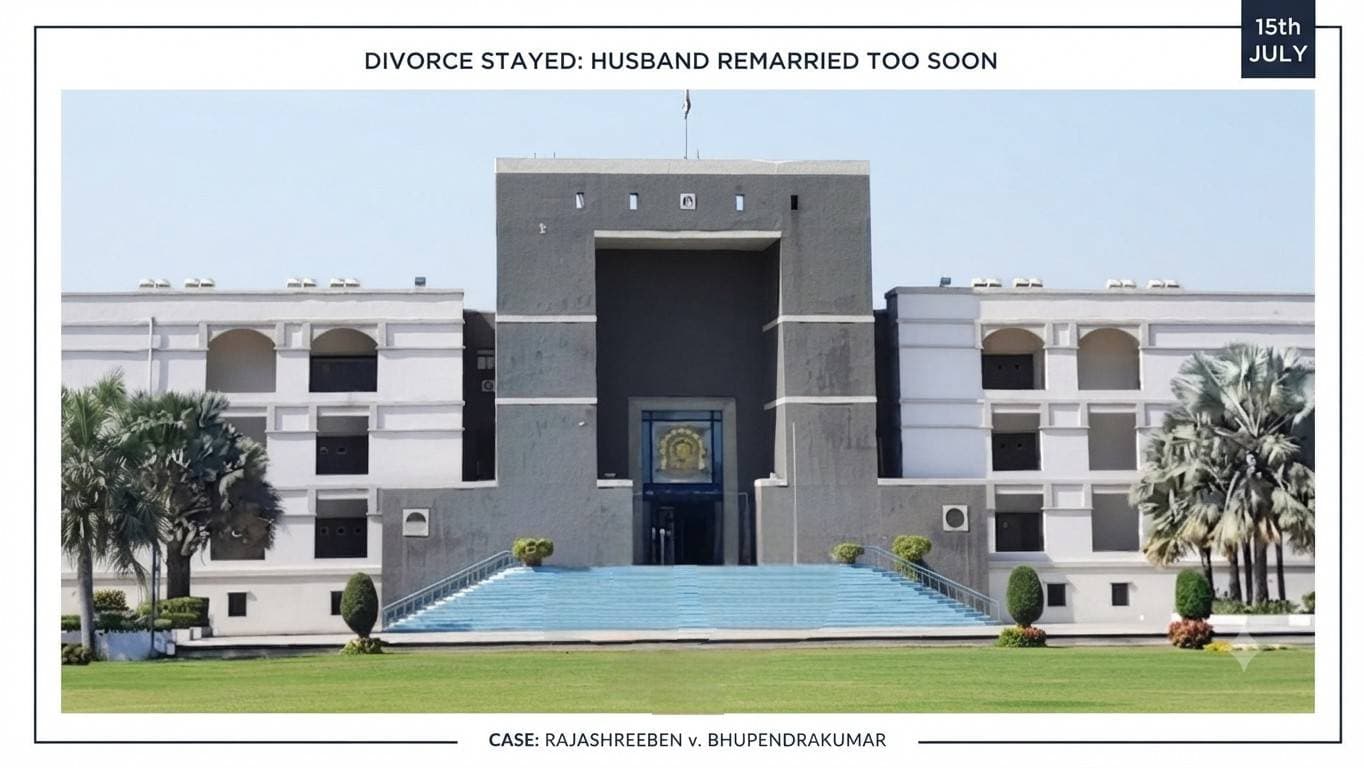
The Gujarat High Court, comprising Justice Ilesh J Vora and Justice RT Vachhani, passed an order staying the execution of a family court judgment that had granted a divorce to the husband. The stay was granted after the court noted that the husband had contracted a second marriage during the pendency of the wife's appeal against the divorce decree.
The underlying proceedings originated from a petition filed by the husband under the Hindu Marriage Act, 1955, seeking dissolution of his marriage. The family court, on 15 May 2024, granted the divorce and simultaneously awarded permanent alimony to the wife together with a sum for medical expenses. Aggrieved by the order, the wife preferred an appeal before the High Court and concurrently filed an application seeking an interim stay of the family court's decree.
In her stay application, the wife contended that the husband's remarriage, which took place on 11 July 2024 and was duly registered on 15 July 2024 before the Registrar of Marriages, occurred while her appeal was still pending. She argued that such a remarriage frustrated the protection envisaged under Section 15 of the Hindu Marriage Act, which safeguards the right of a party to prosecute an appeal against a decree of dissolution without the risk of the appeal being rendered infructuous by a subsequent marriage.
The husband, in response, maintained that the marriage between the parties had been legally dissolved by the family court's judgment dated 15 May 2024. He asserted that his second marriage, having been solemnised on 11 July 2024, preceded the presentation of the wife's appeal, which was filed on 15 July 2024. Consequently, he submitted that no appeal was pending at the time of his remarriage and therefore the statutory bar did not apply.
The Division Bench examined the scope and object of Section 15 Hindu Marriage Act. The provision stipulates that a party may remarry only after a divorce decree has become final, either because no right of appeal exists, the period for appeal has expired without an appeal being filed, or an appeal has been filed and dismissed. The Bench emphasised that the legislative intent behind Section 15 is to protect the appellant's right to have the appeal heard on its merits and to prevent the emergence of legal and factual complications that would arise if a second marriage were contracted during the pendency of the appeal.
Referring to prior judicial pronouncements on the provision, the Court observed that the husband's act of marrying immediately after the decree, on a date when the wife's appeal was either already filed or about to be filed, amounted to contracting a second marriage during the subsistence of the appeal. The Bench held that by doing so, the husband deprived the wife of her legitimate right to present her case in appeal, which otherwise could be adjudicated on its own merits.
Considering the balance of convenience, the Court found that it heavily favoured the wife. It noted that the wife had established a prima facie case for the grant of interim relief, and that denial of such relief would result in her being nonsuited, causing irreparable loss. The loss of her status as the wife, consequent to the operation of the divorce decree, could adversely affect her legitimate claims against the husband and impede any proceedings initiated to secure her status against the family court's judgment.
Accordingly, the Court granted a stay of the execution, operation, and implementation of the family court's order granting divorce, pending the final disposal of the wife's appeal. The Bench clarified that its observations were prima facie in nature, based solely on the facts of the present case, and were not intended to serve as a precedent for future cases.
The case is titled RAJASHREEBEN W/O BHUPENDRAKUMAR PATEL v/s BHUPENDRAKUMAR AMBALAL PATEL, Civil Application (For Stay) No. 1 of 2024 in R/First Appeal No. 2740 of 2024.