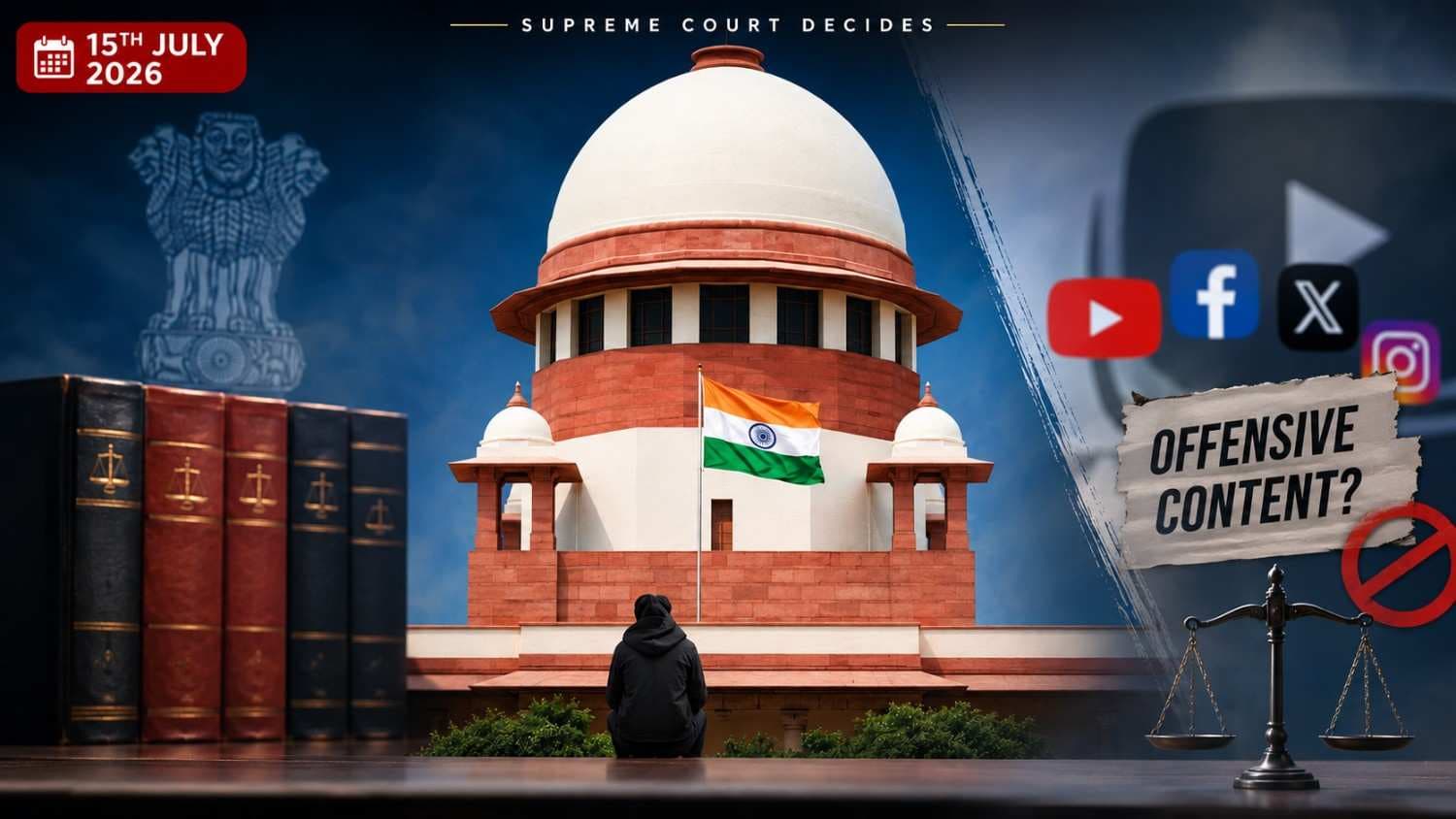
The Supreme Court on 15 July 2026 dismissed a criminal writ petition filed by MD Anas Chaudhary that sought directions to prevent the circulation of videos allegedly containing offensive comments against Prophet Muhammad and his family. The bench comprising Justice PS Narasimha and Justice Alok Aradhe heard the matter and concluded that the petition did not warrant the exercise of Article 32 jurisdiction.
At the outset, counsel for the petitioner, Advocate Rajat Kumar, submitted that the controversy stemmed from certain remarks made during a podcast by influencer Nazia Elahi Khan in June 2026, which were claimed to have hurt a particular religious community. He argued that the petition was not intended to seek censorship of social media but to highlight a constitutional silence on the regulation of online content. He noted that pan‑India creators are increasingly producing podcasts and reels, and that the Court would eventually have to determine the limits of permissible speech on digital platforms.
Justice Narasimha responded orally, stating that the Court understood the petitioner’s concerns but that Article 32 petitions are meant to serve a different purpose. He emphasized that the present case did not fall within the scope of constitutional remedies available under Article 32 of the Constitution.
Justice Aradhe questioned whether the petitioner’s counsel was aware of the existing procedural framework governing interception, monitoring and decryption of information under the Information Technology (Procedure and Safeguards for Interception, Monitoring and Decryption of Information) Rules, 2009. He suggested that the appropriate forum for addressing grievances about online content lay within the statutory mechanisms provided by those Rules rather than through a constitutional writ.
The Court further observed that the petition appeared to be filed with the objective of sensationalising the matter rather than seeking a substantive legal remedy. It noted that the petitioner had not exhausted the regular criminal remedies available, including the multiple FIRs already registered against the influencer in connection with the alleged remarks.
The petition impleaded the Union of India’s Department of Home, the Ministry of Electronics and Information Technology, major social media platforms namely YouTube, Facebook, X (formerly Twitter) and the influencer Nazia Elahi Khan. It sought three broad categories of relief: first, directions for the formulation and implementation of guidelines or regulations to curb the publication, circulation and dissemination of content that is deliberately derogatory or insulting towards revered religious figures such as Prophet Muhammad and Bhagwan Shri Ram; second, directions to the authorities to put in place adequate safeguards to prevent the intentional misuse of online platforms for outraging religious sentiments and promoting communal disharmony; and third, directions for the identification, removal and deletion of all defamatory videos and related posts from all social media platforms to avert any untoward incident arising from their wide circulation.
Earlier, the Court had refused to list the petition for an urgent hearing, advising the petitioner to pursue the regular criminal route. The present dismissal reinforces that view, indicating that the Court considers the existing criminal proceedings and statutory provisions sufficient to address the alleged offence.
The case is recorded as MD Anas Chaudhary v Union of India, Department of Home, Principal Secretary, W.P.(Crl.) No. 255/2026. The observations of Justices Narasimha and Aradhe highlight the Court’s reluctance to expand the ambit of Article 32 to cover disputes over social media content where alternative remedies are available.