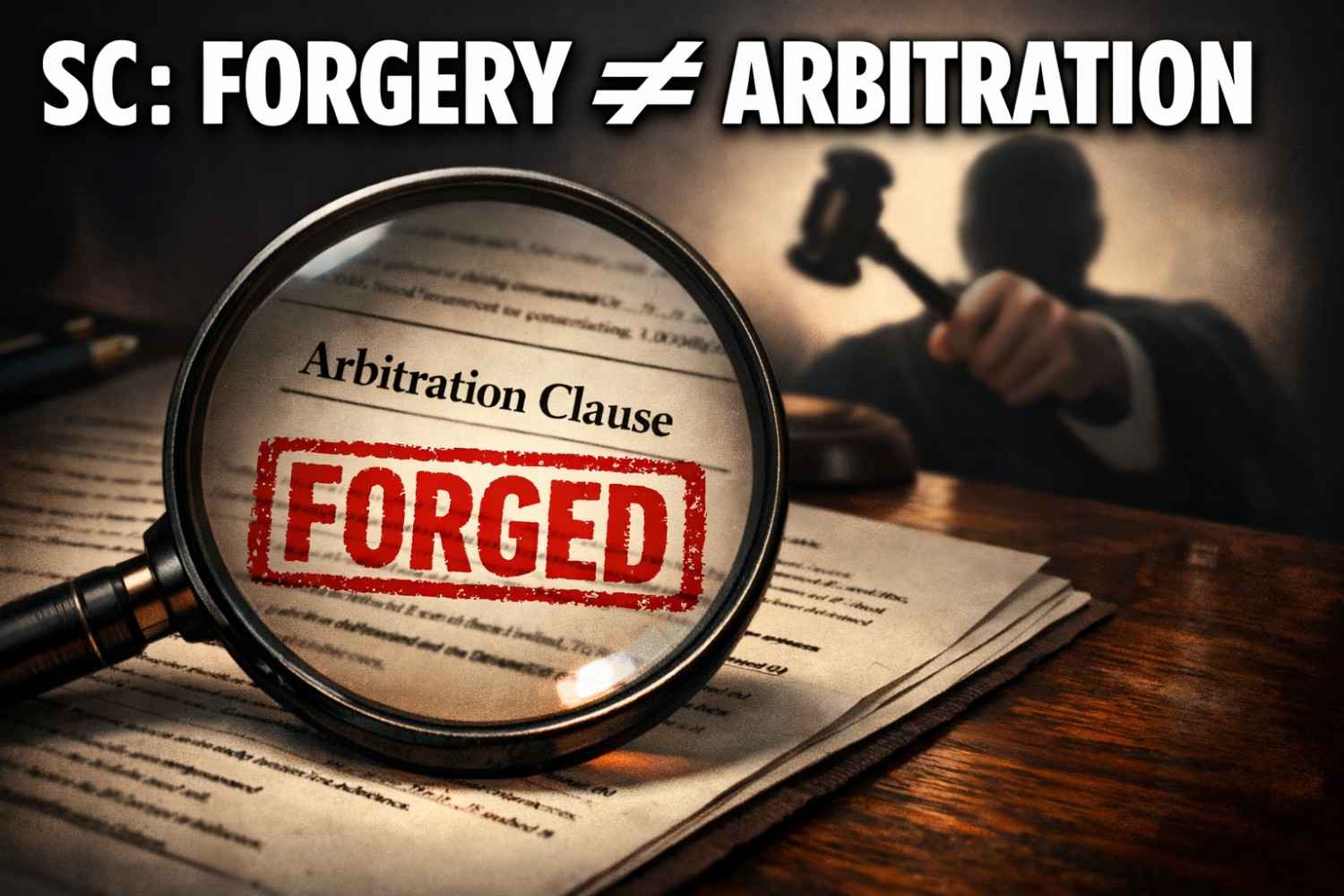
In a decisive judgment protecting litigants from being forced into arbitration based on fraudulent documents, the Supreme Court of India has ruled that disputes where the arbitration agreement itself is alleged to be forged are non-arbitrable. The Court held that when the very existence of the contract containing the arbitration clause is challenged as a fabrication, the issue goes to the "root of the jurisdiction" and must be adjudicated by a court of law, not an arbitrator.
The Case: Barnali Mukherjee v. Rajia Begum & Ors.- The judgment was delivered by a bench comprising Justice P.S. Narasimha and Justice Alok Aradhe (2026 INSC 106). The case arose from a complex family partnership dispute where one party sought to refer the matter to arbitration based on a partnership deed (Admission Deed). The opposing party vehemently denied the existence of this deed, alleging it was a forged document and that they had never signed it.
The High Court had previously issued conflicting orders—in one instance referring the dispute to arbitration under Section 8 of the Arbitration and Conciliation Act, 1996, while in another refusing to appoint an arbitrator under Section 11(6).
The Supreme Court set aside the High Court's order referring the matter to arbitration. Justice Aradhe, authoring the judgment, distinguished between "fraud simpliciter" (fraud in the performance of a contract) and "serious allegations of fraud" that vitiate the agreement itself.
The Bench observed:
"Where the arbitration agreement itself is alleged to be forged or fabricated, the disputes cease to be merely contractual and strike at the very root of arbitral jurisdiction. A controversy of this nature falls squarely within the category of disputes that are generally recognized as non-arbitrable."
The Court relied on the "twin test" established in precedents like A. Ayyasamy v. A. Paramasivam and Avitel Post Studioz Ltd. v. HSBC PI Holdings. It noted that since the original Admission Deed was never produced and its existence was shrouded in doubt, referring the matter to arbitration would be akin to building a house on a non-existent foundation.
Consent is Key The judgment reinforced the principle that arbitration is a creature of consent. If a party claims they never signed the document, forcing them before an arbitrator—whose authority derives from that very contested document—would be a violation of legal principles. The Court clarified that while courts usually adopt a "hands-off" approach to arbitration, they cannot turn a blind eye when the validity of the arbitration agreement itself is impeached by serious allegations of forgery. This ruling serves as a critical safeguard against the misuse of the arbitration mechanism. In recent years, there has been a trend of "pro-arbitration" rulings where courts referred almost all disputes to arbitrators, leaving them to decide their own jurisdiction (Kompetenz-Kompetenz). However, this judgment draws a clear red line: Arbitrators cannot decide whether the document appointing them is a forgery. This responsibility remains with the public courts to ensure that no party is hijacked into a private tribunal based on a fraudulent document.