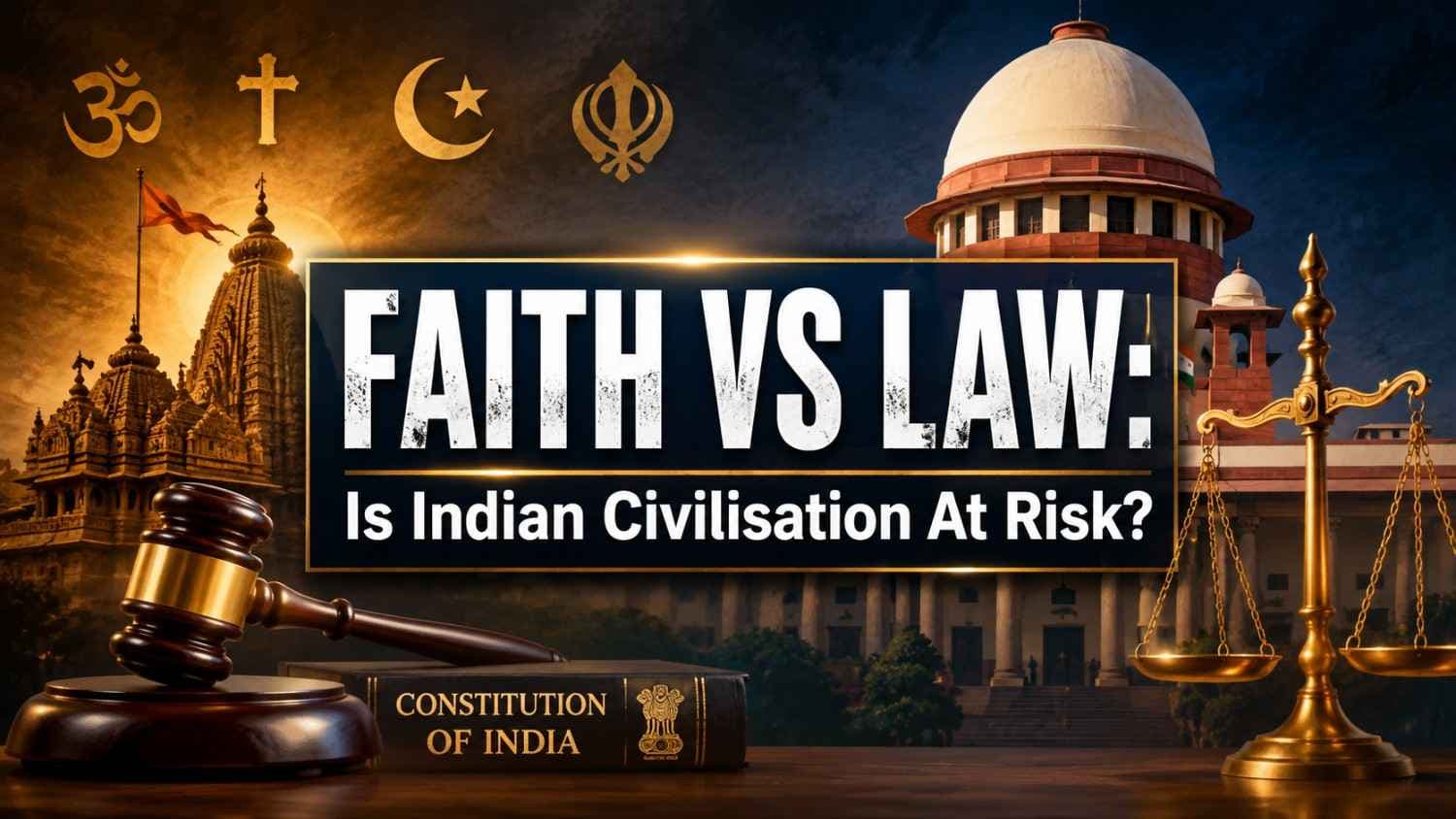
In a country as diverse as India, the intersection of law and religion has always been a delicate tightrope walk. Recently, while hearing the landmark Sabarimala reference case, a nine-judge bench of the Supreme Court of India raised a profound and soul-searching question: “What happens to Indian civilisation if every religious practice is questioned in courts?”
This observation, particularly from Justice Surya Kant, touches upon the very heart of India’s social fabric. It brings to the forefront a debate that has lasted decades: To what extent can a court of law use the "touchstone of the Constitution" to test the validity of age-old religious traditions?
To understand why the Supreme Court made such a heavy observation, we must look back at the Sabarimala journey. In 2018, the Supreme Court, in a 4:1 majority, allowed the entry of women of all ages into the Lord Ayyappa Temple at Sabarimala, Kerala. This judgment broke the centuries-old tradition that restricted women of menstruating age from entering the shrine.
However, the verdict was met with massive protests and a wave of review petitions. In 2019, a five-judge bench led by then-CJI Ranjan Gogoi did not immediately overturn or uphold the 2018 ruling. Instead, they realized that this wasn’t just about one temple. It was about a much larger legal question: How do we balance the Right to Equality (Article 14) with the Right to Freedom of Religion (Articles 25 and 26)?
Thus, a "9-judge bench" was formed to decide these "larger questions of law." These questions include:
- The scope of "Essential Religious Practices" (ERP).
- The definition of "Constitutional Morality."
- Whether a person who does not belong to a particular faith can file a Public Interest Litigation (PIL) challenging that faith’s practices.
During the recent hearings, the bench explored the dangers of judicial overreach. Justice Surya Kant’s remark was not just a comment; it was a warning about the potential "homogenization" of Indian culture.
India is often described as a "museum of different faiths." From the unique rituals of tribal communities to the specific traditions of South Indian temples, many practices might seem "irrational" or "discriminatory" when viewed through a purely modern, secular lens.
If the Supreme Court begins to strike down every practice that doesn't align with modern logic, what remains of the diversity that defines Indian civilisation? The court expressed concern that if every ritual is dragged to the courtroom, the unique identity of various religious denominations might be erased, leaving behind a sterile, uniform society.
At the center of this legal storm is the "Essential Religious Practices" doctrine. This is a tool created by the Supreme Court in 1954 (Shirur Mutt case). It says that the State can only protect those religious practices that are "essential" to the religion.
The problem? It is the judges—not the priests or the community—who decide what is "essential." Over the years, the courts have decided:
- Whether Tandava dance is essential to Ananda Margis.
- Whether mosque is essential to the practice of Islam for offering Namaz.
- Whether the exclusion of women is essential to the Sabarimala pilgrimage.
Critics, and some judges on the current bench, argue that this puts the judiciary in the role of a "clergyman" or "theologian." By questioning the 9-judge bench, the court is essentially asking: Should we even have the power to decide what is essential to your faith?
Another major point of discussion in the Live Law report is the concept of Constitutional Morality. In the original 2018 Sabarimala judgment, Justice D.Y. Chandrachud (the current CJI) emphasized that "morality" in the Constitution refers to "Constitutional Morality"—values like justice, liberty, and equality—rather than "social or religious morality."
However, the opposing view is that for a devotee, their "morality" is dictated by their deity and their scriptures. If the court imposes "Constitutional Morality" on a temple’s inner sanctum, is it protecting rights, or is it infringing upon the "Freedom of Conscience" guaranteed under Article 25?
The Supreme Court is now grappling with whether "morality" can be used as a gateway for the government to interfere in religious affairs at all.
You might wonder why a legal debate about 9-judge benches and Article 25 matters to the average person. The answer is simple: The outcome of this case will decide the future of religious freedom in India.
If the court decides it has the power to test every practice, it could open the doors to legal challenges against:
- Specific dietary laws in certain religions.
- Gender-segregated spaces in mosques or churches.
- Specific rituals of Parsi women who marry outside their community.
- The unique traditions of tribal groups in the North East or Central India.
On the other hand, if the court withdraws too much, it might leave individuals (especially women) without a remedy against genuine discrimination hidden under the garb of "tradition."
The tone of the recent observations suggests that the Supreme Court is leaning toward Judicial Restraint. The judges seem wary of setting a precedent where every local custom becomes a legal battle.
As the legal portal Live Law noted, the court is sensitive to the fact that religion in India is not just a set of rules but a way of life that has sustained the civilisation for millennia. Questioning the core of these practices might lead to social unrest and a loss of cultural heritage.
The 9-judge bench has a monumental task. They are not just deciding on a temple; they are defining the boundaries of the Indian State.
As we await the final verdict, Justice Surya Kant's question serves as a reminder: A Constitution is meant to transform a society, but it must also respect the roots that hold that society together. Balance is the keyword. The court must protect the individual's dignity without destroying the collective's identity.
In the coming months, the legal world will be watching closely. Will the Supreme Court choose to be a "social reformer" or a "guardian of traditions"? The answer will shape the "Indian Civilisation" for generations to come.