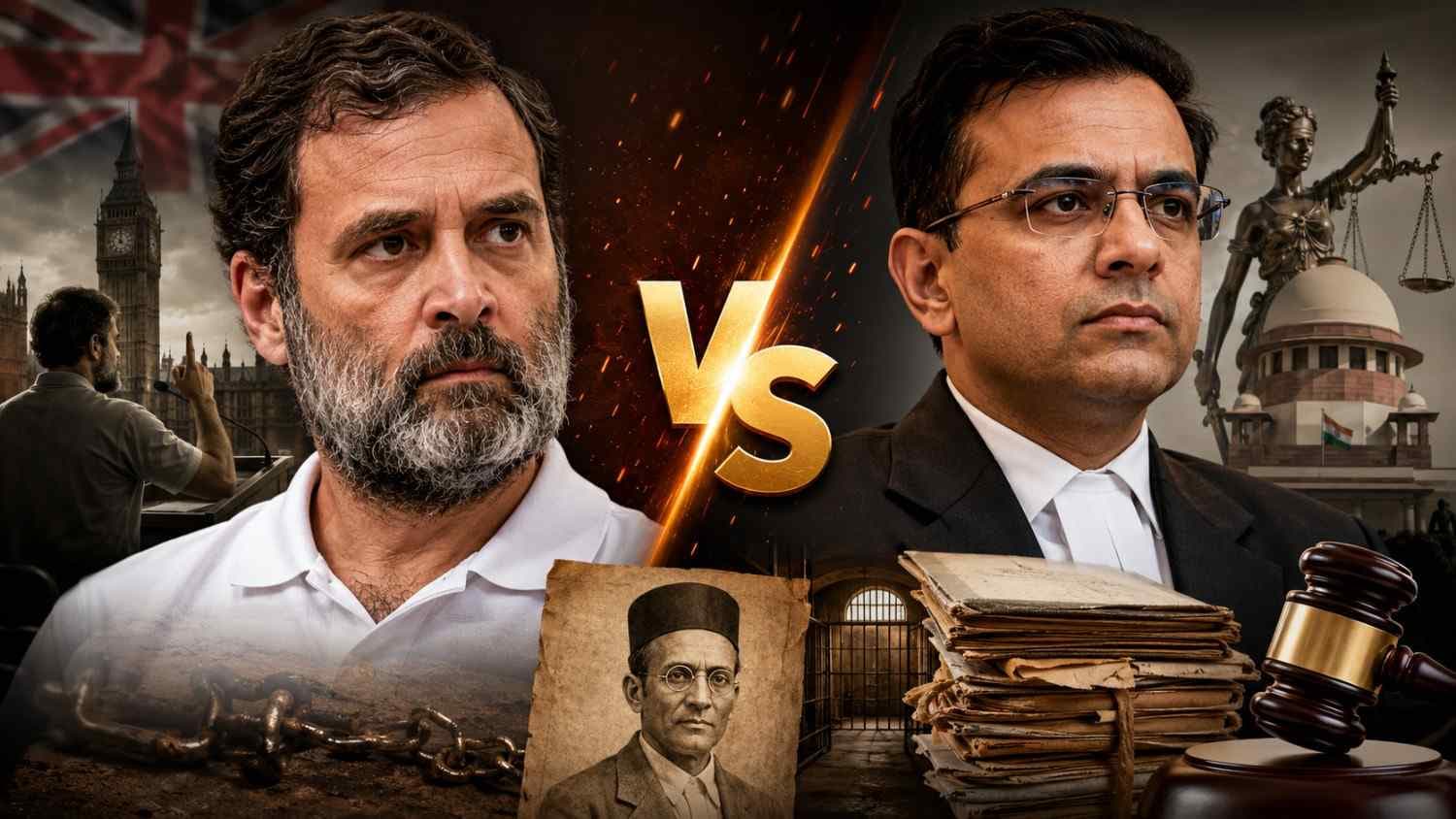
Satyaki Savarkar has instituted a criminal defamation complaint against Congress leader Rahul Gandhi under Section 500 of the Indian Penal Code, alleging that Gandhi’s address to the Overseas Congress in the United Kingdom on 5 March 2023 contained false and malicious statements concerning Vinayak Savarkar. The complainant contends that Gandhi falsely asserted that Savarkar authored a book describing the beating of a Muslim individual, a claim that, according to the complaint, never occurred and was made with the intent to injure Savarkar’s reputation and cause mental anguish to the complainant and his family. The complaint seeks the maximum penalty prescribed under Section 500 IPC and requests compensation under Section 357 of the Code of Criminal Procedure.
The matter is pending before the Special MP/MLA Court in Pune, presided over by Special Judge Amol Shinde. Gandhi’s counsel, Milind Pawar, is conducting the cross‑examination of the complainant. On 2 July 2026, during the ongoing cross‑examination, Satyaki Savarkar testified that he is unable to state whether Vinayak Savarkar requested release from British imprisonment on a condition that he refrain from participating in any political or revolutionary movement. He said he does not know if such a request was made in any of the mercy petitions submitted by Savarkar to the British Government.
Further, Satyaki stated that he cannot confirm whether Savarkar used the expression “Your Most Obedient Servant” in any of his mercy petitions. He acknowledged that the record contains a petition dated 30 March 1920 bearing the sentence “I beg to remain, Sir, your most obedient servant”, but noted that the document lacks Savarkar’s signature. Consequently, he expressed uncertainty about the authenticity of that petition and whether the phrase originated from Savarkar himself.
Satyaki also referred to the historical circumstances surrounding Savarkar’s release in 1923, observing that the Kakinada Congress, under the presidency of Mohammad Ali Johar, had passed a resolution demanding his release. He added that public pressure for Savarkar’s freedom had been mounting and speculated that, had a similar resolution been adopted before the execution of Bhagat Singh, Sukhdev and Rajguru, those executions might have been avoided. These remarks are attributed to the complainant’s testimony and are not findings of the court.
The defence, through counsel Milind Pawar, is probing the complainant’s personal knowledge of the historical facts concerning Savarkar’s imprisonment and mercy petitions, aiming to demonstrate that the complainant lacks direct evidence to substantiate the alleged defamation. The defence strategy appears to focus on showing that the complainant’s assertions about Savarkar’s conditional release and the use of particular phrasing in petitions are based on hearsay rather than personal knowledge.
To date, the court has not recorded any interim order or observation on the merits of the case. The cross‑examination is scheduled to resume on 7 July 2026. No finding has been made regarding whether Gandhi’s statements constitute defamation under Section 500 IPC, nor has any determination been made about the appropriateness of compensation under Section 357 CrPC.
The legal question before the court remains whether the statements made by Gandhi in his London speech were false, made with knowledge of their falsity, and caused harm to the reputation of Vinayak Savarkar. The burden of proving these elements lies with the complainant. The court’s inquiry is confined to the alleged defamatory content and its impact; it is not tasked with adjudicating historical controversies surrounding Savarkar’s petitions or his political activities.
Should the court ultimately find that Gandhi’s remarks were defamatory, it may impose the maximum penalty under Section 500 IPC and award compensation as prescribed under Section 357 CrPC. Conversely, if the defence succeeds in showing that the complainant cannot establish the requisite elements of defamation, the complaint may be dismissed. The outcome will have relevance for how courts treat claims of defamation that rely on historical narratives and the evidentiary standards required to link alleged statements to reputational harm.