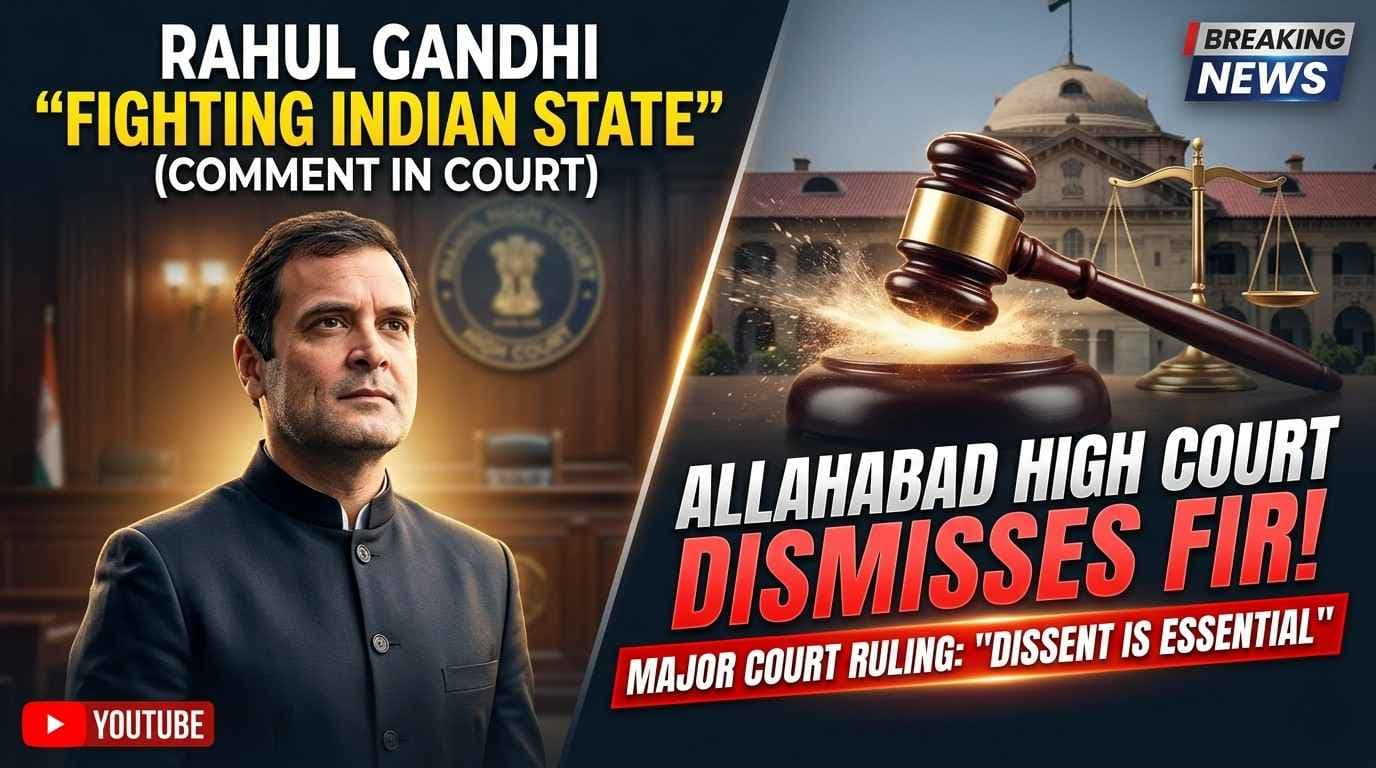
In a landmark observation that reinforces the pillars of democratic dissent, the Allahabad High Court recently dismissed a petition seeking the registration of an FIR against Congress leader Rahul Gandhi. The case centered on a televised remark made by the Leader of the Opposition in January 2025, where he stated that his political struggle was not just against a specific party, but against the "Indian State" itself. Justice Vikram D. Chauhan, presiding over the case, clarified that in a parliamentary democracy, the criticism of government actions or policies is not only permitted but is an essential requirement for a healthy political ecosystem.
The court’s ruling comes at a time when the boundaries of political speech are being frequently tested in the legal arena. The petitioner had alleged that Gandhi’s remarks amounted to an act endangering the sovereignty and integrity of India, potentially falling under Section 152 of the Bharatiya Nyaya Sanhita (BNS). However, the High Court upheld the findings of the lower courts in Sambhal, noting that "suspicion cannot be the foundation for criminal prosecution." The bench emphasized that for a speech to be considered a criminal offense, there must be a tangible link to incitement, rebellion, or subversive activities.
Central to the court's reasoning was the distinction between ideological opposition and an actual rebellion against the nation. The bench observed that the word "fight," when used by elected representatives, typically signifies intense advocacy, persistence, or opposition to a particular policy or ideology rather than physical combat or a call to arms. By interpreting the language through a democratic lens, the court protected the space for robust political debate, ensuring that metaphorical language used in the heat of political rivalry is not misconstrued as a literal threat to national security.
The judgment also highlighted the significance of Article 19(1)(a) of the Constitution, which guarantees the freedom of speech and expression. The court noted that restricting this freedom reduces individuals to an "approved narrative," which ultimately undermines the moral and political growth of the citizenry. Justice Chauhan pointed out that even after a year since the speech was delivered, no evidence was presented to show that the remarks had led to any public disorder or secessionist feelings, further weakening the case for criminal intervention.
Furthermore, the High Court criticized the tendency to file multiple litigations based on political statements without providing the full context or material evidence. In this specific case, the petitioner failed to bring the complete extract of the televised interaction before the court. The bench reiterated that the burden lies heavily on the complainant to demonstrate that an expression crosses the constitutional threshold of "reasonable restrictions" under Article 19(2) and enters the realm of criminal incitement.
The ruling serves as a vital check on the "chilling effect" that frequent FIRs can have on political leaders and the general public. By affirming that ideological differences do not constitute a crime, the Allahabad High Court has sent a clear message to lower judiciaries and law enforcement agencies: the legal machinery must not be used as a tool to silence dissent or to settle political scores. This decision aligns with long-standing judicial precedents that protect "strong words" as long as they do not advocate for violence or the overthrow of the state.
In conclusion, the dismissal of the plea against Rahul Gandhi underscores the judiciary's role as a guardian of free speech. The court’s insistence that criticism is essential to democracy provides a much-needed safeguard for the opposition's right to challenge the ruling establishment. As India continues to navigate a complex political landscape, such judgments ensure that the spirit of inquiry and the right to disagree remain protected under the rule of law.
Ultimately, the case highlights that the "Indian State" is robust enough to withstand verbal critique. By distinguishing between the government of the day and the permanent sovereignty of the nation, the Allahabad High Court has reaffirmed that loving one's country often involves the right to criticize the way it is being governed. This balanced approach is fundamental to maintaining the integrity of India's parliamentary democracy.