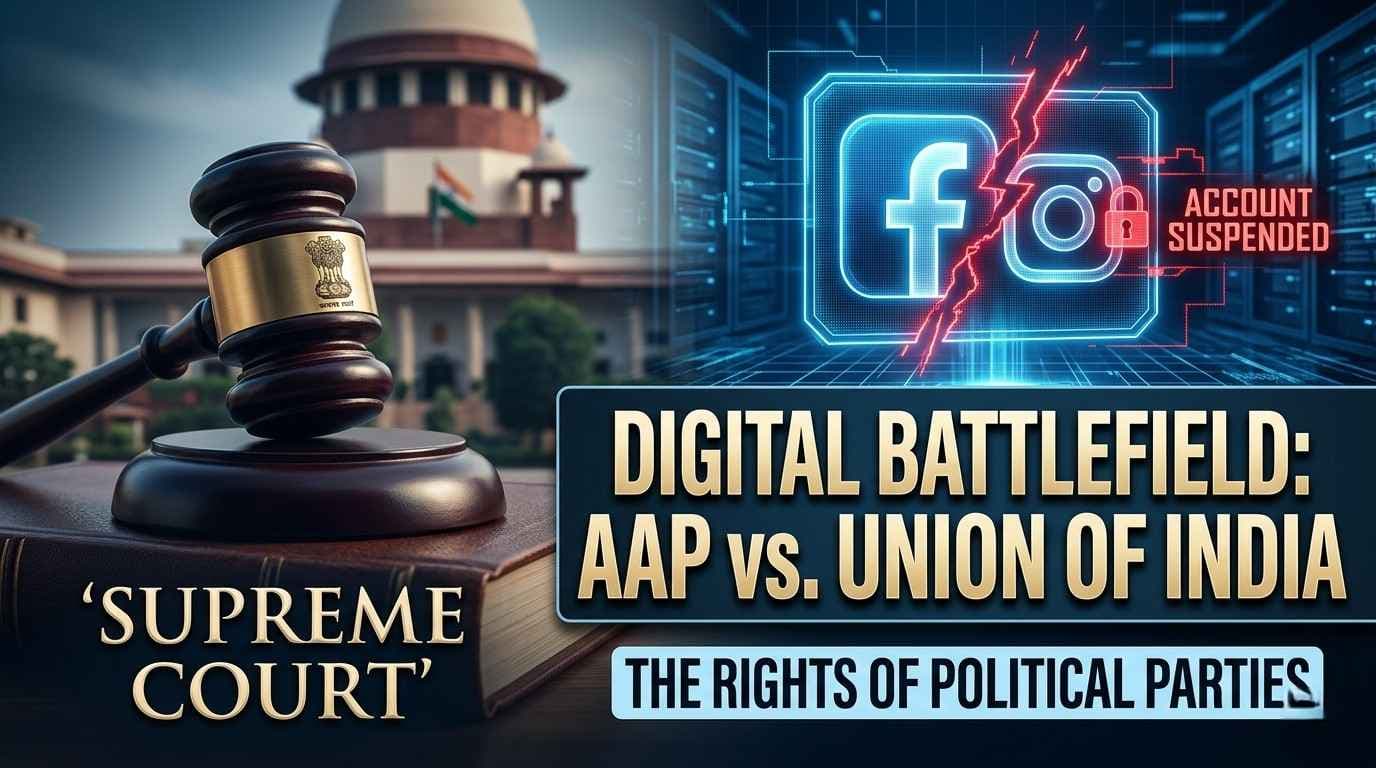
In an era where the political battlefield has shifted from the streets to the server, the Supreme Court of India has waded into a significant dispute regarding the digital rights of political parties. The Court recently issued a notice to the Union government in response to a petition filed by the Aam Aadmi Party (AAP), challenging the suspension of its Gujarat unit’s Instagram and Facebook accounts. This case is not merely about a "deactivated page"; it is a profound constitutional inquiry into whether the suspension of a political party's digital megaphone during or after an election constitutes an unreasonable restriction on the fundamental right to free speech and expression.
The AAP’s grievance centers on the "arbitrary" nature of the takedown by Meta (the parent company of Facebook and Instagram), allegedly acting on directives or guidelines linked to the Union's regulatory framework. For a modern political entity, social media is the primary artery for voter engagement, grievance redressal, and policy dissemination. The party argues that silencing these accounts effectively "disarms" them in the democratic arena, creating an unlevel playing field where their digital footprint is erased without a clear "due process" or a documented violation of law.
At the heart of the legal debate is the tension between Article 19(1)(a) of the Constitution and the Information Technology (Intermediary Guidelines and Digital Media Ethics Code) Rules, 2021. The Supreme Court’s decision to seek the Union's response suggests that the judiciary is ready to examine the "Standard Operating Procedures" for the suspension of political accounts. The Court will likely scrutinize whether such actions are "proportionate" and if there are adequate safeguards to prevent the "digital disenfranchisement" of political organizations by either the state or private intermediaries.
From a strategic perspective, this case highlights the vulnerability of political movements in the age of "Algorithm Governance." If a party's primary communication channel can be severed without a prior hearing or a specific "speaking order," it raises the specter of "censorship by proxy." The AAP’s petition emphasizes that in a democracy, the flow of political information should be protected with the highest degree of scrutiny, as the digital space has become the "Modern Marketplace of Ideas" where the "will of the people" is often forged.
The Union’s response will be critical in defining the "Intermediary Liability" of platforms like Meta. The government must explain the legal threshold that triggers such suspensions—whether it involves "hate speech," "misinformation," or "national security"—and why a wholesale suspension was deemed necessary over the removal of specific offending posts. This case could lead to the establishment of a "Digital Code of Conduct" for political parties, ensuring that while they are held accountable for their content, their "right to exist" in the digital sphere is not subject to the whims of an algorithm or an opaque administrative order.
Furthermore, the timing of the suspension—linked to the aftermath of the high-stakes 2026 electoral cycle—adds a layer of political urgency to the matter. The judiciary is being asked to act as a "Digital Referee," ensuring that the post-poll period does not become a season for "digital vendettas." By seeking the Union's view, the Supreme Court is asserting its role as the final arbiter of how the Constitution applies to the "New Media," ensuring that the "Basic Structure" of democracy remains intact even when it is hosted on a private server.
In the final analysis, the AAP vs. Union of India case is a litmus test for the future of digital campaigning in the world's largest democracy. It forces us to confront a difficult reality: if the law cannot protect a political party’s right to post, it may eventually fail to protect a citizen’s right to hear. As the government prepares its reply, the legal community and digital rights activists are watching closely. The eventual verdict will not just decide the fate of a few social media handles in Gujarat; it will calibrate the volume of political dissent allowed in the digital age.