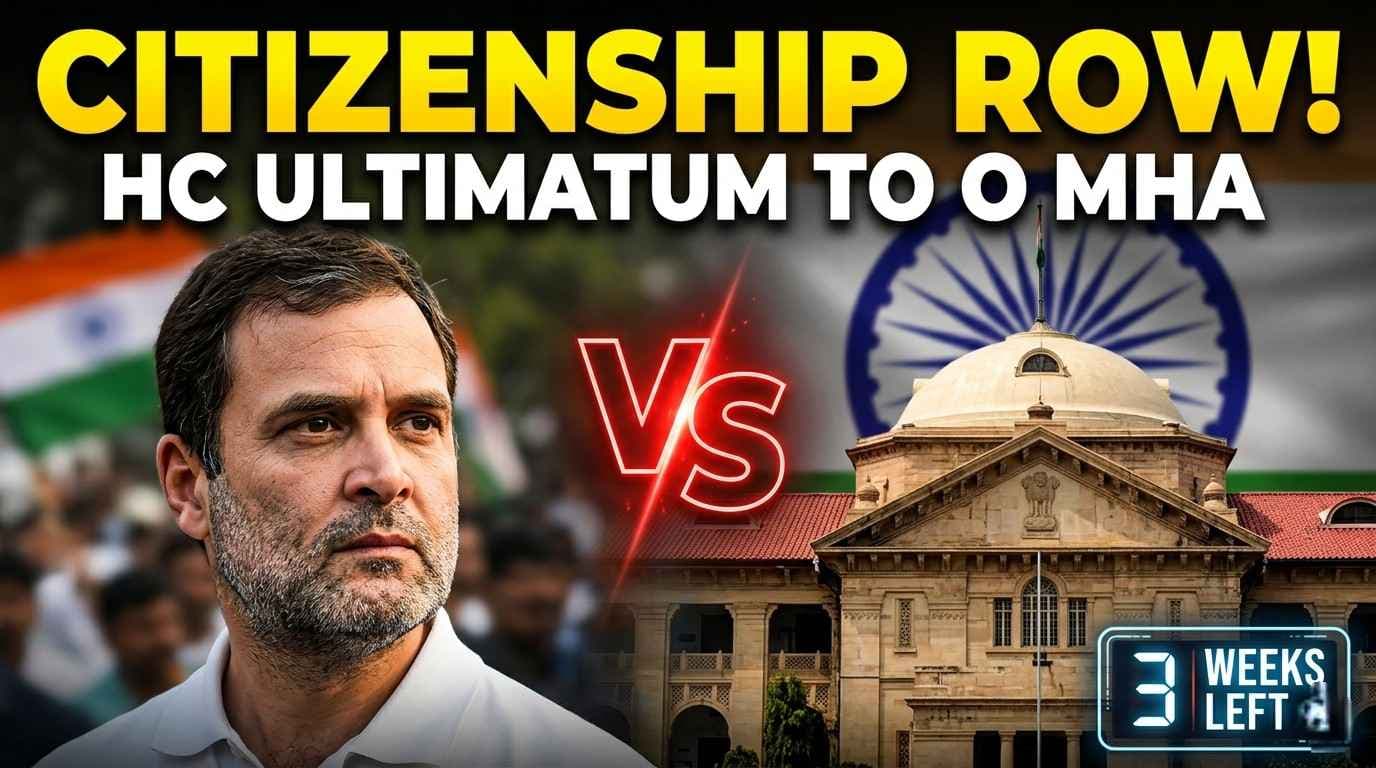
The Allahabad High Court has issued a significant directive to the Government of India regarding the long-standing controversy surrounding the citizenship of Leader of Opposition (LoP) Rahul Gandhi. A Division Bench comprising Justice Manoj Kumar Gupta and Justice Kshitij Shailendra has asked the Ministry of Home Affairs (MHA) to provide a clear update on the status of a 2019 representation that alleged Gandhi holds British citizenship. The Court’s intervention comes in response to a Public Interest Litigation (PIL) seeking the registration of an FIR against the Congress leader for allegedly "misrepresenting" his citizenship status to hold public office in India.
The petitioner, S. Vignesh Shishir, a resident of Karnataka, contended that documents from a defunct British company named Backops Limited, where Gandhi was a director, listed his nationality as "British." The petitioner argued that under Article 9 of the Constitution of India, any citizen who voluntarily acquires the citizenship of a foreign state automatically ceases to be an Indian citizen. Consequently, the plea sought to disqualify Gandhi from his seat in the Lok Sabha and initiate criminal proceedings for a violation of the Citizenship Act, 1955 and the Passports Act.
During the hearing, the Court noted that the Ministry of Home Affairs had previously issued a notice to Rahul Gandhi in April 2019, asking him to clarify his "factual position" on the matter following a complaint by former MP Subramanian Swamy. However, the petitioner alleged that there has been no visible progress or final decision from the Ministry in the seven years since that notice was issued. The High Court remarked that the matter cannot remain in a state of perpetual limbo and that the executive must take a definitive stand on the validity of the documents presented.
The Union government's counsel informed the Court that the matter is still "under consideration" and that the process of verifying foreign records involves complex international legal protocols. The Bench, however, emphasized that the citizenship of a Member of Parliament and the Leader of Opposition is a matter of profound national importance. The Court held that the government is duty-bound to inform the public and the judiciary whether the allegations have been found to be substantiated or if the representation has been dismissed after due inquiry.
The Bench was careful to clarify that it was not currently passing any judgment on the merits of the allegations against Rahul Gandhi. Instead, the Court’s focus is on the administrative "inaction" of the MHA. Justice Gupta observed that the registration of an FIR is a secondary stage; the primary requirement is a determination by the competent authority—the Central Government—under Section 9(2) of the Citizenship Act, which holds the exclusive power to decide questions of dual or foreign citizenship.
The Congress party has consistently dismissed the allegations as "frivolous and politically motivated," asserting that Rahul Gandhi is an Indian citizen by birth and has never held a foreign passport. Legal representatives for the party have previously pointed out that clerical errors in private company filings in a foreign jurisdiction cannot override the sovereign status of an Indian citizen. They argue that the repeated revival of this "citizenship row" before various High Courts is an attempt to use the judiciary for political character assassination.
This case adds to a series of legal challenges Gandhi has faced across different states, including the defamation cases that led to his temporary disqualification from Parliament in 2023. By demanding a status report from the MHA, the Allahabad High Court has shifted the burden back to the central government to either close the matter with a formal clearance or proceed with a statutory inquiry. This effectively prevents the issue from being used as a recurring tool for litigation without a factual conclusion.
The Court has granted the Union government three weeks to file a detailed affidavit outlining the current status of the 2019 notice and the steps taken to verify the "Backops Limited" documents. The Bench also directed the petitioner to provide more "tangible evidence" beyond photocopies of internet records to support the claim of foreign citizenship. The outcome of this status report will determine whether the PIL proceeds toward a formal investigation or is dismissed as lacking a prima facie criminal basis.
With the next hearing scheduled for May 2026, the political and legal stakes remain high. If the MHA report confirms that the inquiry is still pending without cause, the Court may issue further directions for a time-bound disposal. Conversely, if the government provides evidence of a concluded inquiry that cleared the LoP, it could put a permanent legal quietus to one of the most persistent controversies in contemporary Indian politics.