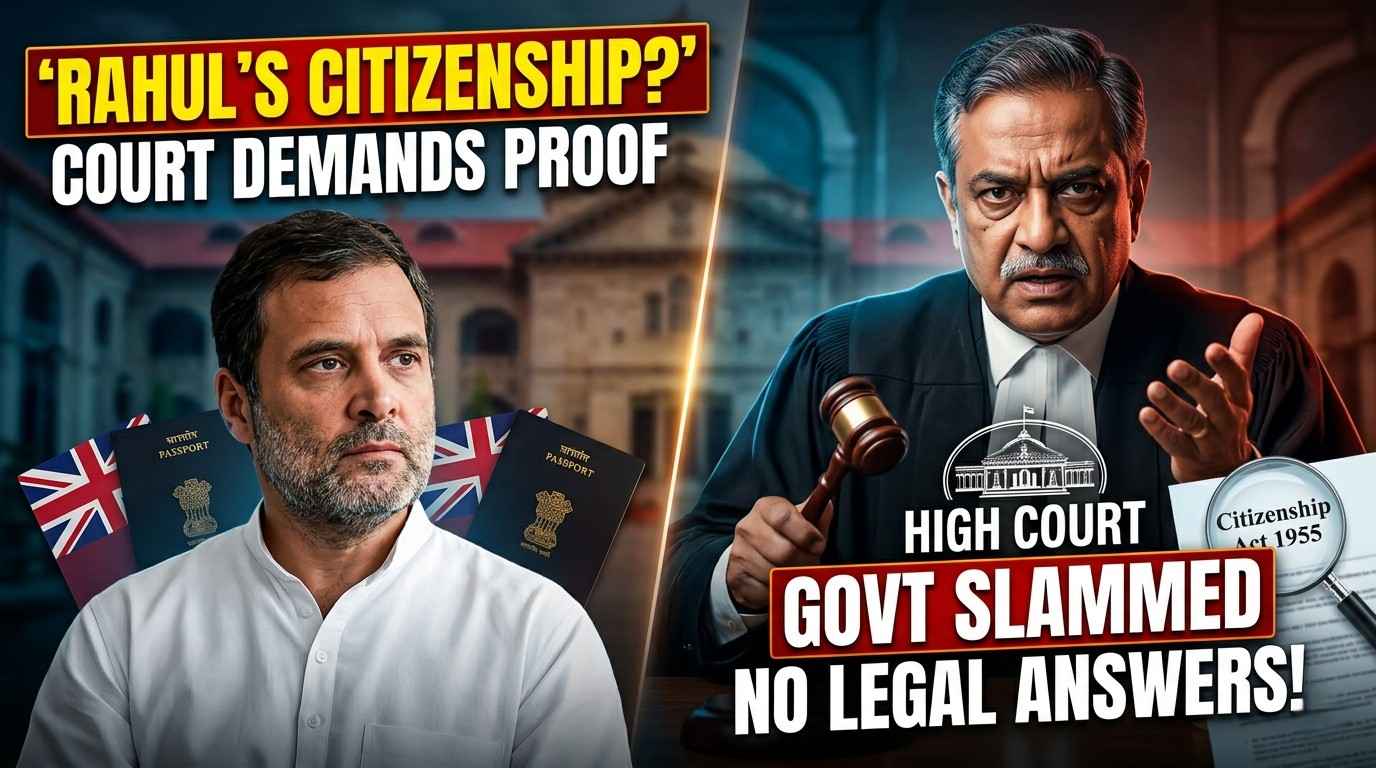
The Lucknow Bench of the Allahabad High Court has expressed strong dissatisfaction with the legal assistance provided in a petition challenging the Indian citizenship of Leader of Opposition Rahul Gandhi. A division bench comprising Justice Rajan Roy and Justice Om Prakash Shukla criticized both the petitioner’s counsel and the Deputy Solicitor General (DSG) representing the Union of India for failing to provide clear legal answers to the court's specific queries.
The court's frustration stemmed from a lack of clarity regarding the statutory framework governing the cancellation of citizenship. The bench had repeatedly asked whether the Central Government has the authority under the Citizenship Act, 1955, to determine a person's citizenship status based on allegations of acquiring foreign nationality. The judges noted that neither the petitioner nor the government’s representative could definitively point to the specific provisions or rules that mandate such an inquiry by the executive.
The petition, filed by BJP worker S. Vignesh Shishir, alleges that Gandhi holds British citizenship and seeks a directive for the Ministry of Home Affairs to take action. However, the court observed that the arguments presented were largely "superficial" and lacked the necessary "legal depth" required for a matter of such constitutional gravity. The bench remarked that it is the duty of the advocates to assist the court with precise law rather than merely presenting news reports or allegations.
Furthermore, the court questioned the DSG on the status of a previous representation filed by the petitioner before the Ministry of Home Affairs. When the government’s counsel was unable to provide a concrete update or explain the delay in the Ministry's decision-making process, the bench noted that such "laxity" in high-profile litigation hampers the judicial process.
The judges emphasized that the court cannot act as an investigating agency and requires a solid legal foundation to issue any directives. They cautioned that if the parties failed to improve the quality of their assistance, the court would be forced to pass an order based on its own interpretation of the law, which might not be favorable to the lackadaisical approach shown by the litigants.
The matter has been adjourned to a later date, with a strict instruction to the Union of India to come prepared with the relevant records and a clear legal stance. This development underscores the judiciary's insistence on procedural and statutory rigor, even in cases involving high-ranking political figures.