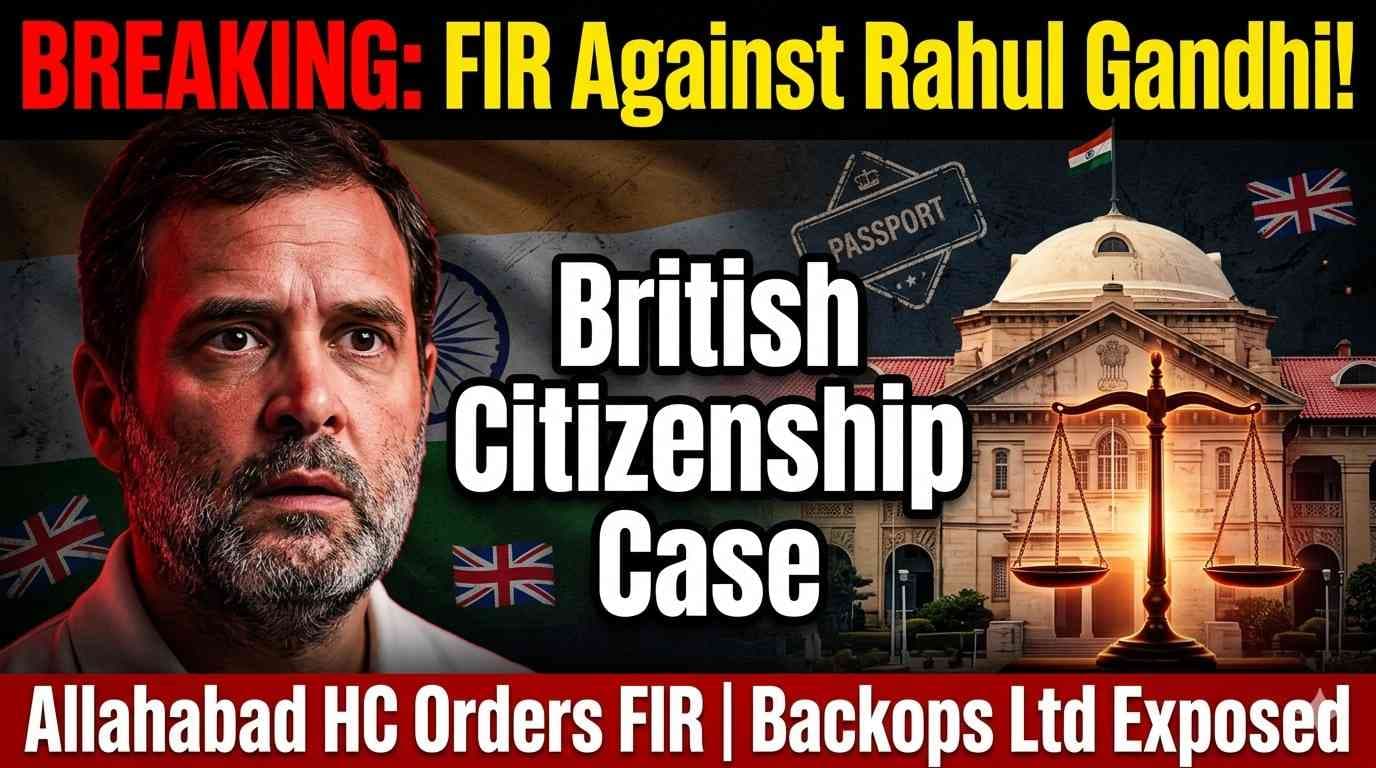
The Lucknow Bench of the Allahabad High Court has made a significant procedural pivot in the case involving allegations of British citizenship against Leader of Opposition Rahul Gandhi. While Justice Subhash Vidhyarthi initially dictated an order in open court on April 17, 2026, directing the registration of a First Information Report (FIR), the court has now withheld the formal signing of that order. This decision stems from the court's self-identification of a legal precedent that may require the accused to be heard before such a directive is finalized.
The petition, filed by Karnataka-based BJP worker S. Vignesh Shishir, alleges that Gandhi is a British national holding a UK passport. The petitioner relies on documents purportedly from 2003 to 2009 related to a UK-registered company, M/s Backops Ltd, where Gandhi’s nationality was allegedly listed as British. Shishir challenged a previous January 2026 order from a special MP/MLA court that had refused to register an FIR on the grounds of jurisdictional limitations regarding citizenship.
During the initial hearing, the High Court found a prima facie case and suggested that the state government could refer the matter to the Central Bureau of Investigation (CBI). However, before the judgment could be typed and signed, the Court took note of a 2014 Full Bench judgment in Jagannath Verma vs. State of U.P.. This precedent establishes that a prospective accused is entitled to an opportunity to be heard in criminal revision proceedings under Section 397 before a decision is taken to direct an investigation.
The legal challenge involves multiple stringent statutes, including the Bharatiya Nyaya Sanhita (BNS), the Official Secrets Act, the Passport Act, and the Foreigners Act. The petitioner argues that the dual citizenship status, if proven, would have direct implications on Gandhi’s eligibility as a Member of Parliament and his current role as the Leader of the Opposition. The High Court had previously noted that the allegations were of a nature that warranted a formal inquiry to settle the controversy.
The procedural delay emphasizes the court's commitment to following established judicial protocols regarding the rights of the accused. Justice Vidhyarthi observed that the question of whether a suspect must be heard in such a revision petition is a critical legal threshold that must be satisfied to ensure the order's validity. Consequently, the earlier directive to the Rae Bareli police to register the case is currently in abeyance.
The case has drawn significant political attention, given the high-profile nature of the respondent and the gravity of the allegations. Former Rajasthan Chief Minister Ashok Gehlot and other political figures have already described the initial move toward an FIR as "unwarranted," while the petitioner has framed the proceedings as a necessary step for national security and constitutional integrity.
The Court has now scheduled further hearings to determine the necessity of issuing a notice to Rahul Gandhi. This step will decide whether he will be formally invited to present a defense before any order for an FIR or a CBI probe is officially issued. The outcome of this deliberation will be a defining moment in how the judiciary handles citizenship disputes involving high-ranking constitutional functionaries.
As the legal community awaits the final written order, the focus remains on the "Backops Ltd" documentation and the degree to which these historical filings can influence current electoral status. The Ministry of Home Affairs and the Election Commission of India are also expected to be peripheral stakeholders in the unfolding investigation.