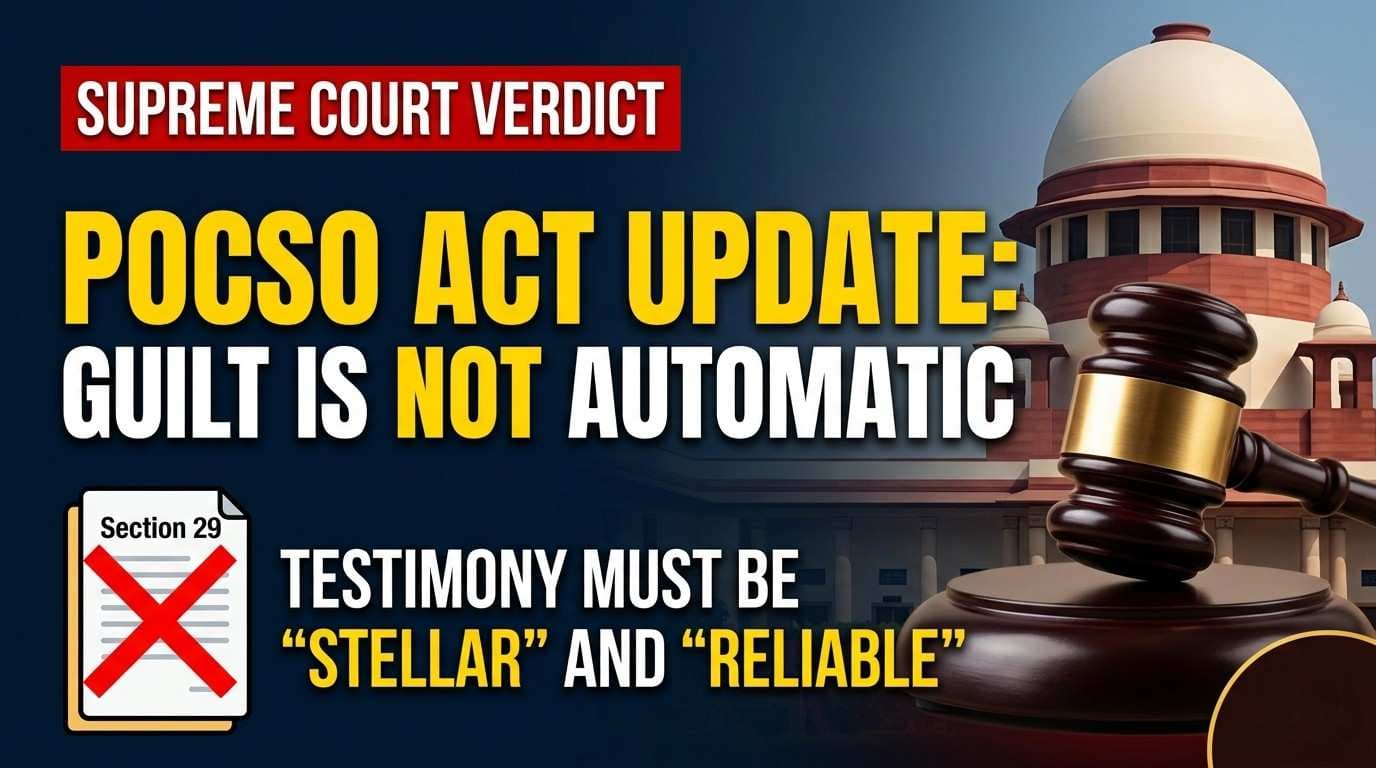
The Supreme Court has clarified that the presumption of guilt against an accused under Section 29 of the POCSO Act cannot be triggered solely by the testimony of a child victim if that testimony is found to be unreliable or inconsistent. A bench comprising Justice Abhay S. Oka and Justice Pankaj Mithal held that while the Act aims to protect children, the foundational facts of the case must be established by the prosecution beyond a reasonable doubt before the burden of proof shifts to the accused.
Section 29 of the Protection of Children from Sexual Offences (POCSO) Act normally mandates that the court "shall presume" that the accused has committed the offense once the prosecution proves that certain acts took place. However, the apex court observed that this presumption is not automatic. The court emphasized that the quality of the child's evidence must be scrutinized like any other witness to ensure it is "trustworthy" and "stellar."
In the case at hand, the Court noted significant discrepancies in the victim's statements made during the trial compared to the initial reports. The bench remarked that if a child witness is coached or provides a version of events that is factually improbable, the court cannot rely on Section 29 to bridge the gaps in the prosecution's story. The ruling reinforces the principle that "presumption of guilt" does not mean "automatic conviction" and does not dispense with the necessity of a fair trial.
The Court further explained that the "foundational facts" required to trigger the presumption include proving that the accused had the opportunity and involved themselves in the specific acts alleged. If the primary evidence is shaky or lacks corroboration where it is reasonably expected, the benefit of the doubt must remain with the accused. This judgment serves as a vital safeguard against potential misuse of the stringent provisions of the POCSO Act, ensuring that the zeal to protect children does not result in the conviction of the innocent based on unreliable testimony.